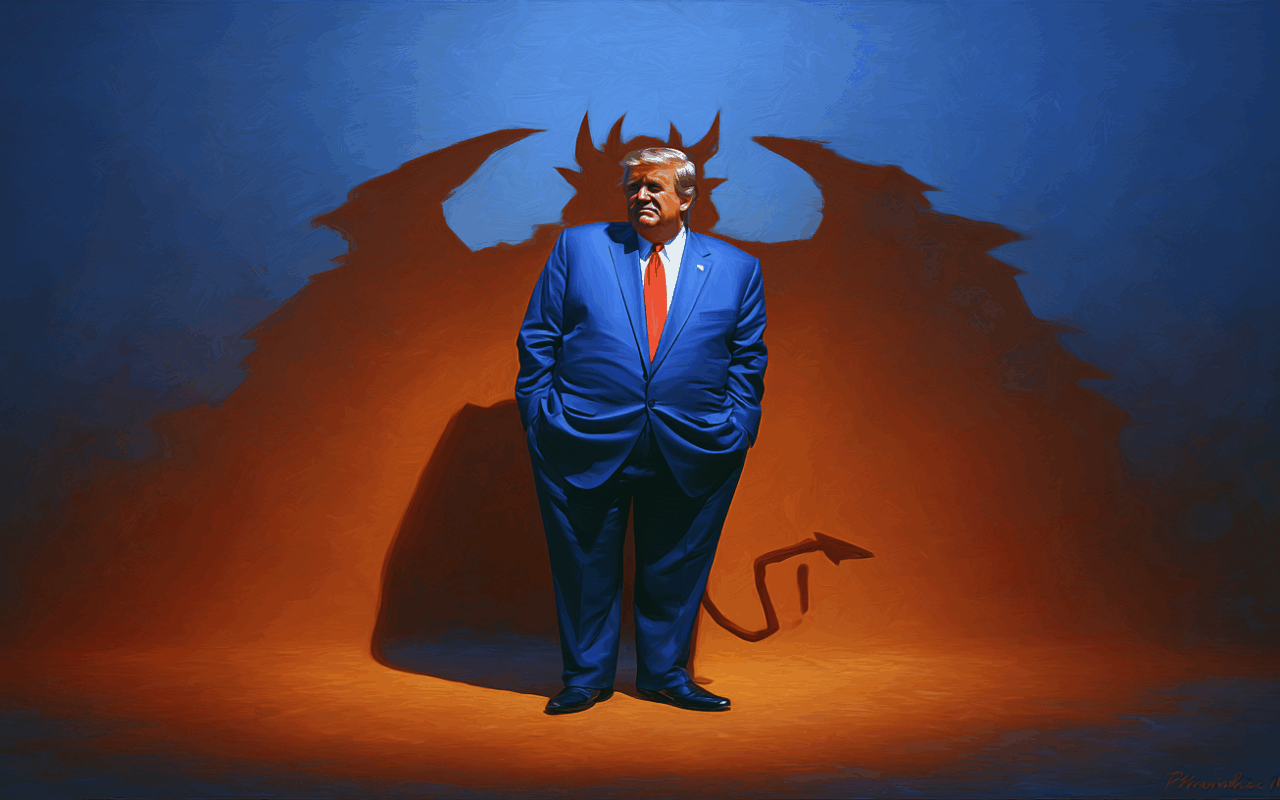

Originally published June 7, 2025. Rewritten and expanded August 29, 2026.
Asked in January what he had learned since returning to office, the president gave the most honest answer of his second term. “I found out that nobody cared.”
He was talking to the New York Times about the guardrails — the ethics norms, the disclosure regimes, the quaint idea that a president shouldn’t be selling things. Nobody cared. So he stopped pretending. In July, asked on CNBC about the billion-plus dollars his family has pulled out of crypto ventures his own administration regulates, he said “there’s nothing illegal, there’s nothing wrong with it,” and volunteered that his children have “inside information” on “almost anything they do” by virtue of the presidency. He has bragged about killing the investigations into his own industry: “You’re lucky I’m president!”
That is the tone now. Not denial. Not deflection. Ownership.
For years, Republican lawmakers and right-wing media outlets frothed at the mouth over Hunter Biden’s laptop and fabricated tales of Burisma “corruption” — stories so thoroughly debunked that the FBI informant who invented them, Alexander Smirnov, went to prison for his lies. The GOP knew the Burisma bribes were fake Russian disinformation from the start, yet they weaponized these fabrications to launch impeachment proceedings and relentlessly smear the Biden family. Meanwhile, they’ve maintained a deafening silence about the brazen, documented, and ongoing Trump corruption stench emanating from the convicted fraudster‘s second presidency. Maryland Representative and House Judiciary ranking member Jamie Raskin called it a “gangster state.” And that was before the president chartered his own bank.
The hypocrisy is breathtaking in its audacity. While Republicans manufactured outrage over phantom millions supposedly flowing to the Bidens — money that never existed, deals that never happened, corruption that was entirely fictional — they’ve turned a blind eye to the very real, very documented flood of cash pouring into Trump’s coffers from foreign governments, cryptocurrency schemes, and pay-to-play access deals that would make a banana republic dictator blush.
What follows is not speculation, not innuendo, not the fever dreams of political opponents. This is a meticulously documented catalog of corruption so vast and shameless that it dwarfs anything previously seen in American presidential history. And the numbers have changed by an order of magnitude since I first wrote this list. In June 2025 the headline figures were $346 million across two inaugural committees and a $400 million airplane. Fifteen months later: $1.4 billion in cryptocurrency income booked on his own sworn financial disclosure, a single month with 1,051 trades in his personal brokerage accounts, a federal bank charter granted to his family’s crypto firm by a comptroller he appointed, and roughly $1 billion drained out of the National Park Service to pay for monuments to himself. The presidency has been converted into a personal ATM with all the subtlety of a smash-and-grab robbery, and the alarm has been disconnected.
The Teapot Dome Scandal of the 1920s served as the quintessential symbol of government corruption for decades — over a mere $7 million worth of bribes to Interior Secretary Albert Fall. It was eclipsed and replaced by Watergate, shortly preceded by the resignation of Vice President Spiro Agnew over the discovery of his $300,000 operation that funneled cash stuffed into plain envelopes by bag men into the White House. Trump’s corruption represents a quantum leap beyond even these watershed moments in terms of sheer orders of magnitude, as well as the brazen manner in which the heists are being conducted in broad daylight.
The same party that spent years screaming about imaginary Ukrainian energy company bribes and fantasy Chinese business deals has remained conspicuously silent as their standard-bearer openly auctions off American foreign policy, drops federal investigations for donors, and literally sells dinner invitations for millions of dollars. The cognitive dissonance would be comical if it weren’t so dangerous to our democracy.
What is an example of political corruption in the United States? You cannot find a bigger collection of brazen examples. This is the story they don’t want you to focus on — the real corruption, the documented grift, the unprecedented monetization of the American presidency happening right before our eyes. Here is where it stands as of late August 2026.
1. The President’s Own Brokerage Account
This is the newest theater and the hardest one to explain away, because the documents are signed by him.
- On August 22, 2026, the Office of Government Ethics released the president’s periodic transaction report for June. One month. 1,051 transactions, worth between $78.1 million and $263.1 million. He signed it himself on August 12.
- An index fund is one line on a disclosure. That is the whole test. On May 15, 2026, Eric Trump said on X that the family’s assets were “invested in a blind trust by the largest financial institutions in broad market indexes.” Four days later a Trump Organization spokesperson told the New York Times the family has no “role in selecting, directing, approving, influencing or soliciting specific investments.” The White House now says the accounts run on “computer-based model portfolios that automatically replicate recognized indexes, such as the Schwab 1000.” Those are not the same explanation. Broad-market index funds produce single line items; direct index replication produces thousands of individual trades. Both cannot be true, and across four months and three explanations nobody has named a single manager.
- The June filing shows a purchase of $15,001 to $50,000 of SpaceX on June 23 — eleven days after the company priced the largest IPO in American history at a $1.77 trillion valuation. Algorithms replicating an index do not get in line for an IPO allocation.
- The same filing shows Palantir sold twice in June — including up to $1 million on June 18 — and bought three times, including $100,001 to $250,000 on June 24. On August 4, Deputy Secretary of Defense Steve Feinberg signed a memo directing up to $243.9 million to Palantir without competitive bidding.
- Ten days before the filing dropped, Senator Elizabeth Warren and Rep. Robert Garcia sent the president a 17-page letter enumerating more than 30 transactions that overlap official government actions, each footnoted to a row number in his own filing and a specific
.govannouncement. The hard, primary-source counts from his own filings are 3,555 transactions in the first quarter of 2026 and 1,051 in June — an average approaching fifty trades for every day the markets were open, which is more trading than all 535 members of Congress did in 2025 combined. (The letter also cites an outside analysis putting 2025 at more than 14,000 trades worth up to $1.06 billion; Bloomberg’s tally of the same filing says 21,000. Those are estimates, not filing counts, and they should not be blended.) - A sample of the overlaps: a purchase of up to $5 million in Axon Enterprise roughly two weeks before ICE posted a $220 million contract notice for some 17,800 Tasers written to a specification only Axon can meet. Purchases of NVIDIA and AMD on January 6, shortly before the administration announced changes easing chip sales to China. Four purchases across BNY Mellon and Robinhood in March, before Treasury designated BNY as the government’s financial agent for the Trump Accounts program and Robinhood as its trustee.
- Their deadline for answers was August 28, 2026.
2. The Crypto Machine: From Meme Coin to National Bank
The crypto theater, which in June 2025 looked like a grubby meme-coin hustle, is now the single largest source of the family’s wealth — and it now has a federal banking charter.
- On August 14, 2026, the Office of the Comptroller of the Currency granted preliminary conditional approval for a national trust bank charter to World Liberty Trust Company, N.A. — an entity roughly 38% owned by a company affiliated with Donald Trump and his family. It clears the venture to issue and redeem the USD1 stablecoin (market capitalization near $4 billion, the fourth-largest dollar-backed stablecoin), hold the reserves backing it, and custody digital assets for institutions nationwide. It is the first time in American history that a company owned by a sitting president’s family has been granted bank status.
- The comptroller who signed it, Jonathan Gould, was appointed by the president whose family owns the applicant. Warren had asked him in January to halt the review until Trump divested; he replied the agency would proceed on its normal timeline “without regard to politics.” At a February hearing she told him: “As soon as you approve that application… you go from being a cheerleader for President Trump to an accomplice in his corruption.” Corey Frayer of the Consumer Federation of America put the structural point plainly: “For the first time in history, a president is leaning on a bank regulator to give his private enterprise the implicit backing of the federal government.”
- Warren’s reaction on the day: “This is the most brazen act of self-dealing our financial system has ever seen.” She, Ruben Gallego and Angela Alsobrooks announced an Ending Presidential Corruption in Banking Act within hours. There is no plausible path for it in this Congress.
- The meme coin, audited. Blockchain analytics firm Nansen ran the on-chain ledger through June 30, 2026: of roughly 1.48 million wallets that bought $TRUMP, 988,905 — about two in three — were underwater, for combined losses of $3.81 billion. Trump personally cleared $636 million. The token has fallen roughly 97% from its $75.35 peak. Because Trump collects a transaction fee on every buy and every sell, he profits whether the price rises or falls.
- The disclosure. His 927-page annual financial disclosure, released June 30, 2026, booked about $1.4 billion in cryptocurrency income for the year — including roughly $515 million from World Liberty Financial token sales, about $65 million from the sale of equity in WLF’s holding company, and $636 million through CIC Digital LLC, the vast majority of it a $635 million licensing agreement for the meme coin. Reporting converted that into an average of more than $6 million a day. Molly White noted that the phrase “value not readily ascertainable” appears more than 100 times in the filing.
- The UAE money. A firm tied to Emirati royal Sheikh Tahnoon bin Zayed Al Nahyan took a stake of roughly 49% in World Liberty Financial, reported at about $500 million (some accounts put the net figure closer to $263 million, and the timing has been reported both as the days before the inauguration and as early 2026) — in the window when the administration was loosening export controls on advanced AI chips to the UAE. Five Senate Democrats demanded hearings in June. Rep. Ro Khanna wrote that “taken together, these arrangements are not just a scandal, but may even represent a violation of multiple laws and the United States Constitution.” Senator Chris Murphy named the quid and the quo out loud.
- The $100 million from a man under investigation. On August 9, 2026, the New York Times traced one of the largest single purchases in World Liberty’s history to Guren “Bobby” Zhou, a former hardwood-flooring retailer named in a 2024 British court record among six people suspected of money laundering — an investigation British officials confirmed is still active. Under World Liberty’s revenue-share structure, a company controlled by Trump and his three sons received as much as $75 million of Zhou’s $100 million. Zhou has not been charged. He used the investment as a credibility badge across Dubai and Abu Dhabi.
- The tally. A June 2026 Reuters investigation found the family generated at least $2.3 billion in profit across four crypto ventures since the term began, while more than a million retail investors lost roughly the same amount. Eight ethics experts called it a conflict “unlike anything seen in modern American history.” Lee Reiners, a former Federal Reserve Bank examiner, told the Times: “This is a president of the United States who has made more money off crypto since he took office than he made in any prior year in his entire business career.”
- The regulators, as promised. The SEC under Paul Atkins dropped its cases against Coinbase, Kraken, and Robinhood, and settled with Ripple, where Public Citizen records the previous SEC seeking $1.95 billion in penalties against a $125 million settlement under Trump’s. Each of those firms donated to the inaugural fund. Justin Sun’s civil fraud case was dropped March 5, 2026 for a $10 million settlement; Sun had put tens of millions of dollars into the Trump family’s crypto venture. (He and World Liberty are now suing each other, after the company blacklisted his wallet.)
- The legislative shield. The CLARITY Act’s ethics provision, released July 22, bars officials from issuing new digital assets — leaving the existing billion-dollar stream untouched — hands enforcement exclusively to the Trump-appointed DOJ, explicitly bars state attorneys general, and sunsets at noon on January 20, 2029, barring prosecution after that date even for conduct committed while it was in force. Senator Alsobrooks called the DOJ-only enforcement “wild and unserious.” Seven Senate Democrats stalled the bill; it slipped past the August recess to September.
3. Inaugural Funds, Donor Pass-Throughs, and the Cases That Went Away
- The 2025 inaugural committee raised at least $239 million — some reports put the final figure above $245 million — the largest inaugural fund in U.S. history by a wide margin, even inflation-adjusted, and more than double his own 2017 record of $107 million. Combined, the two funds have taken in well north of $346 million. There is still no meaningful accounting of how the unspent money is used.
- The Brennan Center counted approximately 200 donors at the $1 million level and at least 30 at $5 million or more. Unlike every previous modern inaugural committee, there was no donation cap. Crypto firms and executives gave at least $18 million. The single largest disclosed corporate donor, at $5 million, was Pilgrim’s Pride — majority-owned by Brazilian meatpacking giant JBS, making the largest corporate inaugural donor effectively foreign-controlled. Shortly after, the administration withdrew the Biden-era rule capping salmonella levels in poultry.
- The cases that went away. Public Citizen’s January 2026 accounting found the administration canceled or halted 159 enforcement actions against 166 corporations, with at least $3.1 billion in penalties forgone by 18 companies alone. Thirty-one of the beneficiaries had donated to the inauguration or to the White House ballroom fund. Roughly a third of the 166 had documented ties to the administration.
- The new pass-through. Agriculture Secretary Brooke Rollins accepted six-figure contributions routed through the National Forest Foundation into a fund for her departmental priorities — from Chobani (over $12 million in USDA commodity contracts), Visa (defending a DOJ antitrust suit), John Deere (defending an FTC antitrust suit), and Tractor Supply, each in the $100,000–$499,999 band. Two of the four were adverse parties to the federal government in active litigation at the time. No investigation of the arrangement has been reported.
4. Foreign Governments and the Family Business
- The plane landed. The Qatari Boeing 747-8, valued at roughly $400 million, is no longer a proposal. Trump unveiled it at Joint Base Andrews on June 19, 2026 and flew on it as Air Force One on July 1, repainted red, white and blue. The Pentagon formally accepted the aircraft so that officially Qatar gave it to the Defense Department rather than to Trump personally — but a source told CNN the plane is expected to leave U.S. service when Trump leaves the White House and go to his presidential library. The government-to-government fiction dissolves into a personal keepsake. Trump’s defense of the gift: “Frankly, we couldn’t build a plane like this because we wouldn’t be willing to spend the kind of money necessary.” It is a Boeing 747-8, built in the United States.
- The jet has since been taken offline for further upgrades after the Secret Service flagged that it had been rushed into service without the full protective suite standard aircraft receive. When the Times reported that gap in July, U.S. Attorney Jay Clayton’s office in the Southern District of New York issued federal grand jury subpoenas to four Times reporters demanding their sources — the first time in years a U.S. Attorney had turned the grand jury power on working reporters at a major newspaper.
- The Trump Organization is not standing down. CREW has documented at least 24 Trump-branded foreign development projects underway during the second term, spanning India, Indonesia, the Philippines, Saudi Arabia, the UAE, Oman, Vietnam, Georgia and the Dominican Republic. The company has explicitly declined to adopt the voluntary no-new-foreign-deals protocols it claimed to follow in the first term. Trump Tower Tbilisi was announced April 17, 2026. The $5.5 billion Qatari Diar / Dar Global golf and villa development at Simaisma has since been expanded with an additional Trump-branded project. The $1.5 billion Hung Yen development in Vietnam, groundbroken with the Vietnamese prime minister after Trump threatened 46% tariffs, showed little sign of activity on the land as of late 2025.
- Two family concessions blew up. In Serbia, Jared Kushner’s Affinity Partners took a 99-year lease on the NATO-bombed General Staff complex in Belgrade for a ~$500 million redevelopment, branded Trump Tower Belgrade days before the second inauguration. Then the official who stripped the site’s protected cultural-monument status admitted fabricating the expert opinion; indictments widened to Serbia’s culture minister; Affinity withdrew on December 15, 2025. In Albania, the Rama government granted Affinity development rights to Sazan Island and the protected Narta Lagoon in a package reported at $1.4 billion for the island and up to roughly $1.6 billion for the broader resort program — with Ivanka Trump in a direct negotiating role per congressional oversight. Excavators began cutting access roads before any final plan was submitted. Protesters in Tirana in May 2026 carried signs reading “Albania is not for sale” and “Ivanka, go home.” Albania’s anti-corruption prosecutors opened an investigation on June 1, 2026.
- Kushner’s fund keeps growing. Affinity Partners reported assets under management above $6 billion by March 2026 — up from the $2 billion the Saudi Public Investment Fund committed in 2021 over the objection of PIF’s own investment committee, which flagged Kushner’s inexperience and unsatisfactory due diligence before being overruled by the crown prince personally. Senator Wyden’s investigation found Affinity had generated roughly $112 million in management fees from the Saudi money alone between June 2021 and August 2024 while returning $0 in distributions. Wyden and Rep. Robert Garcia wrote in March 2026: “Mr. Kushner is currently negotiating U.S. foreign policy with the same Middle Eastern governments that are providing billions of dollars in capital to his private equity firm.” No criminal referral has followed.
- Direct foreign payments. The same disclosure showed the Trump Organization collecting at least $125 million last year directly from foreign sources — including a $2 million non-refundable fee from South Korea’s Base Group, principal investor in a Korean aluminum company simultaneously challenging Commerce Department penalties on its exports.
5. Taxpayer-Funded Vanity: The Parks, the Ballroom, and the Pool
This theater did not exist when I first wrote this list. It is the one where the victims are the most legible.
- Budget documents obtained by The Atlantic show the administration redirected roughly $1 billion in National Park Service money — entrance fees, maintenance accounts, already-approved project funds — from parks nationwide into presidential projects in Washington. Project spending in park regions outside D.C. fell $854 million, or 68%, in the first eight and a half months of FY2026 against the full prior year: −$235 million in the Pacific West, −$254 million in the Intermountain Region, −$33 million in Alaska. Spending around Washington rose about $100 million, a 92% year-over-year jump.
- More than 900 Park Service projects expected to be funded never got the money — including a $424,000 cliff-edge guardrail replacement at Black Canyon of the Gunnison flagged internally as a “significant safety hazard for visitors,” a $1.5 million roof replacement at Yellowstone, and $3 million to keep Acadia’s free bus system running.
- In March 2026, as workers replaced the walkway outside the Oval Office with polished African granite carved in Italy, a reporter asked who was paying. Trump said: “Paid for by me.” NPS ledgers show taxpayers paid $689,232 for the walkway, part of a $1.3 million project — A year earlier, a separate line item labeled “Rush project at request of POTUS” spent $347,503 in Park Service money re-stuccoing the colonnade so he could hang gold frames mocking his predecessors.
- The ballroom. Announced in summer 2025 as a ≤$200 million, entirely privately funded gift. The East Wing was demolished in October 2025. On March 31, 2026 Trump said: “This is taxpayer-free. We have no taxpayer putting up 10 cents.” More than three weeks earlier, the contractor had given the White House an estimate of $600 million, more than half of it from taxpayers. The Post later revealed the work proceeded under a secret $500 million no-bid contract awarded to Clark Construction, justified on a legal theory a federal judge had already rejected in the same project’s earlier phase. Running total reported at roughly $1.4 billion, including a $1 billion taxpayer ask for security after the April 2026 shooting.
- Around $310 million in donations from presidential allies — including $2.5 million-plus from Jeff Yass — was routed to the ballroom through the National Park Service, converting a federal land agency into a donor pass-through with none of the disclosure a formal inaugural fund would require. The full donor list has never been published.
- On August 7, 2026, a divided D.C. Circuit panel affirmed the injunction against the project 2–1, holding that only Congress can authorize structural changes to the Executive Residence. The opinion: “Each President is a temporary tenant, not the owner, of the White House and its Executive Residence.” Trump said he would go to the Supreme Court immediately.
- The pool. On April 3, 2026 a $6.9 million sole-source contract to repaint the Lincoln Memorial Reflecting Pool went to Atlantic Industrial Coatings, a Virginia firm that waterproofs highway culverts and storage tanks, had never held a federal contract, and had no swimming-pool portfolio — but had worked on pools at Trump’s golf club. In the Oval Office on April 23 he vouched for them: “I have a guy who’s unbelievable at doing swimming pools.” Competitive bidding was skipped via an emergency exemption citing his own self-imposed July 4 deadline as the emergency. He had publicly promised the job would cost $1.8 million; costs reached $13.1 million, and NPS analysis found the contractor drawing a 20% profit margin against a 6–12% norm. Senator Blumenthal opened a probe. National Guard personnel were later stationed around the pool, reportedly issuing citations to people who touched the water.
6. The $1.776 Billion Fund He Sued His Own Government Into Existence — and the One Time It Was Stopped
Worth its own section, because it is the only entry in this entire list where a mechanism actually worked.
- Trump sued his own IRS for $10 billion over the leak of his tax returns by a contractor who had already been caught and sentenced to the maximum five years. The IRS’s legal defense is controlled by Treasury, run by his own appointee. When Judge Kathleen Williams demanded both sides explain in what sense they were adversaries, the administration treated her deadline as a settlement deadline.
- In May 2026 the settlement created a $1.776 billion taxpayer-funded “anti-weaponization” fund — commission members serving at Trump’s pleasure and removable without cause, no obligation to disclose its decision-making, compensating people who claim they were wrongfully targeted by the previous administration. Trump was barred from receiving payments directly; entities associated with him were not. The settlement documents were not made public until after Williams agreed to dismiss the suit — and they included an addendum shielding Trump, his family and affiliated entities from IRS enforcement on past returns. Asked under oath whether January 6 rioters who assaulted police could collect, the deputy attorney general reportedly would not rule it out.
- Thirty-five former federal judges from both parties — including a George H.W. Bush appointee and retired Judge Michael Luttig — moved to reopen the case, calling the settlement “a product of collusion” and “a fraud on the Court.” On May 29 Judge Williams reopened it to investigate whether the deal was “premised on deception.” The same day, Judge Leonie Brinkema froze the fund entirely.
- On June 1, the deputy attorney general told Congress: “We are not moving forward with the fund, period.” Creation to death in fourteen days. Two federal judges acting inside 48 hours were the accountability mechanism. Nothing else has worked as well since.
7. Pardons as Currency
In June 2025 this list noted clemency for 25 people. That framing is now obsolete.
- January 20, 2025: pardons for approximately 1,500 January 6 defendants — including more than 600 with assault or law-enforcement-obstruction convictions and 170-plus with deadly-weapon enhancements — plus commutations for 14 Proud Boys and Oath Keepers leaders, including Enrique Tarrio (22 years) and Stewart Rhodes (18 years). The largest single-act mass pardon in U.S. history. CREW found at least 33 of the pardoned facing unrelated criminal charges, including child pornography and illegal firearms.
- Total second-term clemency grants now run to roughly 1,600-plus, against 237 across the entire first term.
- The money that vanished with them. A pardon terminates the sentence and therefore voids the restitution and forfeiture orders attached to it. House Judiciary Democrats calculated in January 2026 that second-term clemency has wiped out roughly $1.3 billion owed to crime victims and taxpayers.
- The access channel is documented. Paul Walczak, who diverted over $7 million in employees’ withheld payroll taxes to buy yachts, was pardoned less than three weeks after his mother attended a $1-million-per-seat MAGA Inc dinner at Mar-a-Lago. Nikola founder Trevor Milton and his wife had given roughly $1.8 million to the 2024 effort. Nursing-home payroll-tax fraudster Joseph Schwartz paid lobbyists over $1 million to pursue his.
- In June 2026 the pattern extended to a fourth category: ex-Rep. Stephen Buyer, convicted of insider trading, pardoned after 40-plus former GOP congressmembers wrote that he had been targeted by the “Deep State.” He had served on the 2016 transition team. The connective tissue is party membership.
8. Family Appointments and Connections
- Charles Kushner, Jared’s father — convicted in 2005 of tax evasion, witness retaliation and illegal campaign contributions, pardoned by Trump in December 2020 — was confirmed 51–45 on May 19, 2025 as U.S. Ambassador to France and Monaco. The pardon-to-office-to-access pipeline, completed.
- Kimberly Guilfoyle, Donald Trump Jr.’s former fiancée, was confirmed and sworn in September 29, 2025 as Ambassador to Greece, with no prior diplomatic experience.
- Massad Boulos, Tiffany Trump’s father-in-law, is now Senior Advisor for Africa and the connective tissue of the 2025–26 Congo minerals deals — the Washington Accords, the US-DRC partnership agreement, and the American corporate entries into Congolese mining. KoBold Metals publicly thanked him for “opening doors for US investment.”
- Lara Trump resigned as RNC co-chair in December 2024 amid speculation she would be appointed to Marco Rubio’s Senate seat — then withdrew her name in February 2025; DeSantis appointed Ashley Moody instead. She declined the North Carolina race in April 2025. She took a Fox News show. Of the whole family she is the clearest case of choosing the media platform over the office.
- Donald Trump Jr. and Eric Trump hold their exposure through vehicles now, not board seats. 1789 Capital, Don Jr.’s fund, saw its portfolio companies take in more than $735 million in federal contracts and funding in the administration’s first year, per CNN’s July 2026 accounting. Warren, Blumenthal and Kim wrote to the Pentagon: “The Trump family is profiting from funds appropriated by Congress to keep Americans safe.”
- The Vulcan Elements loan is the sharpest case. ProPublica reported the Pentagon’s record $620 million Office of Strategic Capital loan to the rare-earth magnet startup was initiated by senior counselor Peter Navarro, a close friend of Don Jr.’s — the only deal among dozens under review pushed by a top presidential aide, rushed through in weeks. “The call came from the White House: We have to get this done.” Three months earlier, 1789 Capital had taken an undisclosed stake in Vulcan’s $65 million round. The company’s valuation went from roughly $200 million to roughly $2 billion. House Democrats’ attempt to subpoena Trump Jr. was blocked by Republicans.
- Kazakhstan. The New York Times reported in June 2026 that the sons stand to profit from a billion-dollar tungsten mining agreement backed by up to $1.6 billion in U.S. federal financing letters, through a Dominari Securities fund that acquired its stake on October 31, 2025. Howard Lutnick’s sons’ firm raised $210 million for a related entity. The Trump Organization demanded a retraction and called the story “libelous.” The Times stood by it, noting the company “does not deny the main point.”
9. Selling the Millisecond
- On August 1, 2026, Trump Media launched Truth API, a low-latency feed delivering the president’s Truth Social posts to paying trading firms milliseconds before the public sees them. List price $100,000 a month, discounted to about $60,000 a month on a three-year commitment — up to roughly $1.2 million a year. Within a week at least five high-frequency trading firms had subscribed.
- His posts are routinely market-moving — tariff announcements, personnel decisions, company-specific attacks, war and peace. Truth Social is simultaneously a Trump-family commercial asset, the primary venue for U.S. government policy announcements, and the bottleneck through which market-moving information passes. The product being sold is time. Ethics lawyers quoted across the coverage called it insider trading “by definition.”
- On August 12, The Intercept and the Freedom of the Press Foundation sued the president, his executive assistant, deputy chief of staff Dan Scavino, and the Executive Office of the President, arguing the government cannot condition access to a president’s public statements on payment. It is the first case in this whole catalog that names the people who physically post to the account as government actors.
10. Turning Off the Lights
The quieter half of the story is the dismantling of the machinery that would otherwise notice any of this.
- The shell-company registry was not just abandoned — it was deleted. On August 11, 2026, FinCEN issued a final rule permanently exempting U.S. companies and persons from beneficial-ownership reporting under the Corporate Transparency Act — and announced it will destroy the ownership records already collected for anyone it believes to be a U.S. person. Switched off for roughly 33 million domestic entities and retroactively erased. The CTA passed in the 2021 NDAA with bipartisan support, over Trump’s own first-term veto. What remains is a registry of foreign entities reporting foreign owners — the inverse of what Congress designed. It sits alongside paused Foreign Corrupt Practices Act enforcement and gutted foreign-agent registration.
- Fraud enforcement now runs downward. White-collar criminal prosecutions have fallen to 4,747 — roughly 5% of all federal criminal cases, against 5,554 under Biden and 8,781 in Obama’s second term. A July 2026 DOJ directive told all 93 U.S. Attorneys that line prosecutors must maintain at least 25 open cases — a quota denominated in case count rather than loss amount, which mechanically rewards the small and fast. The emblematic case: a Santa Ana produce-truck operator federally indicted over $277 in SNAP benefits, investigated by Homeland Security Investigations. In the same period, a U.S. Attorney’s office spent roughly a year and a grand jury subpoena investigating a $468 payment to a firm that had employed the daughter of the judge in Trump’s hush-money trial.
- The election agency has no one in it. On the night of July 9, 2026, Trump fired the last two commissioners of the Election Assistance Commission by email. The agency created after Bush v. Gore — the only federal body that certifies voting-system standards and distributes federal election money to the states — now has zero commissioners and cannot lawfully act, four months before the midterms.
11. Other Related Incidents
- The “Executive Branch” club — co-founded by Donald Trump Jr., Omeed Malik and Chris Buskirk of 1789 Capital, and the Witkoff brothers — charges founding members $500,000 plus annual dues for a basement room off Wisconsin Avenue where roughly 50 people can talk privately with administration officials. Adam Schiff calls it Mar-a-Lago in D.C.
- Palm Beach International Airport was renamed for Trump under Florida legislation, and the county then signed an agreement granting DTTM Operations LLC — Don Jr.’s Delaware licensing company — vendor selection control, off-airport merchandise revenue, unlimited third-party sublicensing, and editorial veto over how Trump is portrayed there. County staff warned commissioners that refusing could cost them state transportation funding. Public infrastructure converted into a private licensing stream.
- Trump Mobile finally shipped in May 2026, eleven months after collecting $100 deposits — a rebranded HTC handset manufactured in China, at flagship prices, from an administration running on anti-China trade rhetoric.
- CREW counts at least 622 products launched in the online Trump Store this term, from sneakers to spa towels.
- Capital One disclosed in August 2026 that it had closed more than 300 Trump Organization accounts in 2021 after its anti-money-laundering team flagged transaction patterns. That rationale only became public because the company sued the bank.
- The administration lifted the 2022 import ban on Central Romana, the Dominican sugar giant, whose Florida-based owners gave $1 million to MAGA Inc and $413,000 to the RNC in 2024 and hosted a $50 million fundraiser. A watchdog’s three-year field investigation, released August 18, 2026, found the forced-labor conditions that triggered the ban are still there.
- The division of the IRS that audits high-earning individuals and corporations has been gutted. The settlement of Trump’s own IRS lawsuit included audit immunity on past returns for him, his sons, and the Trump Organization.
Why None of It Has Stopped
It is worth being precise about the machinery, because “why isn’t anyone doing anything” has an actual answer.
The president and vice president have been exempt from the federal criminal conflict-of-interest statute, 18 U.S.C. § 208, since it was enacted in 1962. The Supreme Court’s 2024 immunity ruling removes prosecution as a check during the term. Jared Kushner and Steve Witkoff serve as unpaid volunteers, which places them outside federal ethics rules entirely while negotiating with governments where they hold investments. Trump is the first president in more than fifty years to decline a blind trust; his assets sit in a revocable trust overseen by his eldest son. As Margaret Dylus-Yukins of the Campaign Legal Center put it: “Ironically, what has happened is, in some ways, lower-level federal employees are subject to stricter ethics rules and laws than the president and the vice president. The reliance on norms clearly no longer holds water.”
Every T1 emoluments case died on standing or mootness without a Supreme Court ruling on what an emolument even is. The clauses are constitutionally robust and operationally unenforced — a legal norm, not a legal constraint.
There is one number in all of this that should worry the White House. Pew found the share of Republicans and Republican-leaning voters who say ethical standards have risen under Trump fell from 59% in January 2025 to 37% by April 2026, with 23% now saying they have fallen. That is a coalition softening, not flipping. But it is the first line on the graph that has ever moved.
Raskin, who would chair House Judiciary if the House flips in November, has named his three subpoena targets: the crypto ventures, the pardons, and the money the president tried to route to himself and his allies. Everything in this catalog above is currently checked by exactly one thing, and it is on the ballot.
I’ll keep this list updated. There is no sign that I will run out of material.
Comments are closed.