
An Introduction to Doctor Paradox Mini Histories
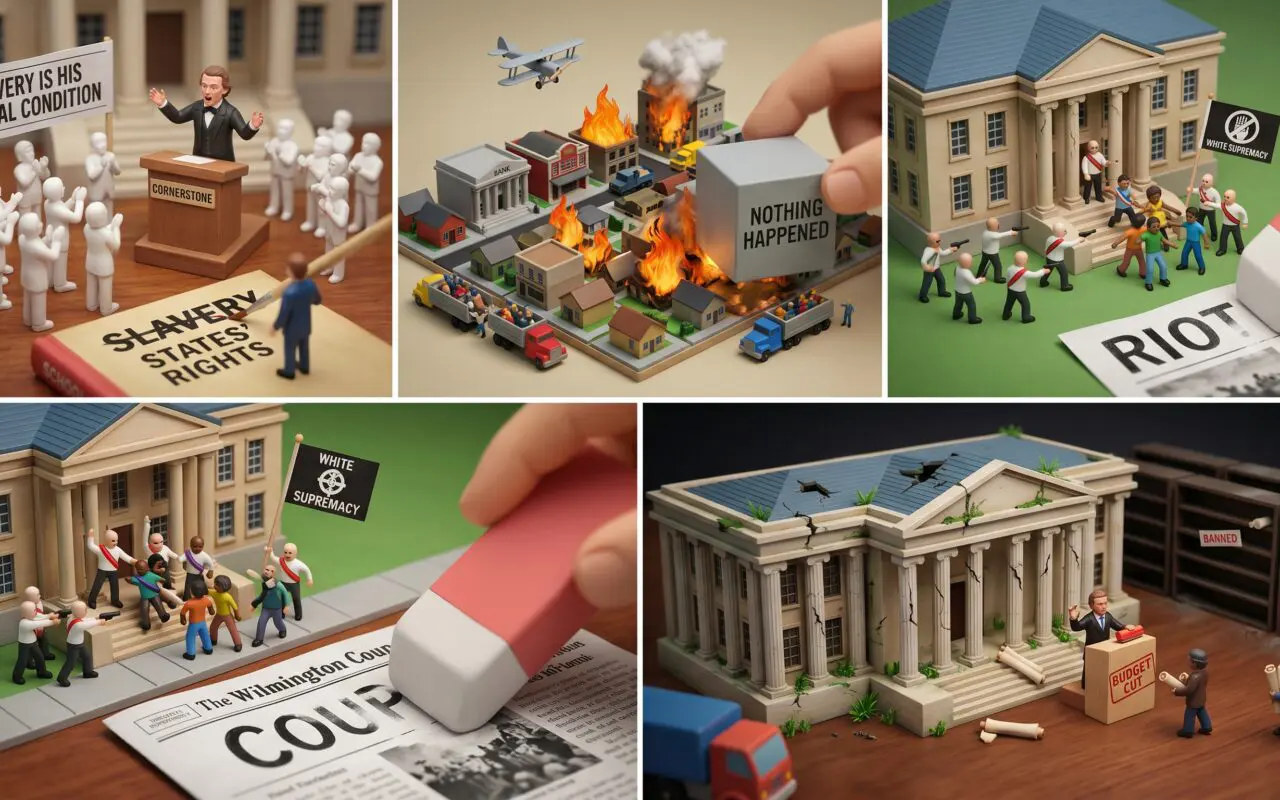
On March 21, 1861, the Vice President of the Confederacy stood up in Savannah, Georgia and said the quiet part out loud.
Alexander Stephens told a packed house in his Cornerstone Speech that the new Southern government’s “cornerstone rests upon the great truth that the negro is not equal to the white man; that slavery, subordination to the superior race, is his natural and normal condition.” He didn’t whisper it. He didn’t code it. He printed it. The newspapers carried it. The crowd applauded.
A century later, Americans were being taught that the Civil War was about states’ rights. That tariffs played a starring role. That slavery was, you know, part of it — but really it was about “Northern aggression” and economic anxiety and the noble agrarian way of life. The most explicit confession in American political history got memory-holed so thoroughly that to this day, polite people at dinner parties will tell you the war’s causes are “complicated.”
That isn’t historical drift. That’s organized forgetting.
And it’s the reason this series exists.
The lie at the foundation: The Lost Cause
The Lost Cause wasn’t a passive misremembering. It was an active, well-funded, multi-generational rewriting project — pushed by the United Daughters of the Confederacy, baked into Southern schoolbooks, cemented in marble on courthouse lawns, sentimentalized by Hollywood from Birth of a Nation to Gone With the Wind. They built the cover-up the same way you build any successful piece of infrastructure: deliberately, expensively, and over a long enough timeline that most people forget it was ever built at all.
The receipts were sitting in plain sight the whole time. Stephens’ speech. The secession declarations from South Carolina, Mississippi, Georgia, and Texas — every single one of which named the protection of slavery as the reason for leaving the Union. The Confederate Constitution, which made abolition literally illegal. None of it was hidden. It just got quietly removed from the version of history most Americans were handed.
And when those tiki torches lit up Charlottesville in 2017, it wasn’t an anomaly. It was the Lost Cause walking out into the open after 150 years of marination — and a sitting president looking at it and seeing “very fine people.”
The cover-up works. Until it doesn’t. Until it does again.
This is the pattern this series is built around.
Erasure by violence: The Tulsa Massacre
In May 1921, a white mob — deputized by the local police, armed in part by the National Guard — burned 35 square blocks of the most prosperous Black community in America to the ground. Black Wall Street, they called it. They didn’t just torch buildings. They strafed the neighborhood from private airplanes. They executed people in the streets. They dumped bodies into mass graves the city of Tulsa would refuse to dig up until 2020.
And then they erased it.
Newspaper archives covering the massacre disappeared. Insurance claims were rejected en masse. Survivors who tried to talk about what happened were threatened, sued, or simply ignored. For three generations, Tulsa schoolchildren — Black and white — were taught nothing. The official story was that nothing had happened, because if nothing had happened, no one had to pay for it.
When the truth threatens the story, you can sometimes erase the truth by erasing the people who lived it.
Erasure by silence: The Wilmington Coup
In 1898, a coalition of white supremacists in Wilmington, North Carolina did something no one else in American history has ever successfully done: they violently overthrew a sitting, legitimately elected government of the United States.
The multiracial Fusionist administration running Wilmington — a Black-majority city at the time — was driven out at gunpoint. An unknown number of Black citizens were murdered (estimates range from dozens to hundreds). The conspirators installed themselves in the offices they had just emptied by force, and then proceeded to rewrite North Carolina’s voting laws to make sure something like a multiracial democracy could never happen again.
And then they wrote the history. For nearly a century, North Carolina textbooks called it the “Wilmington Race Riot” — passive voice, both-sides framing, the perpetrators recategorized as mere participants in some unfortunate misunderstanding. The actual word coup didn’t show up in official state language until 2006.
If you’ve never heard of Wilmington, that’s not because you weren’t paying attention in school. It’s because the people who pulled it off won twice — once in 1898, and again every decade after, when they got to decide whether the next generation would learn what they did.
Erasure by neglect: The Library of Alexandria
Here’s the meta-frame: erasure doesn’t always require violence. Sometimes you just stop paying for the thing.
The Library of Alexandria didn’t burn down in one dramatic night, the way the legend goes. It was starved. Defunded by successive regimes. Deprioritized when budgets got tight. Hollowed out by political shifts that decided the work being done there wasn’t worth protecting. By the time the building was finally destroyed, the institution it had once housed was already a ghost.
Look around. Public libraries getting shuttered. Universities under political assault. Federal research institutions being gutted by people who openly want them dead. School boards banning books faster than librarians can shelve them. Public broadcasting on the chopping block. Primary-source journalism in collapse, getting replaced by AI-generated slop optimized for ad revenue and outrage.
We are watching the Alexandria pattern run in real time. Not as a metaphor — as a method.
Why this Mini Histories series exists
Every Doctor Paradox Mini History is, at its core, a 40-second act of refusal.
It refuses to let the official story stand unchallenged. It refuses to confuse “everyone’s moved on” with “it’s been resolved.” It refuses the polite consensus that says the past is a settled matter and the present is unconnected to it. It looks at a comfortable national myth and asks the impolite question: who benefits from us believing this?
The format is deliberate. Tilt-shift miniature dioramas, four scenes, a paradox at the heart of every episode — because if you can fit a hard truth into 40 seconds and a kid’s-toy aesthetic, the “it’s complicated, you wouldn’t understand” excuse stops working. Complicated is what people in power say when they don’t want you to look. The Mini History bet is that history is exactly as complicated as we let it be — and the parts that matter most are the parts that have been most aggressively buried.
The series runs daily-ish on YouTube Shorts and the Doctor Paradox channel, with the meatiest threads getting full blog treatment here. The throughline is always the same: an event you thought you knew, reframed through politics, economics, psychology, media, or technology, until the line connecting it to right now becomes impossible to unsee.
The pattern is the warning
Every cover-up in this post worked because enough people in power agreed to look away — and enough institutions made looking away the path of least resistance. Tulsa worked. Wilmington worked. The Cornerstone Speech got buried for over a century. The Library of Alexandria starved while the empires that depended on it found other things to fund. These were not failures of memory. They were successes of organized forgetting machines, built on purpose, by people who knew exactly what they were doing.
That machinery is still running. It’s running right now. It runs every time someone says “both sides.” Every time a January 6 rioter gets pardoned. Every time a textbook calls a massacre a riot. Every time a library closes, a university gets gutted, a journalist gets sued into silence, a primary source gets paywalled into obscurity, a YouTube algorithm decides that 40 seconds of historical truth doesn’t perform as well as 40 seconds of nothing.
They count on us forgetting. The whole project — every cover-up, every textbook revision, every monument to a traitor, every “very fine people” deflection — assumes we will.
This series is a small bet that they’re wrong.
P.S. This project was written up in a Glif Creator Spotlight recently!
Comments are closed.