The shooting in Minneapolis last week of Renee Good, a 37-year-old wife and mom to 3 kids, hit me really hard. It’s not just that she was in a lesbian couple like me, with kids from previous husbands — and that I would be the one in the passenger’s seat. It’s because of the brazenness — pride, even — of the officer who ended her life cavalierly and without remorse.
The smear campaign about this woman nauseates me deeply — it began mere milliseconds after her death when the officer who shot her at point-blank range yelled “fuckin’ bitch!” after her vehicle and escalated extremely quickly to the sitting President, Vice President, and Homeland Security Secretary calling her a “domestic terrorist” despite the physical impossibility of being able to confirm that kind of information so quickly.
It is clear that agent Jonathan Ross escalated the situation himself. He broke DHS policy by putting himself in the path of a moving vehicle. And he should not have had his cellphone out, occupying his other hand, when he drew his weapon — you need the hands to be unobstructed to maximize your ability to handle any situation that may emerge.
He claimed he was afraid for his life — when? Show me on tape at which moment(s) in time this agent appears to behave an a fearful manner, because I do not see it. There are the moments when he’s calmly walking around the entire vehicle recording on his cellphone, moments when he has calmly drawn his gun and is pointing it at Renee Good, and moments where he is shouting and shooting bullets into her head. Where is the fear? He doesn’t run or dive; he doesn’t scream; he doesn’t call for help; he doesn’t show any surprise. He doesn’t seem fearful — he seems in control of the situation at all times, including when he pulls the trigger 3 times to take someone’s life as punishment for being cheeky.
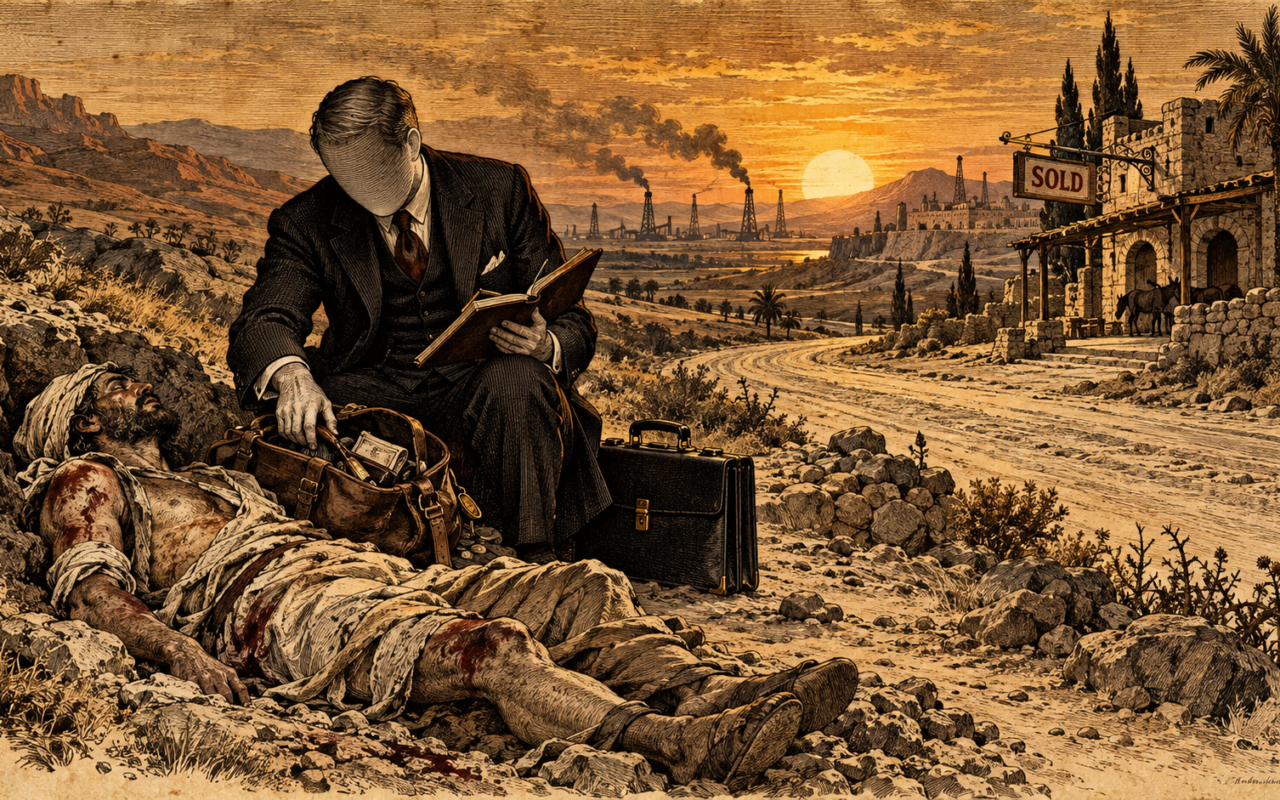
They do not care about you — you are expendable to them. They do not GAF. Especially now with AI — they are gonna replace you anyway brah! At best they are biding time putting you on a drip feed of murder porn and revenge fan fic until the moment they are completely certain they’ve hijacked the electoral system at which time you too, buddy, will be shown the airlock into a deep space void no one will ever hear you from because they have all the powers of the earth to override whatever puny narrative you may have had for yourself.
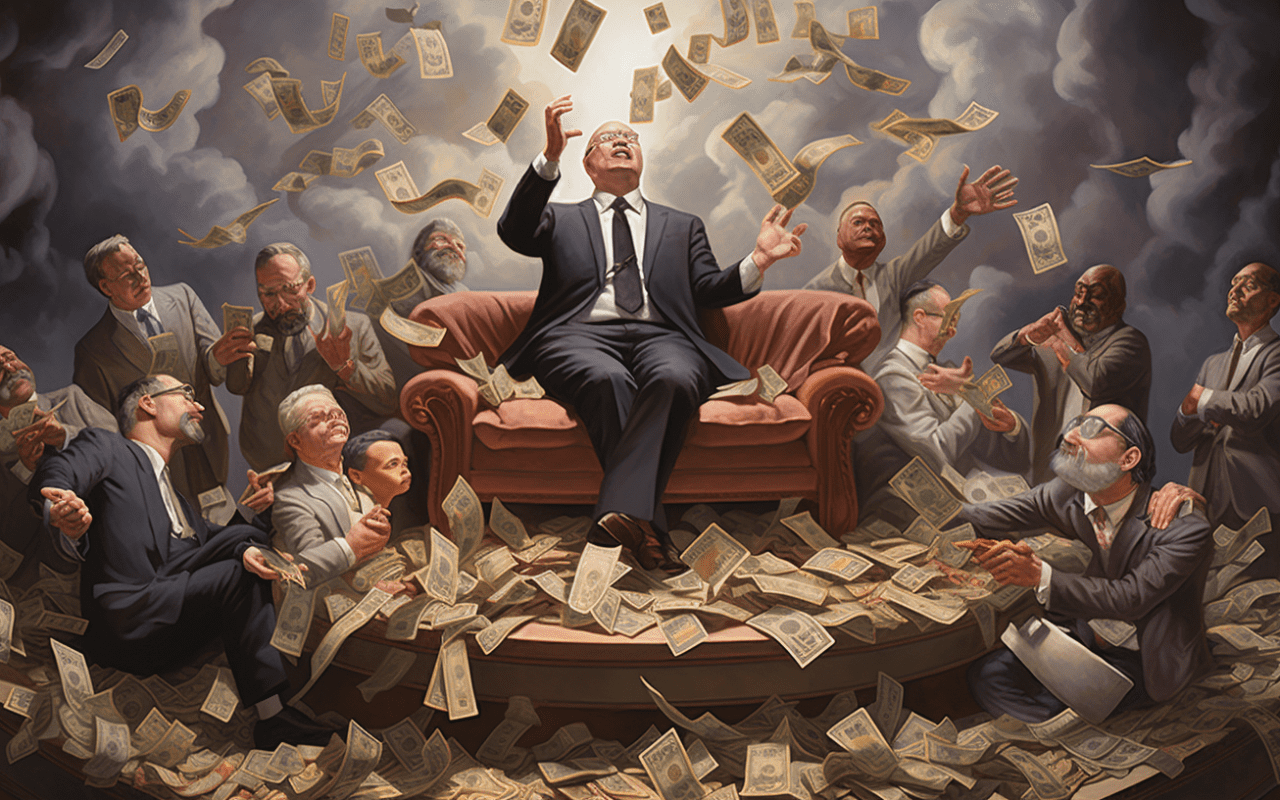
You will be crushed like a bug 1000x tinier than Kafka’s roach — millions at a time under the heels of casually sadistic billionaires many of whom were Democrats up until 5 minutes ago when someone offered them a deal to cut their tax bill in exchange for a measley few million dollars. It’s “irrational” to not take the deal. You have to take the deal. Your competitors have taken the deal. You’d be the only chump not taking the deal. It’s the Art of the Deal, right?
Deals are all that matter. Transactionality is all there is — including reducing the beautiful, awe-inspiring teachings of Jesus to a mere materialistic creed, draped in a flag, shouted from a bullhorn, fired into an already capsized boat, and shot into the heads of innocent bystanders if they don’t comply with conflicting directives.
Five years ago today, a violent mob stormed the United States Capitol in an attempt to overturn a free and fair election. The man who incited them has since been re-elected president, which scuppered the investigation into him by Special Counsel Jack Smith. If that whiplash isn’t enough to give you vertigo, consider this: we now have sworn testimony, under oath, from the prosecutor who investigated Trump laying out exactly why his office believed they could convictβand why they were stopped.
Former Special Counsel Jack Smith’s December testimony before the House Judiciary Committee is the closest thing we’ll get to the trial that should have happened. In it, Smith methodically dismantles every defense Trump and his allies have offered, explains how the case was built on testimony from Republicans willing to put country over party, and makes clear that the evidence of Trump’s guilt wasn’t circumstantialβit was direct.
In this post, I’m breaking down the key takeaways from Smith’s testimony, sharing one of my AI#MiniHistory videos marking the anniversary, and giving you a way to interrogate the evidence yourself through an interactive NotebookLM bot. Because if there’s one thing the incoming administration is counting on, it’s that you won’t have time to read 255 pages of testimony. Let’s make sure they’re wrong.
January 6 in 40 seconds
But first, a J6 refresher course — again, for busy folks.
I’ve been into making these little AI #MiniHistory videos with Glif agents, trying to tease out important signposts along our road to dictatorship and other interesting moments in history to highlight. Here’s the one I did for today and the 5th anniversary of January 6, 2021:
Trump has still never been held accountable for his actions that day — the election of 2024 put a boot in the face of any hope for justice prevailing against the Chief Insurrectionist. Nevertheless, Jack Smith replanted a tendril of hope in his mid-December testimony to Congress with a scathingly clear broken record message that Trump was guilty and they had all the receipts they needed to prove it and then some. It lays down new tracks in the Congressional record that will be impossible to expunge, regardless of whatever trash MAGA fairy tale of J6 the right-wing goons decide to slather on the White House website.
Jack Smith testifies to Trump’s guilt “beyond a reasonable doubt”
In eight hours of testimony before the House Judiciary Committee on December 17, 2025, former Special Counsel Jack Smith laid out why his office was prepared to convict Donald Trump on federal charges. Speaking under oath in a closed-door deposition β the Republicans who now hold the gavel had denied his request to testify publicly (after crying decades of crocodile tears over ‘transparency’?? truly?) βSmith called Trump “the most culpable and most responsible person” in the criminal conspiracy to overturn the 2020 election.
There’s something conspicuously absent from American political discourse: actual discussion of values and the morals, ethical choices, and beliefs that go into the creation of good government policy.
Think about the last major political debate you watched, or the last campaign ad that stuck with you. How much of it was about what government should do versus who you should hate? How much was articulating a vision for society versus performing dominance over the out-group?
This isn’t an accident. It’s a strategy.
When your policy positions are wildly unpopular β when majorities oppose you on healthcare, taxation, abortion, climate change, guns, and wages β you don’t engage on the substance. You change the subject. You make politics about identity, grievance, and tribal belonging. You turn every election into a referendum on vibes rather than vision.
The American right has become extraordinarily sophisticated at this evasion. They’ve built an entire media ecosystem designed not to argue for right-wing values, but to ensure those values never have to be argued for at all. And the Trump administration is chock full of people from that media ecosystem.
The Polling Problem
Here’s the uncomfortable reality the modern right has to navigate, and we need to trumpet: their actual policy preferences are not popular.
Exposed to the individual provisions of the Affordable Care Act, majorities supported them β even among Republicans. Majorities support raising taxes on the wealthy, protecting Social Security and Medicare, acting on climate change, keeping abortion legal in most cases, and implementing universal background checks for gun purchases. On issue after issue, when you strip away the partisan framing and ask people what they actually want government to do, the “conservative” position loses.
This creates a strategic problem. You can’t win elections by articulating positions most people reject. So you articulate… something else.
The Retreat from Argument
Meanwhile, the right-wing has indefensible values, which is why they no longer even bother to try to articulate them. Instead, they express them obliquely through “memes” and mores that evince cruelty, bigotry, narcissism, domination, supremacy, greed, selfishness, and contempt for vulnerability β all while maintaining plausible deniability through irony, “just asking questions,” and the ever-ready accusation that anyone who names the pattern is being hysterical or unfair.
This is the function of the perpetual rhetorical shell game: you can’t pin down a position that’s never stated plainly. The cruelty gets expressed through policy and aesthetic, but when challenged, retreats behind procedural objections or “economic anxiety.” The bigotry shows up in who gets mocked and who gets protected, but is never admitted as such β it’s always reframed as “common sense” or “tradition.”
A network of exceedingly wealthy individuals and organizations have channeled their vast fortunes into influencing American politics, policy, and public opinion — they’ve formed a wealth cult. And they’ve leveraged that cult and its considerable fortune to influence and in many ways dramatically transform American politics.
The most succinct way I have come up with to explain American politics is that the wealthy are dividing us over race and religion. Today far more openly than in the past, where much oligarch shadow influence was delivered via dark money kept intentionally untraceable back to its origins.
The term “dark money” refers to political spending meant to influence the decision-making and critical thinking of the public and lawmakers where the source of the money is not disclosed. This lack of transparency makes it challenging to trace the influence back to its origins, hence the term “dark.”
The wealth cult has funded disinformation campaigns, the spread of conspiracy theories, created fake social movements through astroturfing, enabled violent extremists to attack their country’s capitol, aided and abetted a convicted felon, cruelly deprived vulnerable people (especially immigrants, poor people, and women) of the kind of state aid granted generously throughout the developed world, bribed regulators, rigged elections, crashed economies, and on and on in service of their extremist free market ideology beliefs (which, by the way, have resulted in catastrophic market crashes every single time).
They believe in “makers and takers,” or Mudsill Theory, as it was once called by pedophile and racist Senator and slavery enthusiast James Henry Hammond. Some people were born to serve others, they say. Hierarchies are natural, they claim. Wealthy men should make all the decisions — because that’s what’s best for everyone, they say in paternalistic tones.
But you don’t have to take our word for it — just ask the Vice President of the Confederacy what his reasons were in the infamous Cornerstone Speech of 1861, just a few weeks before the Confederates fired on Fort Sumter:
“The new [Confederate] constitution has put at rest, forever, all the agitating questions relating to our peculiar institution β African slavery as it exists amongst us β the proper status of the negro in our form of civilization. This was the immediate cause of the late rupture and present revolution . . . The prevailing ideas entertained by . . . most of the leading statesmen at the time of the formation of the old constitution, were that the enslavement of the African was violation of the laws of nature; that it was wrong in principle, socially, morally, and politically. . . Those ideas, however, were fundamentally wrong. They rested upon the assumption of . . . the equality of races. This was an error . . .
Our new government is founded upon exactly the opposite idea; its foundations are laid, its cornerβstone rests upon the great truth, that the negro is not equal to the white man; that slavery β subordination to the superior race β is his natural and normal condition.”
β Alexander H. Stephens, March 21, 1861, reported in the Savannah Republican, emphasis in the original
The “States’ Rights” Contradiction
One of the clearest ways to prove the war was about slaveryβand not abstract “states’ rights”βis to look at how the Confederacy treated the rights of Northern states.
The Fugitive Slave Act Paradox:Β Southern leaders explicitly opposed “states’ rights” when Northern states attempted to exercise them. When Northern states passed “Personal Liberty Laws” (exercising their sovereign right to not enforce federal slave-catching laws), Southern states demanded theΒ Federal GovernmentΒ override these state laws.β
South Carolina’s Declaration:Β In its “Declaration of Causes,” South Carolina specifically lists theΒ failureΒ of Northern states to enforce the federal Fugitive Slave Act as a primary grievance. They were not fighting for the right of states to choose their own laws; they were fighting for the federal government to enforce slavery acrossΒ allΒ states
The Rejection of the “Forever” Amendment (Corwin Amendment)
Perhaps the most damning evidence is the South’s rejection of the Corwin Amendment.
The Offer:Β In a last-ditch effort to prevent war, the Northern-controlled Congress actuallyΒ passedΒ a Constitutional Amendment (the original 13th Amendment) in early 1861. It would have protected slaveryΒ foreverΒ in the states where it already existed, guaranteeing the federal government could never abolish it.β
The Rejection:Β If the South were seceding simply to “protect their property” or “defend against Northern aggression,” they would have accepted this victory. Instead, they rejected it. Why? Because the amendment only protected slaveryΒ where it was, but did not guarantee itsΒ expansionΒ into new western territories. The South seceded not just to keep slavery, but to ensure it could grow into a continental empire
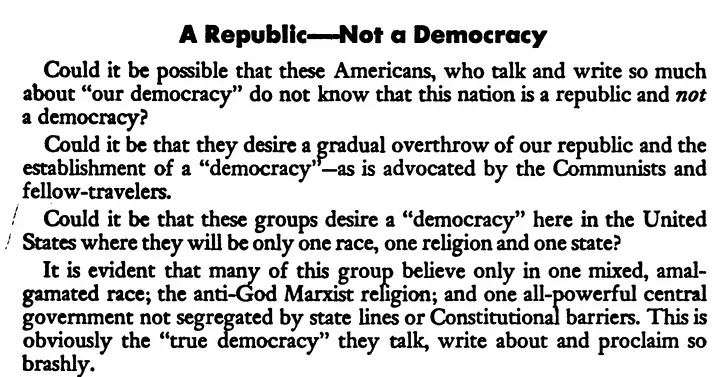
You’ll hear a common retort on the extreme right that now holds sway in the mainstream Republican Party, in response to protests about the dismantling of democracy in this country — that we’re “a republic, not a democracy.” Right off the bat, a republic is a form of democracy — so they are claiming something akin to having a Toyota and not a car. It’s a rhetorical trick, in which people who fully know better are hacking the simple ignorance of civics and basic political philosophy of the right-wing political base.
John Birch Society loonies laud “a republic, not a democracy”
The “republic, not a democracy” meme would go on to be featured in the John Birch Society Blue Book — an organization so toxically extremist that even conservative darling William F. Buckley distanced himself from them. They feared the idea that increasing democratization would be a shifting balance of power away from white conservative men, and they spun numerous conspiracy theories to explain this as the result of nefarious undercover plot to overthrow Western Civilization.
In reality, the trend towards greater democracy is something the Founders themselves envisioned — though they likely could not have imagined how it would turn out. They believed fiercely in self-governance, and a clear separation from the tyranny of kings.
The Golden Rule is a moral maxim that transcends religious, cultural, and philosophical boundaries. At its core, this essential mental model for the world states: “Treat others as you would like to be treated.” This deceptively simple principle serves as a moral compass that has guided human interactions across millennia and continents.
The Critical Distinction: Golden vs. Silver
Not all versions of this rule are created equal. The key difference lies in whether the rule commands action or restraint:
The Golden Rule (Positive Form):
“Do unto others as you would have them do unto you”
Demands proactive kindness and active good
Found in Christianity and Islam’s teachings
Requires you to get up and act
The Silver Rule (Negative Form):
“Do not do unto others what you would not have them do unto you”
Advocates restraint from harmful actions
Found in Confucianism, Judaism, Hinduism, and Buddhism
Can be followed through non-action
This distinction is crucial: you can follow the Silver Rule perfectly by sitting on your couch and doing nothing. The Golden Rule demands that you actively engage with the world.
A Universal Code: The Rule Across Cultures
What makes the ethic of reciprocity so remarkable is its near-universal appearance across human civilization:
Judaism: Hillel the Elder declared this the entire Torah in a nutshellβthe negative version focused on avoiding harm.
Christianity: Jesus framed it as the Greatest Commandment, the positive version demanding active love.
Why Healthcare Costs Stay HighβAnd How the ACA Actually Helps Lower Them
America’s health care cost problem has a perverse logic at its core: we’ve committed to providing emergency care to everyone who needs it, regardless of ability to pay — but we’ve historically failed to ensure people have access to the preventive and primary care that would keep them out of astronomically expensive emergency rooms in the first place.
This contradiction creates a predictableβand expensiveβspiral. Uninsured patients, lacking regular access to doctors, delay care until conditions become acute. They end up in emergency departments, where hospitals are legally required to treat them under EMTALA (the Emergency Medical Treatment and Labor Act — signed into law by Ronald Reagan in 1986). Those visits generate massive uncompensated costs that hospitals pass along to everyone else: insured patients through higher prices, insurance companies through higher premiums, and taxpayers through increased public spending.
The Affordable Care Act was designed, in part, to break this cycle by attacking the problem at its source. The logic is straightforward: expand insurance coverage, and you enable people to seek preventive and primary care before minor issues become medical emergencies. Fewer emergency visits mean less uncompensated care, which translates to lower costs for hospitals, taxpayers, and the broader healthcare system.
And the data backs this up. Research consistently shows that after the ACA’s implementation, emergency department visits by uninsured patients declined significantly. More people with insurance meant more people managing chronic conditions, catching health problems early, and avoiding the emergency room when they had other, more appropriate care options. The shift from reactive emergency care to proactive preventive care doesn’t just improve health outcomesβit fundamentally reduces the financial burden on everyone in the system.
The image above captures the four key outcomes: more insured people leading to fewer ER visits, lower taxpayer costs, and increased preventive care. Understanding this mechanism reveals why expanding coverage isn’t just a moral imperativeβit’s a rational economic policy that makes the system work better for everyone, including those already insured.
But how exactly does this work in practice? And if the ACA helps lower costs, why don’t more people understand this benefit? Below, we answer the most common questions about healthcare costs, the hidden “emergency room tax” that everyone was paying before the ACA, and why the law remains one of the most misunderstood cost-saving policies in American history.
Why is health care so expensive in America?
Because hospitals must provide emergency care to everyone under EMTALA (1986). When patients canβt pay, those uncompensated bills ripple into higher local taxes and insurance premiums. Itβs the costliest way to fund care.
There’s a certain type of political document that doesn’t just argue for changeβit manifests the psychological conditions that make change feel inevitable. Thomas Paine’s Common Sense is the template for this genre, and if you’re trying to understand how populist movements gain momentum, how institutional legitimacy crumbles, or how a pamphlet can reshape a nation’s self-concept in under 50 pages, you need to study this text like it’s a masterclass in persuasion engineering. And we’ll help you do just that in this Common Sense Book Review.
Published in January 1776, Common Sense sold an estimated 500,000 copies in a population of 2.5 million. Do the math: that’s a 20% penetration rate in an era when literacy wasn’t universal and distribution meant physical printing presses. In modern terms, Paine achieved what every content creator dreams ofβhe didn’t just go viral, he became the conversation.
But Paine wasn’t writing for the Continental Congress or the educated elite debating in Philadelphia drawing rooms. He was popularizing revolutionary ideas among ordinary colonistsβfarmers, tradesmen, shopkeepersβtransforming an elite political dispute into a mass movement. This wasn’t theory; it was a manual for collective action that an entire society could rally behind.
The Structural Genius: Four Pillars, One Conclusion
Paine’s architecture is deceptively simple:
Government vs. Society – Establishes the mental model that government is inherently suspect
Monarchy is Absurd – Demolishes hereditary succession through both scripture and reason
The Case for Independence – Makes reconciliation seem more radical than revolution
America’s Material Capability – Provides the practical roadmap
He doesn’t start with independence — he starts by reframing how you think about authority itself. By the time you reach his actual policy proposal, your conceptual framework has been rebuilt from the foundation up. This is first-principles argumentation at its finest.
And the foundation he’s building? It’s the core democratic principle that the law should rule, not hereditary dynasties. Not kings, not aristocrats, not whoever was born into the right family. Paine is arguing for a system where the law governs consenting people who agree to the terms of mutual self-governanceβeven when they disagree on specific policies. This is the actual American political tradition, and reading Common Sense is the perfect antidote to the current disinformation campaign claiming “the US is a republic, not a democracy!” Paine clearly articulates what the public sentiment actually was at the founding: a forceful rejection of monarchy and inherited power.
Before we dive deeper into the specifics, here’s a video overview:
Mental Model: The Overton Window as Battering Ram
What Paine understoodβand what every effective propagandist since has internalizedβis that you don’t persuade people by meeting them where they are. You move the window of acceptable discourse so dramatically that your previously extreme position becomes the moderate compromise.
In 1776, most colonists still considered themselves British subjects seeking redress of grievances. Independence wasn’t just radicalβit was treasonous. Paine’s innovation was to make continued loyalty to Britain seem like the radical position:
“As well can the lover forgive the ravisher of his mistress, as the continent forgive the murders of Britain.”
Peter Thiel FAQ: The Contradictions of Silicon Valleyβs Dark Philosopher
Peter Thiel occupies a rarefied place in the modern pantheon of tech billionaires β less the tinkerer or engineer than the theorist-king of the movement. A venture capitalist, PayPal co-founder, Facebookβs first major outside investor, and the billionaire backer of numerous reactionary causes, Thiel has built a career at the intersection of money, ideology, and myth. He is the financier of futuristic dreams β and dystopian nightmares.
His ventures, from PayPal to Palantir, form a kind of metaphysical architecture of control. PayPal, the proto-financial infrastructure of the internet, made Thiel his fortune. Palantir, as explored deeper in What Is Palantir?, has monetized the surveillance state. In between, Thiel cultivated a cadre of disciples β the so-called PayPal Mafia β that went on to dominate Silicon Valley. His investments in companies like Facebook gave him not only wealth but leverage: a front-row seat in the grand experiment of data-driven social engineering.
What is fascism, and what are the signs of fascism? The fascist form of government is a complex and multi-faceted ideology that can manifest in various ways, making it challenging to pin down with a single definition.
Fascism resists simple definition precisely because it’s a syncretic ideologyβadaptable to different contexts while maintaining core structural features. Rather than a fixed doctrine, it operates as a political methodology characterized by specific power dynamics, rhetorical strategies, and institutional patterns.
Structural characteristics of fascism
These are the ideological foundations and belief systems that define fascist movementsβnot merely policy positions but the fundamental orientations toward power, identity, and social organization that shape how fascism understands the world and its place in it.
Authoritarian Consolidation: Fascism centralizes power through the dismantling of horizontal accountability structures, typically concentrating authority in a charismatic executive who positions themselves above institutional constraints.
Ultranationalism as Identity Politics: Goes beyond patriotism to assert inherent civilizational superiority or racial supremacy, often manifesting as collective narcissism where national mythmaking replaces historical accuracy.
Anti-Intellectualism and Epistemic Closure: Systematic devaluation of expertise, academic inquiry, and empirical reasoning in favor of intuition, emotion, and revealed truth. The “coastal elite” or “ivory tower” becomes a rhetorical enemy.
Ethno-Nationalism and Boundary Enforcement: Xenophobia operating through strict in-group/out-group categorization, often targeting immigrants, religious minorities, or racialized “others.”
Reactionary Temporal Orientation: Deployment of a mythologized past as political programβthe promise to restore a golden age that never existed, weaponizing nostalgia against pluralism.
Anti-Leftist Mobilization: Positioning communism, socialism, and progressive movements as existential threats, often conflating disparate left ideologies to create a unified enemy.
The Us vs. Them Architecture: In-group/Out-group dynamics as core infrastructure
Fascism doesn’t just exploit social divisionsβit requires their constant production and intensification as its primary source of political energy. While most political movements contain some degree of group identity, fascism is structurally dependent on a stark binary between insiders and outsiders, making this dynamic its foundational operating system rather than an incidental feature. The movement coheres not around shared policy goals or governance philosophy, but around the ongoing project of boundary maintenance: defining, defending, and purifying the “us” against an ever-present “them.”
Peter Thiel has a plan to save the world, and it looks like a nightmare. He’s casting around for scapegoats, but perhaps Peter Thiel and the Antichrist are one and the same.
The PayPal co-founder, Facebook‘s first outside investor, and Silicon Valley‘s most influential political operator has spent years developing a political philosophy so strange that most people assume it can’t be serious. Democracy and freedom are incompatible, he says. Global cooperation is the Antichrist. The only hope for civilization is absolute monarchy modeled on tech startups. And he’s not just theorizingβhe’s building it.
Thiel has poured millions into political campaigns, funded think tanks, mentored a generation of “New Right” intellectuals and alt-Right screeders, and cultivated politicians who share his vision. He’s amplified fringe thinkers like Curtis Yarvin (the blogger behind “Neoreaction” who openly advocates abolishing democracy), but Thiel’s worldview is uniquely his ownβa bizarre synthesis of Christian eschatology, corporate governance theory, and techno-authoritarianism that’s far more sophisticated and disturbing than anything coming from the intellectual dark web.
The media often portrays Thiel as an enigmatic libertarian or contrarian thinker. But that framing misses what’s actually happening. This is a systematic rejection of 250 years of democratic governance, wrapped in theological language and corporate efficiency rhetoric. And it’s weirder and more methodical than most people realize.
Peter Thiel and the Antichrist in 8 minutes (video)
This NotebookLM video does a great job explaining the background and impact of Thiel’s dangerously apocalyptic rhetoric inspired by Nazi theorist Carl Schmitt — and below it you can find a deeper explanation of all major points:
Here are the five interlocking beliefs that form Thiel’s visionβand why each one should terrify you.
1. Democracy Is the Bug, Not the FeatureβReplace It With a Tech Startup Dictatorship
Thiel doesn’t just critique democracyβhe’s concluded it’s fundamentally incompatible with freedom. In a 2009 essay, he wrote: “I no longer believe that freedom and democracy are compatible.” Not ideal partners; not in tension — but incompatible.
His alternative is coldly corporate: run countries like founders run startups. One CEO. One vision. Absolute authority. No consensus. No debate. No democracy.
The Founders knew acutely the pains of centuries of religious warfare in modern Europe and resoundingly did not want that for their new nation. Many of them moreover knew religious persecution intimately — some whose families fled the Church of England for fear of being imprisoned, burned at the stake, or worse. Is America a Christian nation? Although many Christians certainly have come here, in a legal and political sense the nation’s founders wanted precisely the opposite of the “Christian nation” they were breaking with by pursuing independence from the British.
Contrary to the disinformation spread by Christian nationalists today, the people who founded the United States explicitly saw religious zealotry as one of the primary dangers to a democratic republic. They feared demagoguery and the abuse of power that tilts public apparatus towards corrupt private interest. The Founders knew that religion could be a source of strife for the fledgling nation as easily as it could be a strength, and they took great pains to carefully balance the needs of religious expression and secular interests in architecting the country.
The main impetus for a large percentage of the early colonists who came to the Americas was the quest for a home where they could enjoy the free exercise of religion. The Protestant Reformation had begun in Europe about a century before the first American colonies were founded, and a number of new religious sects were straining at the bonds of the Catholic Church’s continued hegemony. Puritans, Mennonites, Quakers, Jesuits, Huguenots, Dunkers, Jews, Amish, Lutherans, Moravians, Schwenkfeldians, and more escaped the sometimes deadly persecutions of the churches of Europe to seek a place to worship God in their own chosen ways.
By the late 18th century when Thomas Jefferson wrote the Declaration of Independence, many religious flowers were blooming within the 13 colonies. He had seen for himself the pitfalls of the experiments in which a unitary control of religion by one church or sect led to conflict, injustice, and violence. Jefferson and the nation’s other founders were staunchly against the idea of establishing a theocracy in America:
The founding fathers made a conscious break from the European tradition of a national state church.
The words Bible, Christianity, Jesus, and God do not appear in our founding documents.
The handful of states who who supported “established churches” abandoned the practice by the mid-19th century.
Thomas Jefferson wrote that his Virginia Statute on Religious Freedom was written on behalf of “the Jew and the gentile, the Christian and the Mahometan, the Hindu and the infidel of every denomination.” In the text he responds negatively to VA’s harassment of Baptist preachers — one of many occasions on which he spoke out sharply against the encroachment of religion upon political power.
The Constitution explicitly forbids a religious test for holding foreign office.
The First Amendment in the Bill of Rights guarantees that “Congress shall make no law respecting the establishment of religion, or prohibiting the free exercise thereof.”
There is a right-wing conspiracy theory aiming to discredit the phrase “wall of separation between church and state” by claiming that those exact words aren’t found in the Constitution.
The phrase comes from Thomas Jefferson’s 1802 letter to the Danbury Baptists, wherein he is describing the thinking of the Founders about the meaning of the First Amendment’s Establishment Clause, which Jefferson contemplates “with sovereign reverence.”
The phrase is echoed by James Madison in an 1803 letter opposing the building of churches on government land: “The purpose of separation of Church and State is to keep forever from these shores the ceaseless strife that has soaked the soil of Europe with blood for centuries.”
The 1796 Treaty of Tripoli states in Article 11: “As the government of the United States of America is not in any sense founded on the Christian Religion,-as it has in itself no character of enmity against the laws, religion or tranquility of Musselmen,-and as the said States never have entered into any war or act of hostility against any Mehomitan nation, it is declared by the parties that no pretext arising from religious opinions shall ever produce an interruption of the harmony existing between the two countries.” — President George Washington first ordered the negotiation of a treaty in 1795, and President John Adams sent the treaty to the Senate for ratification in 1797, with this article widely interpreted to mean a reiteration of the purpose of the Establishment Clause to create a secular state, i.e. one that would not ever be going to holy war with Tripoli.
Critical Dates for Religious Freedom in America
From the very beginning the Founders made clear they did not want to repeat the mistakes of Old Europe. They established a secular government that offered religious freedom to many who had felt persecuted in their homelands — for generations to come.
Get a quick overview of some of the most important moments in American history and its founding documents with our interactive timeline below.
The Founders were deists
Moreover, the majority of the prominent Founders were deists — they recognized the long tradition of Judeo-Christian order in society, but consciously broke from it in their creation of the legal entity of the United States, via the Establishment Clause and numerous other devices. The founders were creatures of The Enlightenment, and were very much influenced by the latest developments of their day including statistics, empiricism, numerous scientific advancements, and the pursuit of knowledge and logical decision-making.
What Deism Actually Meant: Deism in the 18th century was a rationalist religious philosophy that accepted the existence of a creator God based on reason and observation of the natural world, but rejected supernatural revelation, miracles, and divine intervention in human affairs. Think of it as “God as clockmaker” β God designed the universe with rational laws, set it in motion, and then stepped back. This was a radical departure from traditional Christianity.
Empiricism over revelation β knowledge comes from observation and reason, not scripture
Natural rights derived from human nature and reason, not divine command
Social contract theory β government legitimacy comes from consent of the governed, not God’s anointing
Scientific method β Newton’s physics showed that the universe operated by discoverable natural laws
This was a revolutionary shift. They were designing a government based on Enlightenment principles in an era when most of the world still operated under divine-right monarchy.
The European Church-State Problem They Rejected:
The Founders had vivid historical examples of why mixing religion and state power was dangerous:
The Thirty Years’ War (1618-1648) killed roughly 8 million Europeans in religious conflict
The Spanish Inquisition showed what happens when church and state merge
Various European states still had official churches that persecuted religious minorities — prompting many of them to consider a new line in the American colonies
They saw how “established” (government-sponsored) religions inevitably led to:
Paine went even further than most Founders. In “The Age of Reason” (1794), he argued:
All national churches are “human inventions set up to terrify and enslave mankind”
Revelation is meaningless β “it is revelation to the first person only, and hearsay to every other”
True religion is simply “to do justice, love mercy, and endeavor to make our fellow-creatures happy”
He predicted that as education and reason spread, traditional organized religion would wither
This was considered extremely radical β even scandalous β at the time. Yet Paine was celebrated as a hero of the Revolution and widely read. He once lamented that “Persecution is not an original feature in any religion; but it is always the strongly marked feature of all religions established by law.”
The Structural Safeguards They Built:
This wasn’t just philosophy β they built specific mechanisms:
No religious test for office (Article VI)
Establishment Clause β no official national religion
Free Exercise Clause β no prohibition of religious practice
Disestablishment at state level β states gradually abandoned their established churches (Massachusetts was last in 1833)
The framers of our Constitution who established this nation distrusted the concept of divine right of kings that existed in Europe under its historical monarchies. We fought a revolution to leave all that behind for good reason. They were adamantly against the idea of a national church, and were clear and insistent about the necessity of keeping the realms of religion and politics independent of each other.
It is the Christian nationalists who have it backwards — America was never a Christian nation that lost its way. Rather, the United States was founded as a secular nation and has become truer to fulfilling that mission over the centuries. It is the Project 2025 folks who are engaging in revisionist history, inventing a mythical past for the country that simply didn’t exist.
Sometimes our minds play tricks on us. They can convince us that untrue things are true, or vice versa.
Cognitive distortions are bad mental habits. They’re patterns of thinking that tend to be negatively slanted, inaccurate, and often repetitive — the very opposite of healthy, critical thinking.
These unhelpful ways of thinking can limit one’s ability to function and excel in the world. Cognitive distortions are linked to anxiety, depression, addiction, and eating disorders. They reinforce negative thinking loops, which tend to compound and worsen over time.
Irrational thinking: And how to counter it
Every day, our minds take shortcuts to process the overwhelming amount of information we encounter. These shortcutsβcognitive distortionsβhelped our ancestors survive in environments where quick judgments meant the difference between life and death. But in today’s complex world, where we’re making decisions about careers, relationships, investments, and strategy, these same mental patterns can systematically lead us astray.
Cognitive distortions are systematic patterns of thought that can lead to inaccurate or irrational conclusions. These distortions often serve as mental traps, skewing our perception of reality and affecting our emotional well-being.
The good news? Simply knowing these distortions (as well as other common psychological biases) exist makes you a better thinker. Research in metacognition shows that awareness is the first step toward correction. You can’t debug code you don’t know is buggy, and you can’t fix thinking patterns you can’t see.
Here’s the hard truth: everyone experiences these distortions. The difference between mediocre and exceptional decision-makers isn’t that one group never falls into these trapsβit’s that they’ve trained themselves to spot the patterns, pause, and course-correct. They’ve built systems to counteract their brain’s default programming.
Types of cognitive distortion
What types of cognitive distortion should we be aware of? Let’s delve into three common types: emotional reasoning, counterfactual thinking, and catastrophizing.
Emotional Reasoning: This distortion involves using one’s emotions as a barometer for truth. For example, if you feel anxious, you might conclude that something bad is going to happen, even if there’s no objective evidence to support that belief. Emotional reasoning can create a self-perpetuating cycle: your emotions validate your distorted thoughts, which in turn intensify your emotions.
Counterfactual Thinking: This involves imagining alternative scenarios that could have occurred but didn’t. While this can be useful for problem-solving and learning, it becomes a cognitive distortion when it leads to excessive rumination and regret. For instance, thinking “If only I had done X, then Y wouldn’t have happened” can make you stuck in a loop of what-ifs, preventing you from moving forward.
Catastrophizing: This is the tendency to imagine the worst possible outcome in any given situation. It’s like always expecting a minor stumble to turn into a catastrophic fall. This distortion can lead to heightened stress and anxiety, as you’re constantly bracing for disaster.
But there are many more mental pitfalls to watch out for besides just these 3. The table below catalogues some of the most common cognitive distortions that shape (and warp) human thinking. As you read through them, you’ll likely recognize patterns from your own mental habits. That moment of recognition isn’t a weaknessβit’s the beginning of cognitive sovereignty. The path to better decisions starts with knowing when your brain is trying to take shortcuts, and choosing to think deliberately instead.
Consider this your debugging toolkit for the most important software you’ll ever run: your own mind.
Cognitive distortions list
Cognitive distortion
Explanation
Example
all-or-nothing thinking
viewing everything in absolute and extremely polarized terms
“nothing good ever happens” or “I’m always behind”
blaming
focusing on other people as source of your negative feelings, & refusing to take responsibility for changing yourself; or conversely, blaming yourself harshly for things that were out of your control
“It’s my boss’s fault I’m always stressed at work, or conversely, “It’s all my fault that the project failed, even though I had no control over the budget cuts.”
catastrophizing
belief that disaster will strike no matter what, and that what will happen will be too awful to bear
If I don’t get this promotion, my life will be ruined and I’ll end up homeless.
counterfactual thinking
A kind of mental bargaining or longing to live in the alternate timeline where one had made a different decision
If only I had studied harder for that exam, I wouldn’t be in this situation now.
dichotomous thinking
viewing events or people in all-or-nothing terms
“If I don’t get a perfect score on this test, then I’m a complete failure.”
discounting positives
claiming that positive things you or others do are trivial, or ignoring good things that have happened to you
“I got a promotion, but it’s not a big deal; anyone could have done it.”
emotional reasoning
letting feelings guide interpretation of reality; a way of judging yourself or your circumstances based on your emotions
“I feel like a failure, so I must be one.”
filtering
mentally “filters out” the positive aspects of a situation while magnifying the negative aspects
Even though I got a promotion and a raise, I can’t stop thinking about the one negative comment my boss made during my performance review.
fortune-telling
predicting the future negatively
I just know I’m going to fail this test, even though I’ve studied for weeks.
framing effects
tendency for decisions to be shaped by inconsequential features of choice problems
Choosing the “90% fat-free” yogurt over the “10% fat” yogurt, even though they are nutritionally identical, because the positive framing sounds healthier.
halo effect
belief that one’s success in a domain automagically qualifies them to have skills and expertise in other areas
Because someone is a successful actor, I assume they must also be a brilliant political commentator.
illusory correlation
tendency to perceive a relationship between two variables when no relation exists
Every time I wash my car, it rains, so I must be causing the rain.
inability to disconfirm
reject any evidence or arguments that might contradict negative thoughts
Despite being shown evidence of her good work, she clung to the belief that she was incompetent.
intuitive heuristics
tendency when faced with a difficult question of answering an easier question instead, typically without noticing the substitution
When asked if they are a happy person, someone might answer if they are happy right now, instead of considering their overall happiness.
just-world hypothesis
belief that good things tend to happen to good people, while bad things tend to happen to bad people
She believes that because she works hard and is a good person, she is guaranteed to win the lottery, while bad things only happen to those who deserve it.
labeling
assigning global negative traits to self & others; making a judgment about yourself or someone else as a person, versus seeing the behavior as something they did that doesn’t define them as an individual
“I’m a complete idiot for making that mistake,” instead of “I made a mistake.”
ludic fallacy
in assessing the potential amount of risk in a system or decision, mistaking the real randomness of life for the well-defined risk of casinos
A gambler believes that since a roulette wheel has landed on red five times in a row, it’s more likely to land on black next, mistaking the independent probability of each spin for a predictable pattern.
a way of imagining you can wish reality into existence through the sheer force of your mind. Part of a child developmental phase that not everyone grows out of.
If I just wish hard enough, I can make my dream job appear without applying for it.
magnification
exaggerating the importance of flaws and problems while minimizing the impact of desirable qualities and achievements
Even though I successfully completed the complex project, I can’t stop focusing on the minor typo I made in one email.
mind reading
assuming what someone is thinking w/o sufficient evidence; jumping to conclusions
My boss didn’t say good morning, so she must be angry with me.
negative filtering
focusing exclusively on negatives & ignoring positives
Even after receiving a glowing performance review, she could only dwell on the one minor suggestion for improvement.
nominal realism
child development phase where names of objects aren’t just symbols but intrinsic parts of the objects. Sometimes called word realism, and related to magical thinking
A child believing that if you call a dog a “cat,” it will actually become a cat, demonstrates nominal realism.
overgeneralizing
making a rule or predicting globally negative patterns on the basis of single incident
Because I tripped on the sidewalk today, I know it’s going to be a terrible week.
projection
attributing qualities to external actors or forces that one feels within and either a) wishes to promote and have echoed back to onself, or b) eradicate or squelch from oneself by believing that the quality exists elsewhere, in others, but not in oneself
He accused his coworker of being lazy, when in reality, he was struggling with his own motivation.
provincialism
the tendency to see things only from the point of view of those in charge of our immediate in-groups
She couldn’t understand why anyone would disagree with her team’s strategy, assuming their way was the only correct approach because it’s what her superiors believed.
shoulds
a list of ironclad rules one lives and punishes oneself by
“I should always be perfect, and if I’m not, I’m a complete failure.”
teleological fallacy
illusion that you know exactly where you’re going, knew exactly where you were going in the past, & that others have succeeded in the past by knowing where they were going
I always knew I would become a successful entrepreneur because every step I took, even the detours, perfectly led me to this point.
what if?
keep asking series of ?s on prospective events & being unsatisfied with any answers
What if I fail the exam, and what if that means I’ll never get into college, and what if my whole future is ruined because of this one test?