You learned the fairy tale in civics class. The ballot box is the one clean machine — the sacred mechanism, the great equalizer, the place where the powerful and the powerless cancel each other out one vote at a time. The peaceful transfer of power is American scripture. We even built a little ritual around it: the concession call, the inauguration, the loser standing on the dais clapping for the winner.
It’s a lovely story. The documentary record just doesn’t back it up — especially after the 2020 election and the events of January 6, 2021.
This is part of my daily Mini Histories series — 40-second tilt-shift AI-created video dives into the moments American memory conveniently misplaced, each one built around a thesis that runs against the grain of what you were taught. (You can find the whole archive on the channel.)
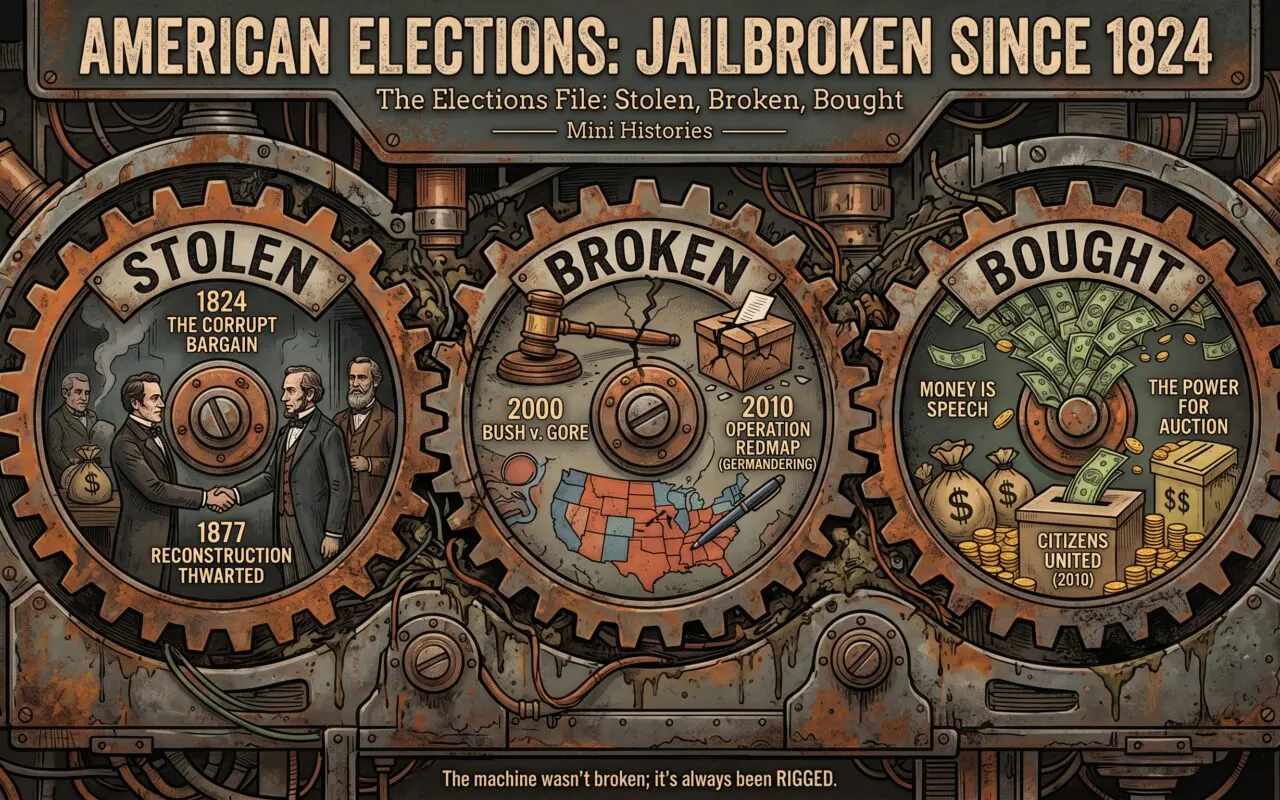
And the elections file is one of the thickest, because the thing the fairy tale leaves out is that American elections don’t get stolen on election day, via so-called voter fraud. They get stolen before it, broken around it, or bought after it — by the very elites who cry big crocodile tears about the unfairness of elections as they rig them in their favor (sometimes, with the blessing of SCOTUS including recently). Election denial becomes a whole grift in itself for the unpopular party that cheats. Using three failure modes, over two hundred years, one remarkably consistent cast of beneficiaries emerges again and again to wield power against the will of the people.
Let’s go to the tape.
Stolen: the backroom
Long before anyone “stopped the steal,” the steal was a gentleman’s arrangement — the proverbial smoke-filled back rooms where deals were made amongst men of influence.
The Corrupt Bargain (1824)
The first stolen presidential election happened earlier than you think — Andrew Jackson won the most votes and the most electors, and still walked away with nothing after the contest got thrown to the House and the runners-up cut a deal.
Reconstruction, Thwarted (1877)
A half-century later they did it again, only this time the price was an entire people’s freedom. To settle a disputed election, the parties traded away Reconstruction itself — federal troops out of the South, the door held open for Jim Crow.
A new long-form data brief on how representativeness has been gerrymandered away — and the first installment of a series on how American democracy was engineered to stop being competitive.
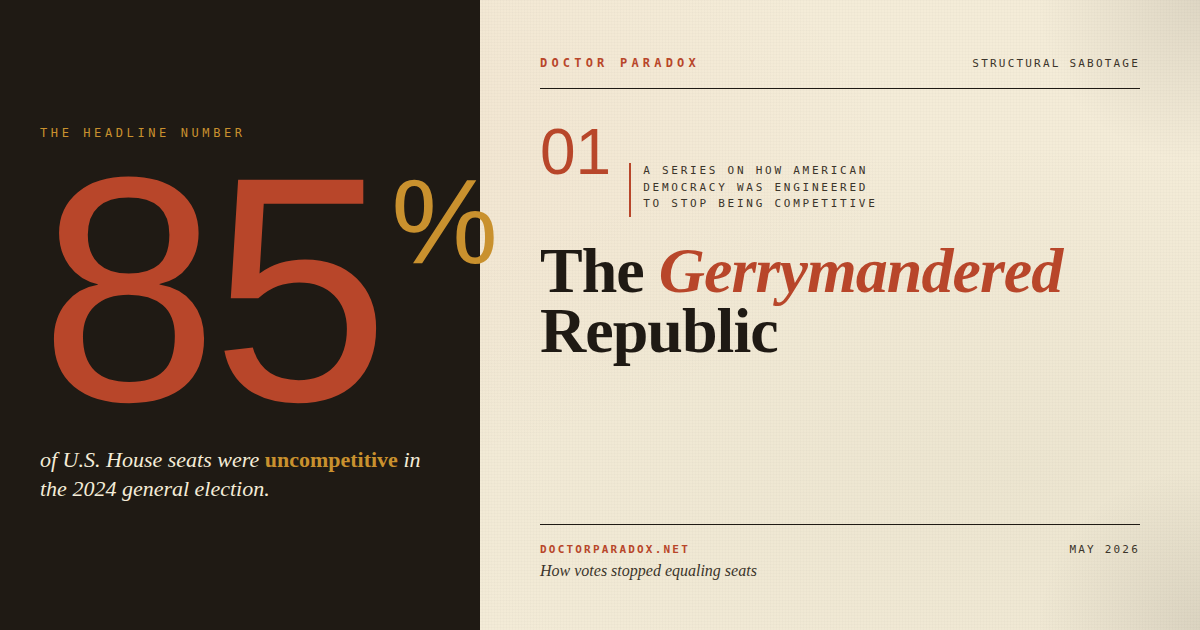
In 2024, Americans went to the polls to elect 435 members of the U.S. House of Representatives. 366 of those races were over before a single ballot was cast.
Not “predictable.” Not “incumbent advantage.” Decided — by maps drawn years earlier, with software, by politicians choosing their voters instead of the other way around. According to the Cook Political Report‘s 2024 ratings, only 69 of 435 House seats — 15% — were genuinely competitive in the general election. The other 85% were already in the Republican or Democratic column before campaigning began.
That’s the headline of the new Doctor Paradox data brief, The Gerrymandered Republic, and it’s the launch piece for a new series: Structural Sabotage, on the ways American democracy has been engineered to stop being competitive.
This first installment is the receipt-collection edition. It covers:
The vote-share vs. seat-share gap in Wisconsin, North Carolina, Ohio — and Maryland as the Democratic counter-example, because honesty matters
Packing and cracking — the two techniques every gerrymandered map uses, unchanged since 1812
The efficiency gap — the metric that quantifies how badly a map cheats
The collapse of swing seats from 164 in 1999 to 82 today — a 50% loss of competitive districts in 25 years
What actually works — independent commissions draw 19% of America’s districts and produce 41% of its toss-up races, a four-to-one ratio in favor of taking the pen out of politicians’ hands
The Supreme Court’s 2019 Rucho v. Common Cause decision, which closed the only federal door left
Click the image below to open the new mini-magazine style format:
Stay tuned for part 2 of the Structural Sabotage series — on how primaries weaponize safe seats — that will be coming next. If 85% of seats are decided before the general election, then who actually decides them? The answer is a much smaller and more ideological electorate than most Americans realize.
Please share. The cover-up that worked is still working, and the least we can do is make sure people can see the map.
The Kansas Prophecy: We Already Ran This Experiment and the SAVE Act in Kansas Was a Disaster
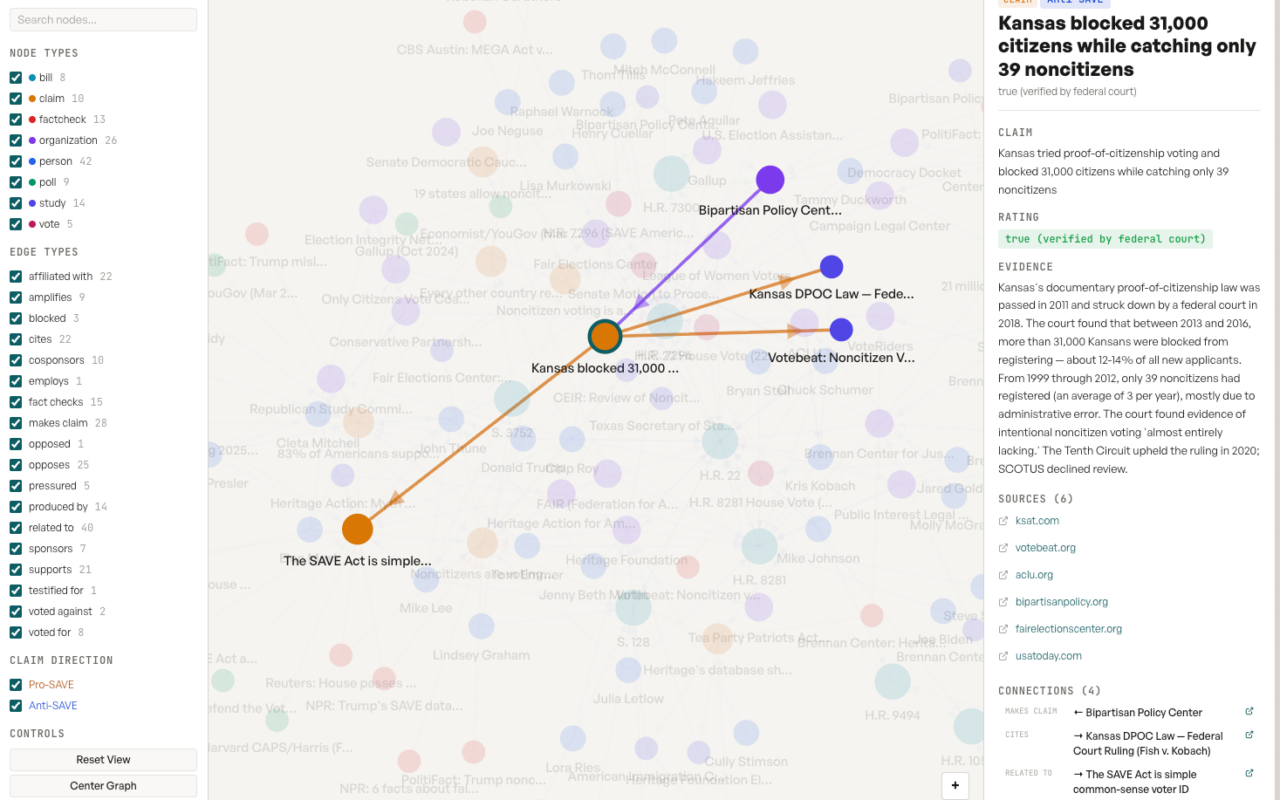
When Kansas tried its early version of the SAVE Act, a whopping 31,089 eligible American citizens were blocked from voting. Meanwhile only 39 noncitizens were “caught”… over 19 years. And many of them turned out to be administrative errors.
That’s the final score from Kansas’s proof-of-citizenship experiment — the same core policy the SAVE America Act would impose on all 50 states. Republicans are selling it as “election security.” Kansas already has the receipts on what it actually is.
Been There, Done That
In 2011, Kansas passed a law requiring documentary proof of citizenship to register to vote — a birth certificate, passport, or naturalization papers. It was the brainchild of then-Secretary of State Kris Kobach, who styled himself as America’s foremost crusader against the specter of rampant illegal voting. The law went into effect in 2013 and immediately went sideways.
DMV clerks weren’t allowed to request the new documents — or even tell people the requirement existed. Voter registration drives cratered: one effort at Washburn University collected 400 applications but managed to fully register roughly 75 people. A process that used to take five minutes stretched to an hour. Steven Fish, a warehouse worker born on a now-closed Air Force base in Illinois, couldn’t produce an acceptable birth certificate. Multiple plaintiffs in the lawsuit that followed were military veterans. All were U.S. citizens. None were the noncitizen bogeymen the law was supposed to stop.
The federal courts annihilated it. A 118-page district court ruling struck it down as unconstitutional. The 10th Circuit affirmed. The Supreme Court declined to hear it. The judge sanctioned Kobach personally and ordered him to take remedial legal education — a humiliation nearly without precedent for a sitting state official. Kansas paid $1.9 million in attorneys’ fees to the winning parties. The state’s current Republican Secretary of State, Scott Schwab — who voted for the law as a legislator — delivered the epitaph: “It didn’t work out so well.”
The “Problem” Rounds to Zero
And it’s not just Kansas. Everywhere officials have looked for the noncitizen voting crisis, they’ve found a rounding error:
The Heritage Foundation itself — which advocates for the SAVE Act — found 68 documented cases of noncitizen voting since the 1980s out of over a billion ballots cast; a rate of 0.0000001% (!). Utah reviewed its entire voter list of two million registrants and found one noncitizen registration and zero noncitizen votes. Georgia audited 8.2 million voters and found 20 noncitizens. The Brennan Center found 30 suspected cases across 23.5 million votes. This isn’t a policy responding to a problem. It’s a solution in search of a pretext.
The bill is also set to take effect immediately, which is fairly insane to think about such a radical change to the rules of voting mere months before an election. I’m old enough to remember when supposedly Good Governance dictated that we leave a Supreme Court seat empty for an entire year — allegedly so “The People” could have their say on this important lifetime appointment. If the precedent is supposed to be that no major structural changes happen during an election year, then how does the right wing justify the sudden about face? It’s okay only when a Republican is in office, no doubt.
Kansas at Scale
The SAVE America Act is Kansas’s disaster, federalized and supercharged. In addition to the proof-of-citizenship registration requirements, it would force states to hand voter roll data to DHS with no safeguards on how it’s used, criminalize election workers who register someone without the right paperwork — even if that person is a citizen — and effectively eliminate online registration, mail registration, and automatic voter registration programs used by millions.
It passed the House in February 2026. The Senate opened debate March 17. Prediction markets give it roughly an 11% chance of becoming law. Trump has threatened to block all other legislation — including DHS funding during a partial shutdown — until it passes. A leaked 17-page executive order draft would require all 211 million registered Americans to re-register in person if the Senate doesn’t comply.
SAVE Act Network Graph Explorer
Explore the web of people, organizations, and money behind the push.
Kansas proved that proof-of-citizenship laws don’t catch noncitizen voters. They catch citizens. The 31,000-to-39 ratio isn’t a bug — it’s the feature. And the bill doesn’t need to pass the Senate to serve its real purpose: manufacturing a narrative that “Democrats are blocking election security,” setting the stage for executive overreach, filibuster destruction, or post-election delegitimization.
The Kansas cautionary tale isn’t that the policy is flawed. It’s that it works exactly as intended — just the opposite of the way they’re selling it.
What is RT.com? If you’ve been following international news in recent years, you’ve likely encountered content from RT — the state-owned Russian news service formerly known as Russia Today. But what exactly is this network, and why does it matter in our global information landscape?
The Birth of a Propaganda Powerhouse
RT didn’t emerge out of nowhere. Back in 2005, the Russian government launched “Russia Today” with a substantial $30 million in state funding. The official mission? To counter what the Kremlin perceived as Western media dominance and improve Russia’s global image.
What’s fascinating is how they approached this mission. Margarita Simonyan, appointed as editor-in-chief at just 25 years old, strategically recruited foreign journalists to give the network an air of international credibility. By 2009, they rebranded to the sleeker “RT” — a deliberate move to distance themselves from their obvious Russian state origins.
While RT initially focused on cultural diplomacy (showcasing Russian culture and perspectives), its mission shifted dramatically after the 2008 Russia-Georgia war. The network increasingly pivoted toward anti-Western narratives — a strategy that continues to this day.
How RT Spreads Disinformation
RT’s playbook is both sophisticated and concerning. The network regularly promotes conspiracy theories about everything from COVID-19 origins to U.S. election fraud. It strategically amplifies divisive issues in Western societies, particularly racial tensions in America.
The coverage of the Ukraine war offers a perfect case study in RT’s propaganda techniques. Their reporting consistently and erroneously:
Frames the invasion as a “special operation” to “denazify” Ukraine (led by a Jewish president)
What makes RT particularly effective is its tailored regional messaging. In Africa, they operate “African Stream,” a covert platform promoting pro-Russian sentiment. In the Balkans, RT Balkan (based in Serbia) helps circumvent EU sanctions while spreading Kremlin-aligned content. Meanwhile, their Spanish-language expansion targets Latin American audiences with anti-Western narratives.
The network reportedly recruits social media influencers under fake accounts to obscure Russian involvement. More alarmingly, RT-associated platforms allegedly supply equipment (including drones, radios, and body armor) to Russian forces in Ukraine, with some materials sourced from China.
According to U.S. intelligence assessments, RT hosts a clandestine unit focused on global influence operations — blurring the line between media and intelligence work.
Money and Organization
As with any major operation, following the money tells an important story. RT’s annual funding has grown exponentially — from $30 million at its founding to $400 million by 2015. For the 2022-2024 period, the Russian government allocated a staggering 82 billion rubles.
The network’s organizational structure is deliberately complex. RT operates under ANO TV-Novosti (a nonprofit founded by RIA Novosti) and Rossiya Segodnya (a state media conglomerate established in 2013). Its subsidiaries include Ruptly (a video agency), Redfish, and Maffick (digital media platforms).
Staying One Step Ahead of Sanctions
Despite being banned in the EU and U.S. following Russia’s 2022 invasion of Ukraine, RT continues to expand its reach in Africa, Latin America, and Serbia. The network has proven remarkably adaptable at circumventing restrictions — using proxy outlets like “Red” in Germany and RT Balkan in Serbia to bypass sanctions.
The international response has been significant but inconsistent. The U.S. designated RT a foreign agent in 2017, the EU banned it in 2022, and Meta removed RT from its platforms in 2024. The U.S. has also launched campaigns to expose RT’s ties to Russian intelligence and limit its global operations.
Why This Matters
RT exemplifies modern hybrid warfare — blending traditional state media with covert influence operations and intelligence activities to advance Kremlin interests globally. Despite sanctions and increasing awareness of its true nature, RT’s adaptability and substantial funding ensure its continued reach.
For those of us concerned about information integrity and democratic resilience, understanding RT’s operations isn’t just academic — it’s essential for navigating our increasingly complex media landscape.
A Comprehensive Timeline of Russian Electoral Interference: From Imperial Russia to the Digital Age
Russian election interference around the globe has a much longer history than most people realize, extending back centuries rather than decades. This interference has evolved alongside Russia‘s own political transformations, from imperial ambitions to Soviet ideology to modern geopolitical objectives under Vladimir Putin. Recent actions, particularly during the 2016 U.S. presidential election, represent not an anomaly but the continuation and evolution of long-established patterns of behavior designed to shape foreign politics to Russian advantage.
The Imperial Russian Roots of Electoral Interference
Russia’s involvement in foreign electoral politics dates back to the early 18th century. Following a period when Poland had been the dominant power that once occupied Moscow, the tables turned as Russia grew in strength. Under Peter the Great and his successors, Russia began systematically meddling in Poland’s electoral politics by bribing Polish nobles to vote against attempts to strengthen the Polish central government and national army. This early form of interference was aimed at keeping a neighboring power weak and malleable to Russian interests.
This pattern culminated at the end of the 18th century when Russia, alongside Austria and Prussia, partitioned the Polish state among themselves, effectively erasing Poland from the map. Poland would remain part of the Russian Empire until World War I when it finally regained independence. This early example established a precedent that would continue in various forms through subsequent Russian regimes.
The Birth of Soviet Electoral Interference
After the 1917 Bolshevik Revolution, the Soviet approach to electoral interference took on an ideological dimension. In 1919, Vladimir Lenin founded the Communist International (Comintern), an organization designed to unite communist parties worldwide and foment revolution abroad. The Comintern distributed funding and supported propaganda operations in various countries to help communist parties compete more effectively in elections, with the ultimate goal of having these parties assume power and eventually abolish national borders.
While Lenin’s vision of global communist revolution was not realized, the Comintern’s activities generated significant paranoia in Western democracies like the United States and United Kingdom, where fears of Soviet manipulation of democratic processes took root. This marked the beginning of a more systematic approach to electoral interference that would be refined during the Soviet era.
Post-World War II: Aggressive Soviet Electoral Manipulation
After World War II, the Soviet Union under Joseph Stalin aggressively interfered in elections across Eastern Europe, particularly in countries like East Germany, Hungary, and Poland. These operations foreshadowed many tactics that would later be employed by Putin’s Russia. The Soviet Union manipulated voter rolls, falsified vote counts, and distributed massive amounts of propaganda through posters, pamphlets, and leaflets to influence public opinion.
These elections were effectively rigged, resulting in communist parties coming to power across Eastern Europe and subsequently ending competitive elections in these nations. This period represents one of the most successful campaigns of electoral interference in modern history, as it resulted in the establishment of Soviet-aligned governments throughout the Eastern Bloc.
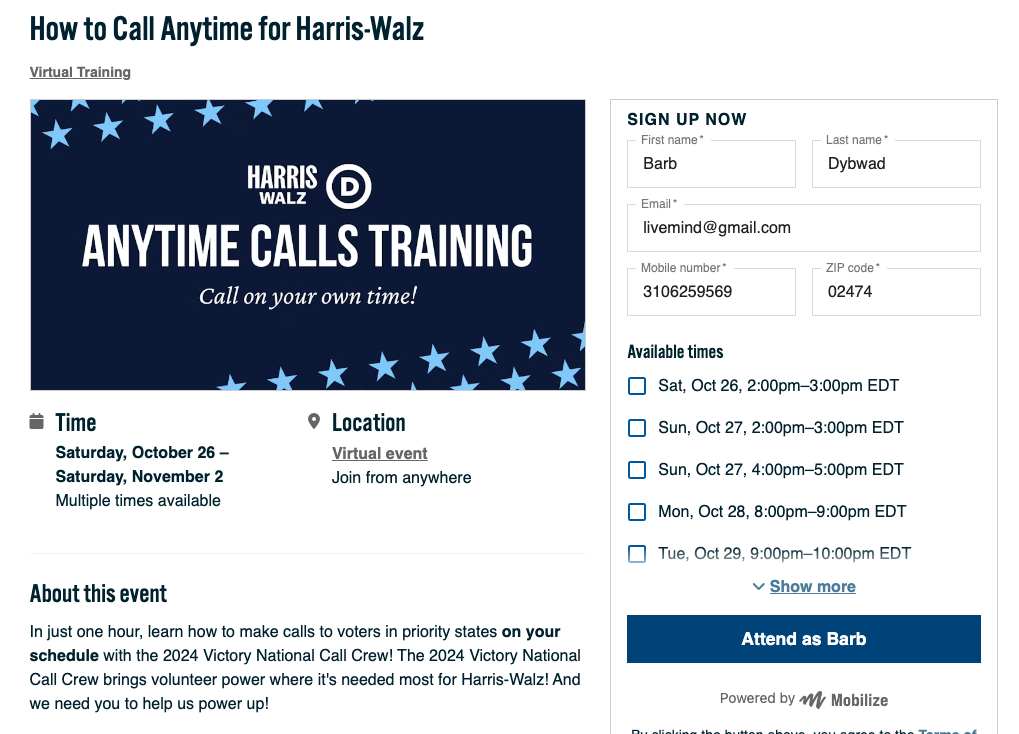
Ask not what your country can do for you, y’all. Here’s how to volunteer your time and energy to elect Kamala Harris and Tim Walz our next President and Vice President.
Early voting has already started! Including in some of the swingiest swing states including Georgia. These final days will be crucial to accelerating our gains and running up the score for Kamala Harris this 2024 Election.
You can pick up the phone, or the pen, open the wallet, or contribute via whatever channel moves you — but We The People have a key part to play in preserving democracy for the next generations. Voting is essential — but can you do more?? As Michelle Obama commanded: DO SOMETHING!
It’s up to us to remember what Kamala’s mother told her: Don’t just sit around and complain — do something!
We only have two and a half months left until Election Day.
Most activist groups had to adjust to political organizing completely online during the pandemic, so it is exceedingly easy now to parachute in to a group and get involved right away, whether that’s on the phone talking to voters or prospective voters, texting potential voters, writing letters or postcards, helping others canvassing directly, using social media as an influencer, or other forms of organizing or messaging. All you really need is an internet connection and ideally a laptop and a phone — but you can get by with a tablet and a phone or even just a phone for certain volunteering campaigns.
2024 Election
“Nobody can do everything, but everybody can do something.” — Gil Scot-Heron
It’s our time, people. We need to turn this tide. We need to confront fascism in its new face. Its new form. Its morphology of ugliness in its ought to have been knowing better by now. We’ve seen this movie before. We know how it ends. It’s not pretty for the outgroup — if they survive at all.
We cannot let that happen in America — the land of the free, and the home of the brave. These are no hollow words. These are not things we take lightly. We will not be moved from our patriotism. We will not allow the right-wing merchants of doubt to kill our joy — to dampen our conviction that America is one of the greatest places in the world.
Getting involved if you don’t have a ton of time
Field 6 BYOP Bring Your Own Phone Text Banks
After a half hour training these Field Team 6 BYOP sessions are so easy to drop right into and register about ~34 new Democrats per day before Google Voice throttles me. It’s super easy and effective which is a rare combo. I feel like it’s a secret little stealth weapon against the GOP that, given the number of participants and texts per day, is likely to wield a consequential influence on the 2024 election.
Donate!
If you don’t have much time to offer, campaigns up and down the ballot can certainly make use of your money.
As of Oct 26, the best way you can get involved is to do local canvassing if you live near or can get to a swing state or swing district. Check Mobilize for canvasses near you.
Next Best: Phone Banking
The second best way is to join the DNC Call Crew. They will deploy you to whichever states are highest priority at a given moment, give you scripts to work from and plenty of support. Phone banking can be intimidating for sure — talking to strangers isn’t most peoples’ idea of a great time — but it actually can be quite great. You’ll get a lot of hang ups and a lot of folks who don’t want to talk to you — very few who will want to argue — and some solid percentage of friendlies who give you excitement and realness and a sense of civic pride. It’s a great reminder about how we’re all Americans, and in that, we have the potential to find common ground.
They will train you in less than an hour, whether you’ve phone banked before or this is your first time. They have been doing this for a while now and the trainings are excellent and operations are efficient and well-oiled. After that, you can call pretty much anytime you like between the hours of 10am and 12am (yes midnight! Pacific campaigns can be dialed until then), hang out in Slack with a bunch of like-minded civic strivers, and contribute your hugely valuable time to contacting a set of voters who could well make the difference in a county, state, or presidential level.
The Democratic National Committee offers phone and text banking as well as numerous other programs and volunteer opportunities. You can also sign up specifically for voter protection efforts, particularly if you live in a crucial swing state.
DCCC for House races
The Democratic Congressional Campaign Committee (DCCC) is the body specifically charged with supporting Democratic candidates in and running for the House. With increasing momentum behind the Harris-Walz campaign, there is increased priority in taking back a House majority in 2024 — get involved at the DCCC Action Center.
Swing Left
Longtime progressive activists Swing Left are swinging hard for Kamala Harris in 2024.
Indivisible
The progressive organization formed to help citizens resist the Trump administration offers a handy tool for finding volunteer opportunities — simply plug in your address to find the most impactful actions based on your location.
Mobilize
Bookmark Mobilize.us to get a large database of volunteer opportunities and other ways to plug in to the 2024 election, Harris campaign, state and local politics, and more.
Kamala Harris is poised to break that glass ceiling that Hillary Clinton cracked and I am so here for it. She was my Senator when I lived in California and I appreciated her energy back then — and I would be thrilled for her service as the first woman president.
And I’m by no means the only one — from White Dudes for Harris to Republicans for Harris to Mormons for Harris, to Democratic groups up and down the spectrum, there is renewed energy in this election and momentum has been building even since Biden’s decision to step down from the race.
The selection of Tim Walz as her running mate adds yet another layer of awesomeness — with his folksy small town dad appeal, military service, midwestern charm, and zingy comebacks and catchy takedowns of Trump and Vance as “weird,” he seems to be bringing a hefty punching up vibe to the campaign.
Meanwhile, all the Orange Man and emo beardo seem able to do is sling racist and sexist insults at Kamala, or attempt a cheap knockoff of the swiftboating of John Kerry with Walz’s military service that’s been swiftly and resoundingly debunked. People aren’t falling for it.
Imagine if the momentum carries us all the way to a blue wave, and a Democratic Congress… we could perhaps have nice things! Time to put shoulders to the wheel. Give whatever time and money you can, if you can.
Election denialism, the refusal to accept credible election outcomes, has significantly impacted U.S. history, especially in recent years. This phenomenon is not entirely new; election denial has roots that stretch back through various periods of American history. However, its prevalence and intensity have surged in the contemporary digital and political landscape, influencing public trust, political discourse, and the very fabric of democracy.
Historical context
Historically, disputes over election outcomes are as old as the U.S. electoral system itself. For instance, the fiercely contested 1800 election between Thomas Jefferson and John Adams resulted in a constitutional amendment (the 12th Amendment) to prevent similar confusion in the future. The 1876 election between Rutherford B. Hayes and Samuel J. Tilden was resolved through the Compromise of 1877, which effectively ended Reconstruction and had profound effects on the Southern United States.
Yet these instances, while contentious, were resolved within the framework of existing legal and political mechanisms, without denying the legitimacy of the electoral process itself. Over time, claims of election fraud would come to be levied against the electoral and political system itself — with dangerous implications for the peaceful transfer of power upon which democracy rests.
The 21st century and digital influence
Fast forward to the 21st century, and election denialism has taken on new dimensions, fueled by the rapid dissemination of disinformation (and misinformation) through digital media and a polarized political climate. The 2000 Presidential election, with its razor-thin margins and weeks of legal battles over Florida’s vote count, tested the country’s faith in the electoral process.
Although the Supreme Court‘s decision in Bush v. Gore was deeply controversial, Al Gore’s concession helped to maintain the American tradition of peaceful transitions of power.
The 2020 Election: A flashpoint
The 2020 election, marked by the COVID-19 pandemic and an unprecedented number of mail-in ballots, became a flashpoint for election denialism. Claims of widespread voter fraud and electoral malfeasance were propagated at the highest levels of government, despite a lack of evidence substantiated by multiple recounts, audits, and legal proceedings across several states.
The refusal to concede by President Trump and the storming of the U.S. Capitol on January 6, 2021, marked a watershed moment in U.S. history, where election denialism moved from the fringes to the center of political discourse, challenging the norms of democratic transition. Widely referred to as The Big Lie, the baseless claims of election fraud that persist in the right-wing to this day are considered themselves to be a form of election fraud by justice officials, legal analysts, and a host of concerned citizens worried about ongoing attempts to overthrow democracy in the United States.
Implications, public trust, and voter suppression
The implications of this recent surge in election denialism are far-reaching. It has eroded public trust in the electoral system, with polls indicating a significant portion of the American populace doubting the legitimacy of election results. This skepticism is not limited to the national level but has trickled down to local elections, with election officials facing threats and harassment. The spread of misinformation, propaganda, and conspiracy theories about electoral processes and outcomes has become a tool for political mobilization, often exacerbating divisions within the American society.
Moreover, election denialism has prompted legislative responses at the state level, with numerous bills introduced to restrict voting access in the name of election security. These measures have sparked debates about voter suppression and the balance between securing elections and ensuring broad electoral participation. The challenge lies in addressing legitimate concerns about election integrity while avoiding the disenfranchisement of eligible voters.
Calls for reform and strengthening democracy
In response to these challenges, there have been calls for reforms to strengthen the resilience of the U.S. electoral system. These include measures to enhance the security and transparency of the voting process, improve the accuracy of voter rolls, and counter misinformation about elections. There’s also a growing emphasis on civic education to foster a more informed electorate capable of critically evaluating electoral information.
The rise of election denialism in recent years highlights the fragility of democratic norms and the crucial role of trust in the electoral process. While disputes over election outcomes are not new, the scale and impact of recent episodes pose unique challenges to American democracy. Addressing these challenges requires a multifaceted approach, including legal, educational, and technological interventions, to reinforce the foundations of democratic governance and ensure that the will of the people is accurately and fairly represented.
The op included/includes bots on social media, fake influencers, paid crisis actors, massive propaganda, financial fraud, old-fashioned spying, and more. There is no evidence this operation has ceased its activities — indeed what would be the incentive, following such Great Success??
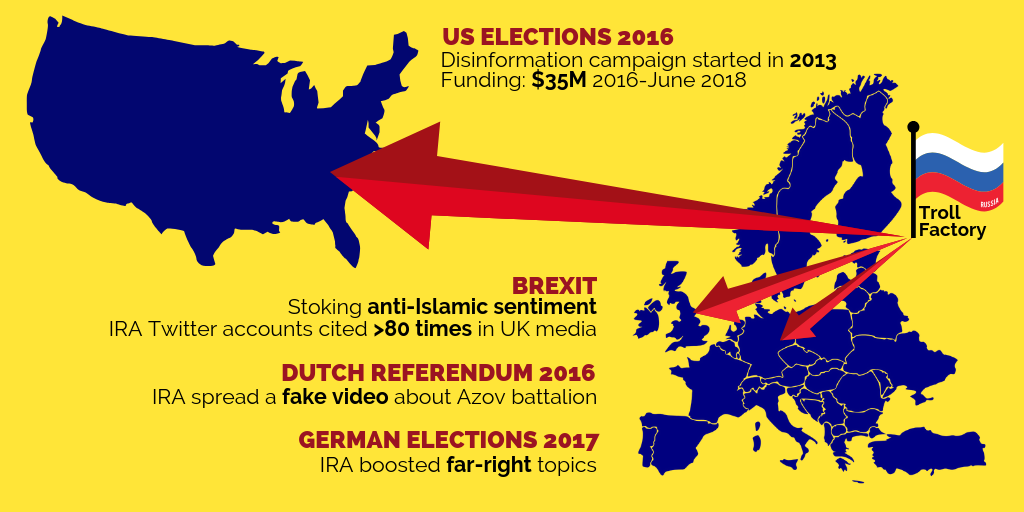
Project Lakhta was a covert operation ordered by Russian president Vladimir Putin with the goal of interfering in the 2016 U.S. presidential election. The interference aimed to harm the campaign of Hillary Clinton, boost the candidacy of Donald Trump, and increase political and social discord in the United States. The Internet Research Agency (IRA), a Russian troll farm, created thousands of social media accounts to support radical political groups and promote events in support of Trump and against Clinton. The operation also involved computer hackers affiliated with the Russian military intelligence service infiltrating information systems of the Democratic National Committee and Clinton campaign officials, then publicly releasing the stolen files and emails. The U.S. intelligence community, the FBI, and the Senate and House Intelligence Committees conducted investigations into the matter. These investigations concluded that Russian interference was “sweeping and systematic” and “violated U.S. criminal law”, but there was insufficient evidence to bring any conspiracy or coordination charges against Trump or his associates (1).
Scale of Project Lakhta
In 2018 a Russian national, Elena Khusyaynova, was charged with being a key member of Project Lakhta. Khusyaynova served as the chief accountant of the operation and managed its financial aspects, including paying off Russian political activists posing as U.S. citizens, advertising on social media platforms, and promoting news postings on social networks. Between 2016 and 2018, Project Lakhta’s expenses exceeded $35 million and its operating budget was over $10 million. The operation allegedly involved the creation of thousands of fake social media accounts to aggravate political groups and create divides before the election. The charges were unsealed in Alexandria, Virginia, emphasizing that the complaint does not allege that Khusyaynova or the broader conspiracy had any effect on the outcome of an election. In response to these meddling efforts and a recent data breach, Facebook is reportedly seeking to acquire a major cybersecurity firm to enhance its security measures (2).
We have a hard time understanding how political polarization has become so extreme in the United States. Forget about right and wrong, and stop being so mystified and affronted that Hillbilly Elegy or Neo Neo-Nazi don’t see things the way you do. “How can they support Trump?!?” many a well-meaning Democrat will plaintively cry.
But these judgments are labels we’ve invented — they’re purely symbolic. It’s the feelings underneath that truly produce motivation — there is a physiological reason that “our camp” and “their camp” seem so drastically different from each other. Almost as if we no longer inhabit the same reality anymore. It used to be that we routinely disagreed (and even fought bitterly) over facts — but now we disagree over whether facts have any value at all, which is a very dangerous place to be.
So we don’t necessarily need right and wrong to understand the Trump cult, and it may even get in the way. A Buddhist would offer a far more neutral perspective on the chasm dividing America today:
DNC - What the liberal left (and a smattering of defected right) enjoyed tonight at the Democratic National Convention was pleasant to us. It felt good. - To the Trumpkins, the DNC was unpleasant, and greatly so.
RNC - For Trump rallies and presumably the RNC, the feelings swap: his fans pass over mere pleasant into a frenzy of malignant envy and sadism. - For us Democrats, those events are nightmarishlyunpleasant. They give us the heebie jeebies.
Political polarization: Nurture and nature
For some of us, it’s just how we’re wired. Others have the nurture member of the dyad to thank, or blame. The community or communities around us and the context we’re in affect our decision-making as well. As our surroundings become more politically polarized, so do we — having a compounding feedback loop effect.
Some of us will grow and stretch and change over the course of our lives. Others have fixed set points. Maybe we should be asking some additional questions beyond, “But how can they believe…” including, “what is it that some people find unpleasant about compassion and love? Is it that they feel those things to be absent in their own lives, or that they’ve been betrayed by those ideals in some way?”
I think James Madison — the Father of the Constitution — would have had many choice words about this development. Since we cannot alas ask him his opinion any longer, perhaps his parting words to the beloved country he was instrumental in creating can suffice:
The advice nearest to my heart and deepest in my convictions is the Union of the States be cherished and perpetuated. Let the open enemy to it be regarded as a Pandora with her box opened; and the disguised one, as the Serpent creeping with his deadly wiles into Paradise.”
While we wring our hands in the United States over whether or not such a strategy is even conceivable, the erstwhile President of Russia has been running this playbook out in the open in Ukraine and Eastern Europe for some time. With help from Propagandist-in-Chief Vladislav Surkov, Putin has leveraged the open secrets about the psychology of crowds we learned in the late 19th and early 20th century to stir up emotional antagonisms within the political spectrum — to predictable results.
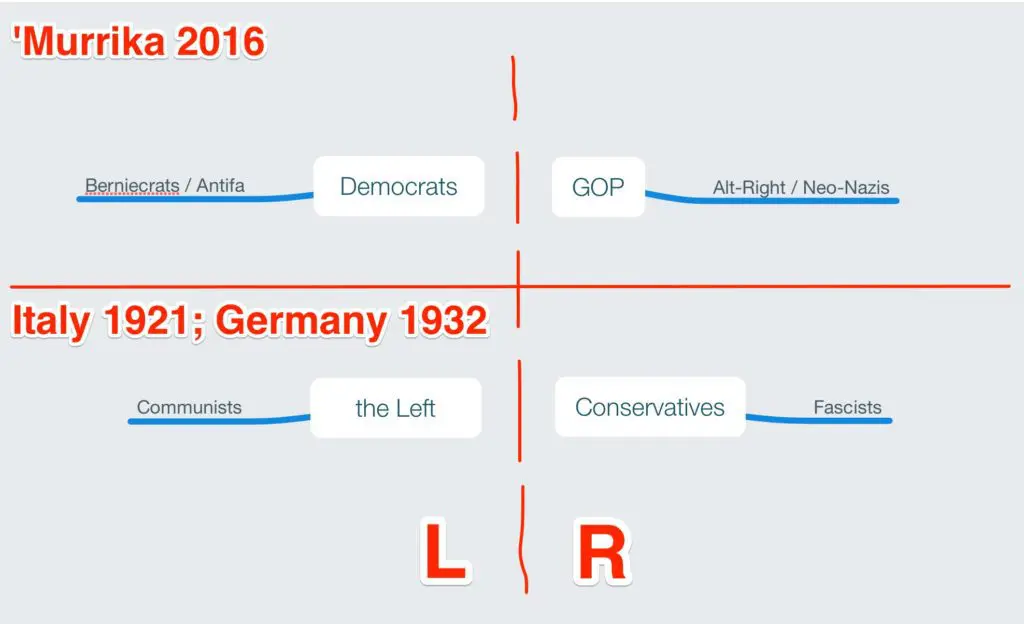
It’s no accident that fascism is on the march in America. The conditions have been brewing for some time, predominantly since the Conservative movement began breaking away more militantly from democratic principles and towards authoritarian philosophy (elite rule by force: preferably invisible force via economic hegemony for the middle and upper classes, and violent force / the carceral state for The Undesirables) in the late 1970s and 1980s. All Putin had to do was make use of available prevailing conditions and tools — the rise of social media in the 2000s counterintuitively blew a gaping wide security hole in the American persuasion landscape that Cold War Soviet operatives of the 1960s would scarcely have believed.
Today, as in parts of Europe between the world wars, the U.S. has partisan gridlock within The Establishment sector of politics; this exacerbates the impatience with and contempt for the status quo (aka the Liberal world order) that in some sense naturally congeals at the far right and far left margins of the political spectrum as a simple consequence of the Normal Distribution (the Median Voter Theorem captures this tendency quite succinctly). Under such conditions, an influence campaign like the one Russia wielded against the United States during the 2016 election season was tasked merely with tilting the playing field a little further — a task that platforms like Facebook and Twitter were in some sense fundamentally engineered to accomplish, in exchange for ad revenue.
New World Order? Be careful what we wish for
“Both Italian and German fascists had done their best to make democracy work badly. But the deadlock of liberal constitutions was not something the fascists alone had brought about. ‘The collapse of the Liberal state,’ says Roberto Vivarelli, ‘occurred independently of fascism.’ At the time it was tempting to see the malfunction of democratic government after 1918 as a systemic crisis marking the historic terminus of liberalism. Since the revival of constitutional democracy since World War II, it has seemed more plausible to see it as a circumstantial crisis growing out of the strains of World War I, a sudden enlargement of democracy, and the Bolshevik Revolution. However we interpret the deadlock of democratic government, no fascist movement is likely to reach office without it.”