Less than two weeks out. Here’s where to learn the part of the midterms nobody puts on screen.
Here’s the paradox of November 3: the number you’ll stare at all night, the one in the corner of the screen with the little checkmark beside it, is the least official number in American democracy.
It has no legal status. None. It’s a private news organization’s running total, pieced together from county websites, state feeds and reporters in the field. This cycle, every major broadcast network reads from the same one. ABC, CBS, NBC, CNN and Fox News all buy their 2026 results data from the Associated Press, the first time since the 2016 election that all the major broadcast networks have used a single vendor. The call desks are still separate. The numbers feeding them aren’t.
Meanwhile, the actual election happens somewhere far less telegenic. In county offices. In rooms where election workers decide what a half-filled oval meant. In Pennsylvania, where counties can’t even start processing mail ballots before 7 a.m. on Election Day. That’s why the mail vote there lands last, and why the margin “moves” overnight. That’s not the count shifting. That’s the calendar.
And when somebody loses? The National Archives has a stock answer to the question of what a concession speech does to the process. It begins with one word: “None.”
So on November 4th someone will tell you the late-counted ballots are suspicious. Or that a race was over because a candidate said so on TV. You’ll want to know how the machine actually works.
It moves fast. In the past week alone, close to 100 midterm pages were added or updated: new race pages, new super PAC money, new court rulings. A “Latest midterm updates” feed at the top of the hub refreshes every morning, so you can see what changed since your last visit. And if reading isn’t enough, the hub will point you to volunteer shifts near you.
The bigger map
The midterms section is one corner of something bigger. The Civics vs. Oligarchy Knowledge Base is more than 10,000 linked pages mapping the people, money, ideas and institutions of the modern American right: who funds what, who knows whom, and where the receipts are. New here? Begin at Start Here, with a 15-minute tour and six one-hour reading tracks. Election season is track one.
Then follow the links. That’s the whole trick. Every page connects to the people and the money around it.
It’s free, and there’s no paywall. Send it to the friend who’s planning to doomscroll through election night.
Because election night is a broadcast. The election is a process: slow, local, deeply unglamorous. When the numbers lurch at 2 a.m., the system isn’t broken. It’s working exactly as designed.
The people who want you to panic are counting on you not knowing the difference.
Almost nobody can see it. That’s not because it’s hidden. It’s because it’s scattered across thousands of filings, press releases and paywalled archives, and nobody has time to trace Leonard Leo to the Federalist Society, then to a 6–3 Supreme Court, then to the rulings that changed your rights. The information is free. Connecting it costs time, and time is what oligarchy counts on you not having.
The money. Dark money networks, donor-advised funds, the Koch Network, Citizens United, and a running tracker of what officials say about federal spending compared with what the contracts and filings show.
The Tech Right. How Silicon Valley money and ideas moved to the center of right-wing power. It runs from Peter Thiel and Palantir to Curtis Yarvin and the defense-tech pipeline. Start at The Tech Right Hub.
The 2026 midterms. With less than three weeks until November 3, the 2026 Midterms Hub covers every Senate and governor’s race, the most competitive House seats, ballot measures, and how the election is actually run and counted.
If you have fifteen minutes, go to Start Here. Five pages tell the whole story in order: the plan, who pays for it, the new money, the story that mobilizes the base, and what’s at stake in November. If you have an hour, pick one of six reading tracks.
If you’re coming back, What’s New is refreshed daily. In the past week alone the wiki added 172 new pages and made 121 major updates.
How it’s built
I came up in the Friendster era, back when we really believed the open web would put information in everyone’s hands. Silicon Valley lost that plot. I didn’t.
I built this with heavy AI assistance for research, drafting and cross-linking, plus a separate fact-checking pass. The rules are simple. Claims carry sources. Where sources conflict or a number can’t be confirmed yet, the page says so in a warning box instead of quietly picking a side. Fast-moving pages say when their figures were last checked. Short pages are placeholders, there so a name can be linked, and they fill in over time.
It’s free and has no sponsors. It grows every day.
Its older sibling, Foundations, is still home to the dictionaries and timelines. The two sites are meant to be read together.
None of this was ever secret. Keeping it scattered was the trick.
There was a weird controversy that set in after the events of the white nationalist Unite the Right rally in Charlottesville, VA in which a neo-Nazi 8chan bottomfeeder killed Heather Heyer by running her over with his car, while injuring 19 others. It was a shocking moment for the nation and all Trump had to say about it was they condemned violence “on many sides, on many sides” — though there were only two sides, and only one of those two sides had killed someone.
A couple of days later he managed to get through a scripted teleprompter statement explicitly condemning white supremacists and neo-Nazis only to walk it back again and then double down on it the following day, saying “The statement I made on Saturday, the first statement, was a fine statement… What I’m saying is this: You had a group on one side and you had a group on the other, and they came at each other with clubs—and it was vicious and it was horrible. You had some very bad people in that group, but you also had people that were very fine people, on both sides.”
First of all, both sides did not have clubs. One side had tiki torches and a car that killed someone while the other side was armed with hymnals and homemade signage. Secondly — where were those “other” fine people? The vagueness allows for almost any interpretation — were some of the people with clubs “very fine” despite beating others about the head? Were some of the people who didn’t have clubs themselves but were cheering on the people with clubs “fine people”? Maybe there was a gathering of small invisible fairies merely caught up in the shuffle and Trump wanted to just make sure that possibility didn’t get overlooked and this innocent group of delicate souls unnecessarily besmirched?
The primary chosen “debunk” that detractors ended up going with from the wet clay of Trump’s stilted statement alleges that the *other* side Trump meant by “both” were simply innocent local townsfolk objecting to the removal of a statue of their beloved hero Robert E. Lee. Besides the fact that the right-wing has failed to this day to produce a shred of evidence that such people were even there, and the inconvenient reality that the rally was openly marketed as a white supremacist event, organized by avowed white nationalist organizations, it doesn’t even matter if they could produce such evidence — because those people are still not very fine! Robert E. Lee was a traitor to the United States and exalting him is not good!
Robert E. Lee Was Not a Fine People
In fact, Robert E. Lee was a terrible human being whose noble cause was maintaining his ownership of other human beings — as well as a shitty general who paid zero attention to the battle after giving a set of static orders and hoping God would sort out the rest. All he had to do was defend the borders of his baby white homeland, but he was an arrogant showboat who couldn’t keep it in his pants and had to go attacking Pennsylvania for no good reason.
He was also a senseless butcher who had the highest casualty rate of the entire war, being so reckless with his soldiers’ lives that he may as well have fed them into a woodchipper. He chewed through his entire army of 100,000 only 14 months into the campaign and by the war’s end had effectively annihilated his original army multiple times over through cumulative losses, as well as obliterating a whopping 30% of the total Confederate forces overall despite leading only one army in one theater.
They do not care about you — you are expendable to them. They do not GAF. Especially now with AI — they are gonna replace you anyway brah! At best they are biding time putting you on a drip feed of murder porn and revenge fan fic until the moment they are completely certain they’ve hijacked the electoral system at which time you too, buddy, will be shown the airlock into a deep space void no one will ever hear you from because they have all the powers of the earth to override whatever puny narrative you may have had for yourself.
You will be crushed like a bug 1000x tinier than Kafka’s roach — millions at a time under the heels of casually sadistic billionaires many of whom were Democrats up until 5 minutes ago when someone offered them a deal to cut their tax bill in exchange for a measley few million dollars. It’s “irrational” to not take the deal. You have to take the deal. Your competitors have taken the deal. You’d be the only chump not taking the deal. It’s the Art of the Deal, right?
Deals are all that matter. Transactionality is all there is — including reducing the beautiful, awe-inspiring teachings of Jesus to a mere materialistic creed, draped in a flag, shouted from a bullhorn, fired into an already capsized boat, and shot into the heads of innocent bystanders if they don’t comply with conflicting directives.
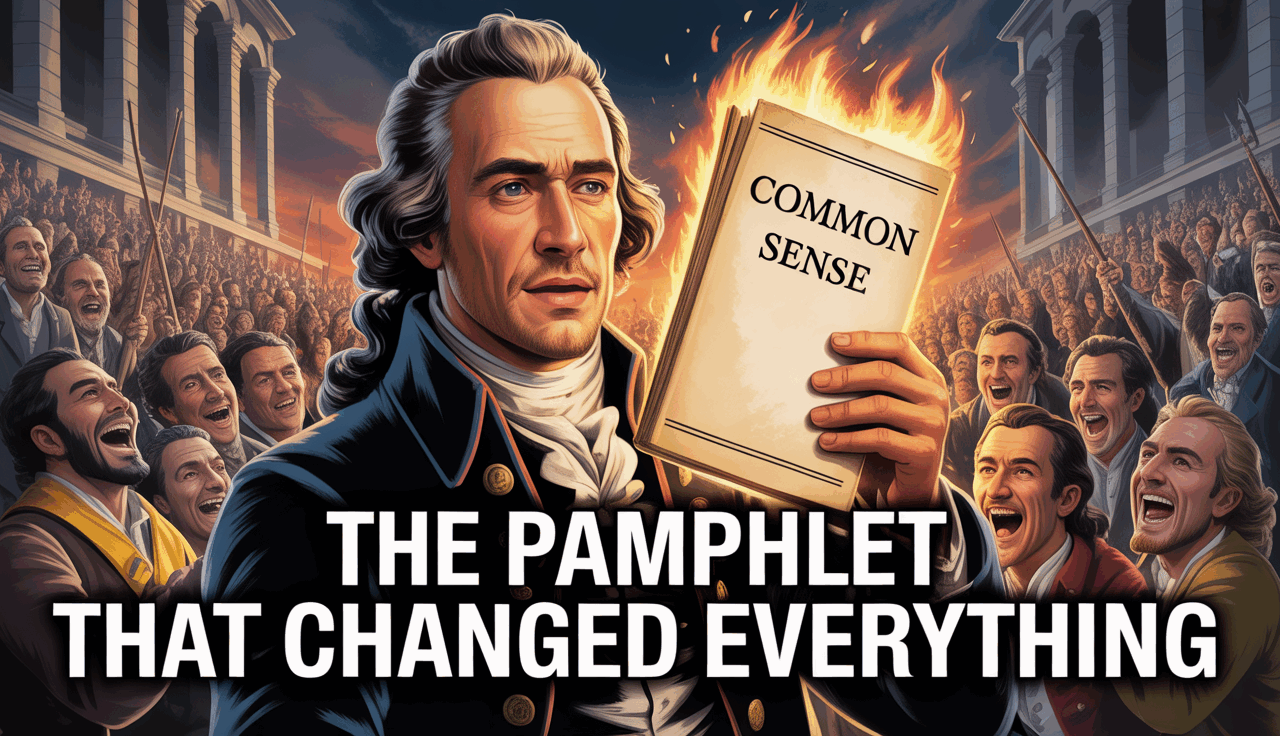
There’s a certain type of political document that doesn’t just argue for change—it manifests the psychological conditions that make change feel inevitable. Thomas Paine’s Common Sense is the template for this genre, and if you’re trying to understand how populist movements gain momentum, how institutional legitimacy crumbles, or how a pamphlet can reshape a nation’s self-concept in under 50 pages, you need to study this text like it’s a masterclass in persuasion engineering. And we’ll help you do just that in this Common Sense Book Review.
Published in January 1776, Common Sense sold an estimated 500,000 copies in a population of 2.5 million. Do the math: that’s a 20% penetration rate in an era when literacy wasn’t universal and distribution meant physical printing presses. In modern terms, Paine achieved what every content creator dreams of—he didn’t just go viral, he became the conversation.
But Paine wasn’t writing for the Continental Congress or the educated elite debating in Philadelphia drawing rooms. He was popularizing revolutionary ideas among ordinary colonists—farmers, tradesmen, shopkeepers—transforming an elite political dispute into a mass movement. This wasn’t theory; it was a manual for collective action that an entire society could rally behind.
The Structural Genius: Four Pillars, One Conclusion
Paine’s architecture is deceptively simple:
Government vs. Society – Establishes the mental model that government is inherently suspect
Monarchy is Absurd – Demolishes hereditary succession through both scripture and reason
The Case for Independence – Makes reconciliation seem more radical than revolution
America’s Material Capability – Provides the practical roadmap
He doesn’t start with independence — he starts by reframing how you think about authority itself. By the time you reach his actual policy proposal, your conceptual framework has been rebuilt from the foundation up. This is first-principles argumentation at its finest.
And the foundation he’s building? It’s the core democratic principle that the law should rule, not hereditary dynasties. Not kings, not aristocrats, not whoever was born into the right family. Paine is arguing for a system where the law governs consenting people who agree to the terms of mutual self-governance—even when they disagree on specific policies. This is the actual American political tradition, and reading Common Sense is the perfect antidote to the current disinformation campaign claiming “the US is a republic, not a democracy!” Paine clearly articulates what the public sentiment actually was at the founding: a forceful rejection of monarchy and inherited power.
Before we dive deeper into the specifics, here’s a video overview:
Mental Model: The Overton Window as Battering Ram
What Paine understood—and what every effective propagandist since has internalized—is that you don’t persuade people by meeting them where they are. You move the window of acceptable discourse so dramatically that your previously extreme position becomes the moderate compromise.
In 1776, most colonists still considered themselves British subjects seeking redress of grievances. Independence wasn’t just radical—it was treasonous. Paine’s innovation was to make continued loyalty to Britain seem like the radical position:
“As well can the lover forgive the ravisher of his mistress, as the continent forgive the murders of Britain.”
Peter Thiel FAQ: The Contradictions of Silicon Valley’s Dark Philosopher
Peter Thiel occupies a rarefied place in the modern pantheon of tech billionaires — less the tinkerer or engineer than the theorist-king of the movement. A venture capitalist, PayPal co-founder, Facebook’s first major outside investor, and the billionaire backer of numerous reactionary causes, Thiel has built a career at the intersection of money, ideology, and myth. He is the financier of futuristic dreams — and dystopian nightmares.
Born in Frankfurt and raised in California, Thiel studied philosophy at Stanford, where he was captivated by the writings of Leo Strauss and René Girard. These thinkers — one obsessed with the hidden logic of political elites, the other with the contagious nature of human desire — shaped Thiel’s enduring worldview: that civilization is locked in cycles of envy and collapse, and only an enlightened few can see beyond the herd. In this sense, Thiel has always seen himself less as a businessman and more as a philosopher of power.
His ventures, from PayPal to Palantir, form a kind of metaphysical architecture of control. PayPal, the proto-financial infrastructure of the internet, made Thiel his fortune. Palantir, as explored deeper in What Is Palantir?, has monetized the surveillance state. In between, Thiel cultivated a cadre of disciples — the so-called PayPal Mafia — that went on to dominate Silicon Valley. His investments in companies like Facebook gave him not only wealth but leverage: a front-row seat in the grand experiment of data-driven social engineering.
What is fascism, and what are the signs of fascism? The fascist form of government is a complex and multi-faceted ideology that can manifest in various ways, making it challenging to pin down with a single definition.
Fascism resists simple definition precisely because it’s a syncretic ideology—adaptable to different contexts while maintaining core structural features. Rather than a fixed doctrine, it operates as a political methodology characterized by specific power dynamics, rhetorical strategies, and institutional patterns.
Structural characteristics of fascism
These are the ideological foundations and belief systems that define fascist movements—not merely policy positions but the fundamental orientations toward power, identity, and social organization that shape how fascism understands the world and its place in it.
Authoritarian Consolidation: Fascism centralizes power through the dismantling of horizontal accountability structures, typically concentrating authority in a charismatic executive who positions themselves above institutional constraints.
Ultranationalism as Identity Politics: Goes beyond patriotism to assert inherent civilizational superiority or racial supremacy, often manifesting as collective narcissism where national mythmaking replaces historical accuracy.
Anti-Intellectualism and Epistemic Closure: Systematic devaluation of expertise, academic inquiry, and empirical reasoning in favor of intuition, emotion, and revealed truth. The “coastal elite” or “ivory tower” becomes a rhetorical enemy.
Ethno-Nationalism and Boundary Enforcement: Xenophobia operating through strict in-group/out-group categorization, often targeting immigrants, religious minorities, or racialized “others.”
Reactionary Temporal Orientation: Deployment of a mythologized past as political program—the promise to restore a golden age that never existed, weaponizing nostalgia against pluralism.
Anti-Leftist Mobilization: Positioning communism, socialism, and progressive movements as existential threats, often conflating disparate left ideologies to create a unified enemy.
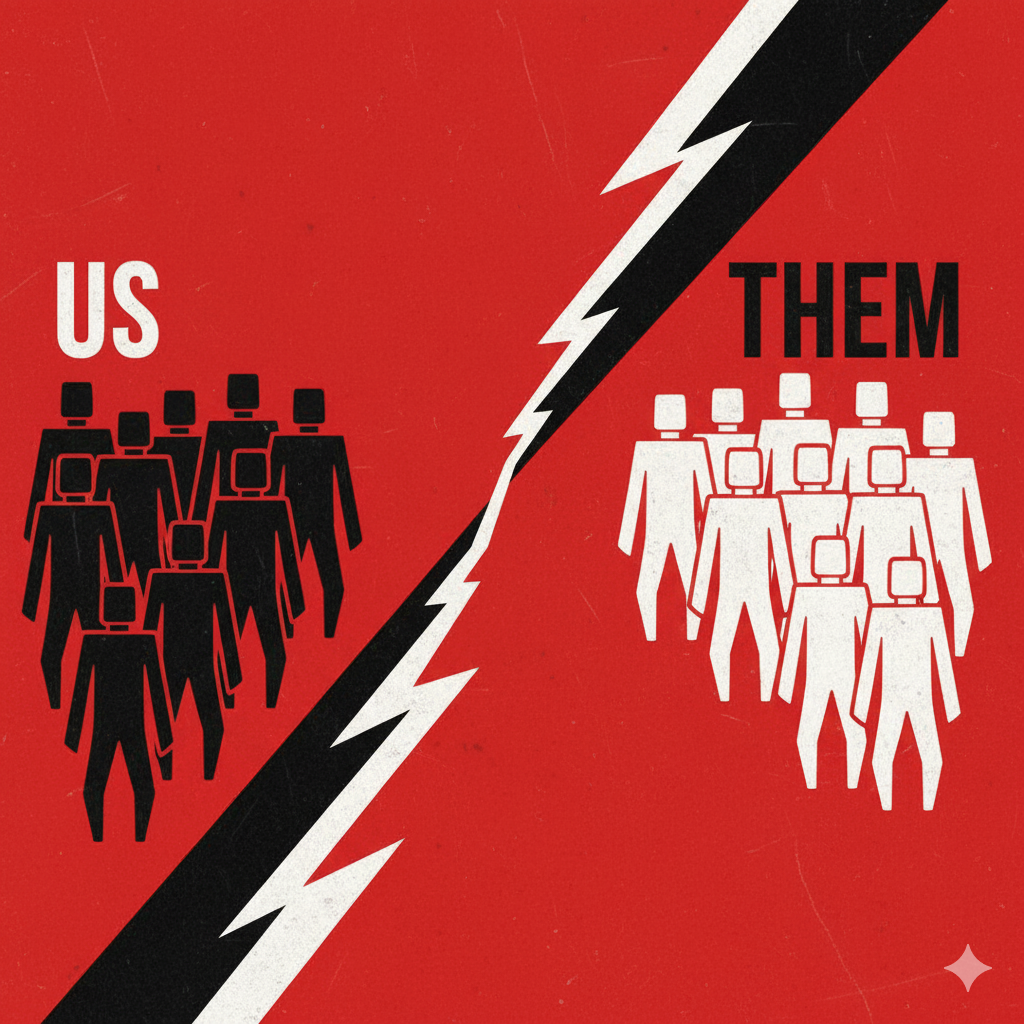
The Us vs. Them Architecture: In-group/Out-group dynamics as core infrastructure
Fascism doesn’t just exploit social divisions—it requires their constant production and intensification as its primary source of political energy. While most political movements contain some degree of group identity, fascism is structurally dependent on a stark binary between insiders and outsiders, making this dynamic its foundational operating system rather than an incidental feature. The movement coheres not around shared policy goals or governance philosophy, but around the ongoing project of boundary maintenance: defining, defending, and purifying the “us” against an ever-present “them.”
Peter Thiel has a plan to save the world, and it looks like a nightmare. He’s casting around for scapegoats, but perhaps Peter Thiel and the Antichrist are one and the same.
The PayPal co-founder, Facebook‘s first outside investor, and Silicon Valley‘s most influential political operator has spent years developing a political philosophy so strange that most people assume it can’t be serious. Democracy and freedom are incompatible, he says. Global cooperation is the Antichrist. The only hope for civilization is absolute monarchy modeled on tech startups. And he’s not just theorizing—he’s building it.
Thiel has poured millions into political campaigns, funded think tanks, mentored a generation of “New Right” intellectuals and alt-Right screeders, and cultivated politicians who share his vision. He’s amplified fringe thinkers like Curtis Yarvin (the blogger behind “Neoreaction” who openly advocates abolishing democracy), but Thiel’s worldview is uniquely his own—a bizarre synthesis of Christian eschatology, corporate governance theory, and techno-authoritarianism that’s far more sophisticated and disturbing than anything coming from the intellectual dark web.
This isn’t just eccentric billionaire philosophy. Thiel’s protégés include a sitting Vice President (J.D. Vance) and multiple Republican senators. His ideas circulate through conservative think tanks and Trump‘s inner circle. What sounds like science fiction is increasingly becoming Republican policy doctrine.
The media often portrays Thiel as an enigmatic libertarian or contrarian thinker. But that framing misses what’s actually happening. This is a systematic rejection of 250 years of democratic governance, wrapped in theological language and corporate efficiency rhetoric. And it’s weirder and more methodical than most people realize.
Peter Thiel and the Antichrist in 8 minutes (video)
This NotebookLM video does a great job explaining the background and impact of Thiel’s dangerously apocalyptic rhetoric inspired by Nazi theorist Carl Schmitt — and below it you can find a deeper explanation of all major points:
Here are the five interlocking beliefs that form Thiel’s vision—and why each one should terrify you.
1. Democracy Is the Bug, Not the Feature—Replace It With a Tech Startup Dictatorship
Thiel doesn’t just critique democracy—he’s concluded it’s fundamentally incompatible with freedom. In a 2009 essay, he wrote: “I no longer believe that freedom and democracy are compatible.” Not ideal partners; not in tension — but incompatible.
His alternative is coldly corporate: run countries like founders run startups. One CEO. One vision. Absolute authority. No consensus. No debate. No democracy.
The Founders knew acutely the pains of centuries of religious warfare in modern Europe and resoundingly did not want that for their new nation. Many of them moreover knew religious persecution intimately — some whose families fled the Church of England for fear of being imprisoned, burned at the stake, or worse. Is America a Christian nation? Although many Christians certainly have come here, in a legal and political sense the nation’s founders wanted precisely the opposite of the “Christian nation” they were breaking with by pursuing independence from the British.
Contrary to the disinformation spread by Christian nationalists today, the people who founded the United States explicitly saw religious zealotry as one of the primary dangers to a democratic republic. They feared demagoguery and the abuse of power that tilts public apparatus towards corrupt private interest. The Founders knew that religion could be a source of strife for the fledgling nation as easily as it could be a strength, and they took great pains to carefully balance the needs of religious expression and secular interests in architecting the country.
The main impetus for a large percentage of the early colonists who came to the Americas was the quest for a home where they could enjoy the free exercise of religion. The Protestant Reformation had begun in Europe about a century before the first American colonies were founded, and a number of new religious sects were straining at the bonds of the Catholic Church’s continued hegemony. Puritans, Mennonites, Quakers, Jesuits, Huguenots, Dunkers, Jews, Amish, Lutherans, Moravians, Schwenkfeldians, and more escaped the sometimes deadly persecutions of the churches of Europe to seek a place to worship God in their own chosen ways.
By the late 18th century when Thomas Jefferson wrote the Declaration of Independence, many religious flowers were blooming within the 13 colonies. He had seen for himself the pitfalls of the experiments in which a unitary control of religion by one church or sect led to conflict, injustice, and violence. Jefferson and the nation’s other founders were staunchly against the idea of establishing a theocracy in America:
The founding fathers made a conscious break from the European tradition of a national state church.
The words Bible, Christianity, Jesus, and God do not appear in our founding documents.
The handful of states who who supported “established churches” abandoned the practice by the mid-19th century.
Thomas Jefferson wrote that his Virginia Statute on Religious Freedom was written on behalf of “the Jew and the gentile, the Christian and the Mahometan, the Hindu and the infidel of every denomination.” In the text he responds negatively to VA’s harassment of Baptist preachers — one of many occasions on which he spoke out sharply against the encroachment of religion upon political power.
The Constitution explicitly forbids a religious test for holding foreign office.
The First Amendment in the Bill of Rights guarantees that “Congress shall make no law respecting the establishment of religion, or prohibiting the free exercise thereof.”
There is a right-wing conspiracy theory aiming to discredit the phrase “wall of separation between church and state” by claiming that those exact words aren’t found in the Constitution.
The phrase comes from Thomas Jefferson’s 1802 letter to the Danbury Baptists, wherein he is describing the thinking of the Founders about the meaning of the First Amendment’s Establishment Clause, which Jefferson contemplates “with sovereign reverence.”
The phrase is echoed by James Madison in an 1803 letter opposing the building of churches on government land: “The purpose of separation of Church and State is to keep forever from these shores the ceaseless strife that has soaked the soil of Europe with blood for centuries.”
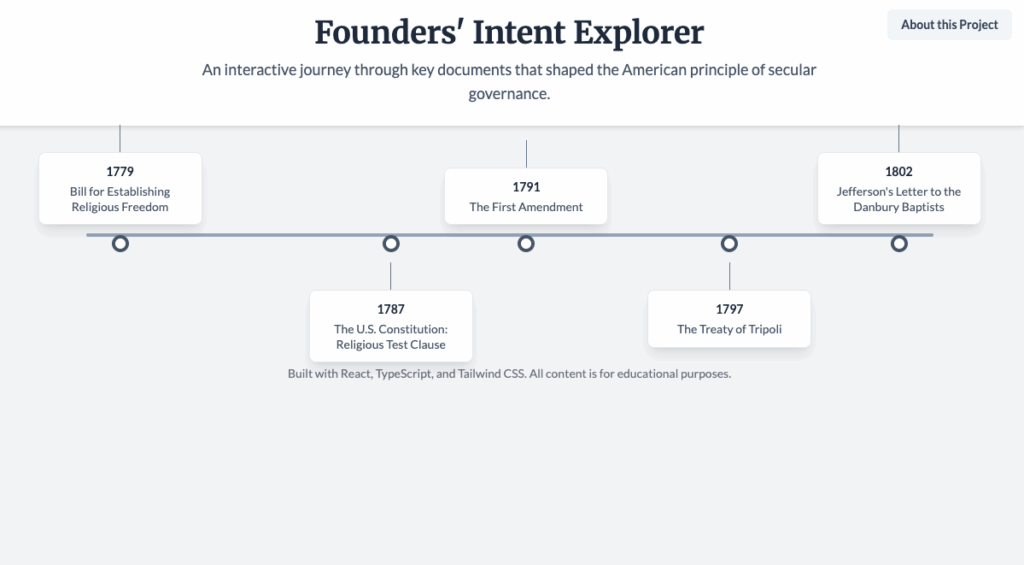
The 1796 Treaty of Tripoli states in Article 11: “As the government of the United States of America is not in any sense founded on the Christian Religion,-as it has in itself no character of enmity against the laws, religion or tranquility of Musselmen,-and as the said States never have entered into any war or act of hostility against any Mehomitan nation, it is declared by the parties that no pretext arising from religious opinions shall ever produce an interruption of the harmony existing between the two countries.” — President George Washington first ordered the negotiation of a treaty in 1795, and President John Adams sent the treaty to the Senate for ratification in 1797, with this article widely interpreted to mean a reiteration of the purpose of the Establishment Clause to create a secular state, i.e. one that would not ever be going to holy war with Tripoli.
Critical Dates for Religious Freedom in America
From the very beginning the Founders made clear they did not want to repeat the mistakes of Old Europe. They established a secular government that offered religious freedom to many who had felt persecuted in their homelands — for generations to come.
Get a quick overview of some of the most important moments in American history and its founding documents with our interactive timeline below.
The Founders were deists
Moreover, the majority of the prominent Founders were deists — they recognized the long tradition of Judeo-Christian order in society, but consciously broke from it in their creation of the legal entity of the United States, via the Establishment Clause and numerous other devices. The founders were creatures of The Enlightenment, and were very much influenced by the latest developments of their day including statistics, empiricism, numerous scientific advancements, and the pursuit of knowledge and logical decision-making.
What Deism Actually Meant: Deism in the 18th century was a rationalist religious philosophy that accepted the existence of a creator God based on reason and observation of the natural world, but rejected supernatural revelation, miracles, and divine intervention in human affairs. Think of it as “God as clockmaker” — God designed the universe with rational laws, set it in motion, and then stepped back. This was a radical departure from traditional Christianity.
Empiricism over revelation — knowledge comes from observation and reason, not scripture
Natural rights derived from human nature and reason, not divine command
Social contract theory — government legitimacy comes from consent of the governed, not God’s anointing
Scientific method — Newton’s physics showed that the universe operated by discoverable natural laws
This was a revolutionary shift. They were designing a government based on Enlightenment principles in an era when most of the world still operated under divine-right monarchy.
The European Church-State Problem They Rejected:
The Founders had vivid historical examples of why mixing religion and state power was dangerous:
The Thirty Years’ War (1618-1648) killed roughly 8 million Europeans in religious conflict
The Spanish Inquisition showed what happens when church and state merge
Various European states still had official churches that persecuted religious minorities — prompting many of them to consider a new line in the American colonies
They saw how “established” (government-sponsored) religions inevitably led to:
Paine went even further than most Founders. In “The Age of Reason” (1794), he argued:
All national churches are “human inventions set up to terrify and enslave mankind”
Revelation is meaningless — “it is revelation to the first person only, and hearsay to every other”
True religion is simply “to do justice, love mercy, and endeavor to make our fellow-creatures happy”
He predicted that as education and reason spread, traditional organized religion would wither
This was considered extremely radical — even scandalous — at the time. Yet Paine was celebrated as a hero of the Revolution and widely read. He once lamented that “Persecution is not an original feature in any religion; but it is always the strongly marked feature of all religions established by law.”
The Structural Safeguards They Built:
This wasn’t just philosophy — they built specific mechanisms:
No religious test for office (Article VI)
Establishment Clause — no official national religion
Free Exercise Clause — no prohibition of religious practice
Disestablishment at state level — states gradually abandoned their established churches (Massachusetts was last in 1833)
The framers of our Constitution who established this nation distrusted the concept of divine right of kings that existed in Europe under its historical monarchies. We fought a revolution to leave all that behind for good reason. They were adamantly against the idea of a national church, and were clear and insistent about the necessity of keeping the realms of religion and politics independent of each other.
It is the Christian nationalists who have it backwards — America was never a Christian nation that lost its way. Rather, the United States was founded as a secular nation and has become truer to fulfilling that mission over the centuries. It is the Project 2025 folks who are engaging in revisionist history, inventing a mythical past for the country that simply didn’t exist.
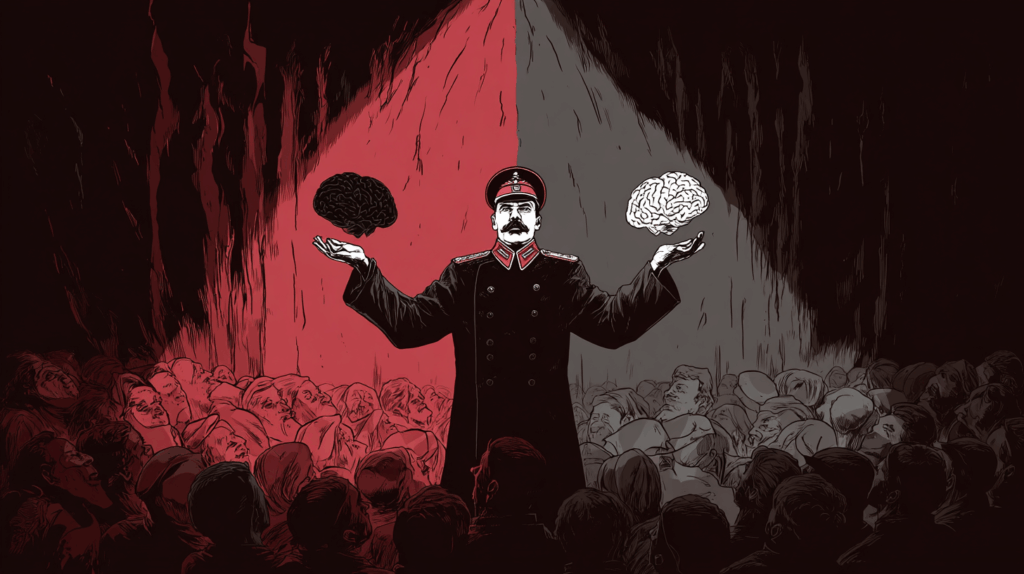
Black and white thinking is the tendency to see things in extremes, viewing the world through a very polarized lens. Even complex moral issues are seen as clearcut, with simple right and wrong answers and no gray areas in between.
Also referred to as all-or-nothing thinking or dichotomous thinking, black and white thinking is a very rigid and binary way of looking at the world. Black and white thinkers tend to categorize things, events, people, and experiences as either completely good or completely bad, without acknowledging any nuance or shades of gray. This can manifest in various aspects of their lives including relationships, decision-making, and self-evaluation. Black and white thinking can be a defense mechanism, as it provides a sense of certainty and control in situations that are complex, uncertain, or anxiety-provoking.
For example, a person who engages in black and white thinking may view their work performance as either completely successful or a complete failure, without considering any middle ground. They may view themselves as either a “good” or “bad” person, based on a single action or mistake. This type of extreme thinking can lead to feelings of extreme anxiety, depression, and self-doubt, as well as difficulties in personal and professional relationships.
Black and white thinking in political psychology
Black and white thinking can also be seen in political or social contexts, where individuals categorize people or groups as either completely good or completely bad, without acknowledging any nuances or complexities. This type of thinking can lead to polarizing beliefs, rigid ideologies, and an unwillingness to engage in constructive dialogue or compromise.
The origins of black and white thinking are complex and multifaceted, but it can stem from a variety of factors, including childhood experiences, cultural and societal influences, and psychological disorders including personality disorder. For example, individuals who have experienced trauma or abuse may engage in black and white thinking as a way to cope with the complexity and ambiguity of their experiences. Similarly, cultural or societal influences that promote a strict adherence to binary categories can also contribute to black and white thinking.
Psychological disorders such as borderline personality disorder, obsessive-compulsive disorder, and eating disorders are also associated with black and white thinking. For example, individuals with borderline personality disorder (BPD) may see themselves or others as either completely good or completely bad, without any middle ground. This type of thinking can lead to unstable relationships, impulsive behavior, and emotional dysregulation.
Narcissists too, especially malignant narcissists, tend to exhibit black and white thinking, with the frequent framing of any narrative as being primarily about themselves (good/The Hero) and everyone else (bad/The Other).
Black and White Thinking: Understanding binary cognition in the modern era
The Digital Amplification of Binary Thinking
The modern information ecosystem has created unprecedented conditions for black and white thinking to flourish. Social media algorithms, designed to maximize engagement, systematically promote content that evokes strong emotional responses—often content that presents complex issues in oversimplified, polarizing terms.
Algorithmic Reinforcement Mechanisms
Contemporary digital platforms operate on engagement metrics that inadvertently reward binary thinking:
Filter Bubble Formation: Recommendation algorithms create echo chambers where users primarily encounter information that confirms their existing beliefs
Engagement Optimization: Content that provokes outrage or strong agreement receives higher distribution (and ultimately, revenue), marginalizing nuanced perspectives
Attention Economy Dynamics: The competition for limited attention spans incentivizes simplified, emotionally charged messaging over complex analysis — going straight for the jugular of common mental heuristics works
Information Processing Under Cognitive Load
Research in cognitive psychology demonstrates that when individuals experience high cognitive load—a common state in our information-saturated environment—they default to simplified decision-making heuristics. This neurological tendency combines with digital information delivery systems to create systematic biases toward binary categorization.
Contemporary Political Manifestations
Black and white thinking has become increasingly prominent in political discourse, with profound implications for democratic institutions and social cohesion.
Legislative Dynamics: Congressional voting patterns show dramatic increases in party-line voting, with bipartisan legislation becoming increasingly rare. This reflects not just strategic positioning but fundamental shifts in how political actors conceptualize policy problems and solutions.
Media Ecosystem Fragmentation: The proliferation of ideologically aligned media sources enables individuals to construct information diets that reinforce binary worldviews. Traditional journalistic ethics of objectivity and balance in a fundamentally evidentiary role have been challenged by partisan media models that explicitly advocate for particular political perspectives.
Electoral Coalition Building: Political campaigns increasingly rely on mobilizing base supporters through appeals to fundamental differences with opponents, rather than building broad coalitions through compromise and incremental policy development.
Identity-Based Political Cognition
Modern political psychology research reveals how black and white thinking intersects with identity formation:
Social Identity Theory: Individuals derive significant psychological satisfaction from in-group membership and out-group differentiation
Motivated Reasoning: People process political information in ways that protect their group identities and existing belief systems
Moral Foundations: Different political coalitions emphasize different moral frameworks, creating seemingly irreconcilable worldview differences
Systemic Analysis: Institutional Impacts
Black and white thinking creates cascade effects across multiple institutional systems:
Democratic Governance Challenges
Compromise Mechanisms: Effective democratic governance requires negotiation and compromise between competing interests. Binary thinking undermines these processes by framing compromise as betrayal of fundamental principles.
Policy Implementation: Complex policy challenges—from healthcare to climate change to economic inequality—require nuanced, multifaceted solutions. Binary thinking promotes oversimplified policy approaches that often fail to address underlying systemic issues.
Constitutional Design: Democratic institutions assume citizens capable of evaluating competing claims and making informed choices. Black and white thinking can undermine these foundational assumptions necessary to making democracy work.
Economic System Implications
Market Dynamics: Binary thinking in economic contexts can create boom-bust cycles, as investors and consumers oscillate between extreme optimism and pessimism without recognizing gradual trends and mixed signals.
Innovation Ecosystems: Complex technological and business model innovation requires tolerance for ambiguity and iterative development. Binary thinking can stifle innovation by demanding immediate, clear success metrics. It turns out that diversity is good to the bottom line, actually.
Labor Relations: Effective workplace dynamics require ongoing negotiation between competing interests. Binary thinking can transform routine workplace disagreements into fundamental conflicts.
Mental Model Frameworks for Analysis
Understanding black and white thinking requires sophisticated analytical frameworks:
The Cognitive Bias Cascade Model
Black and white thinking rarely operates in isolation but typically forms part of broader cognitive bias patterns:
Confirmation Bias: Seeking information that confirms existing beliefs
Group Attribution Error: Assuming individual group members represent entire groups
Systems Thinking Applications
Effective analysis of black and white thinking requires systems-level perspective:
Feedback Loops: How binary thinking creates self-reinforcing cycles that become increasingly difficult to break
Emergence Properties: How individual cognitive patterns create collective social and political dynamics
Leverage Points: Identifying where interventions might most effectively disrupt binary thinking patterns
Historical Pattern Recognition
Historical analysis reveals recurring patterns in how societies navigate between binary and nuanced thinking:
Crisis Periods: Times of social stress typically increase binary thinking as individuals seek certainty and clear action frameworks
Institutional Adaptation: How democratic institutions evolve mechanisms to manage polarization and maintain governance capacity
Cultural Evolution: How societies develop norms and practices that promote or discourage binary thinking
Contemporary Case Studies
Social Media Discourse Patterns
Analysis of millions of social media posts reveals systematic patterns in how binary thinking spreads:
Viral Content Characteristics: Posts that go viral disproportionately feature binary framing of complex issues
Engagement Metrics: Binary content generates higher levels of shares, comments, and emotional reactions
Network Effects: Binary thinking spreads through social networks more rapidly than nuanced analysis
Political Movement Dynamics
Examination of contemporary political movements reveals how binary thinking shapes organizational development:
Movement Mobilization: Binary framing helps movements build initial coalition support by clarifying friend-enemy distinctions
Strategic Communication: Binary messaging dominates political advertising and fundraising appeals
Coalition Maintenance: Binary thinking can help maintain group cohesion but may limit strategic flexibility
Crisis Response Patterns
Analysis of responses to major crises—from pandemics to economic disruptions to international conflicts—demonstrates how binary thinking affects collective decision-making:
Policy Development: Crisis conditions often promote binary policy choices that may not address underlying complexity
Public Communication: Crisis communication frequently relies on binary framing to motivate public compliance with policy measures
International Relations: Crisis situations can push diplomatic relations toward binary alliance structures
Neurological and Psychological Foundations
Understanding black and white thinking requires examining its neurological and psychological foundations:
Cognitive Processing Systems
System 1 vs System 2 Thinking: Daniel Kahneman’s research demonstrates how automatic, intuitive thinking (System 1) tends toward binary categorization, while deliberative thinking (System 2) enables more nuanced analysis.
Threat Detection Mechanisms: Evolutionary psychology suggests that binary thinking may have adaptive advantages in environments requiring quick threat assessment, but becomes maladaptive in complex modern contexts.
Cognitive Load Theory: When individuals experience high cognitive load, they default to simplified decision-making processes that favor binary categorization.
Identity Formation: Erik Erikson’s work on identity development demonstrates how binary thinking can serve important functions during identity formation periods but may become problematic if it persists into adulthood.
Attachment Theory: Insecure attachment patterns can promote binary thinking about relationships and social situations as defensive mechanisms.
Organizational and Institutional Responses
Educational System Adaptations
Educational institutions increasingly recognize the need to develop students’ capacity for nuanced thinking:
Critical Thinking Curricula: Programs specifically designed to help students recognize and resist binary thinking patterns
Media Literacy: Training students to recognize how information systems promote simplified thinking
Interdisciplinary Approaches: Educational approaches that demonstrate how complex problems require multiple perspectives and methodological approaches
Democratic Institution Reforms
Various proposals aim to reduce the institutional incentives for binary thinking:
Electoral System Design: Ranked-choice voting and other electoral innovations that reward coalition-building over polarization
Deliberative Democracy: Institutional mechanisms that bring citizens together for structured discussion of complex policy issues
Legislative Process Reform: Procedural changes that incentivize negotiation and compromise over partisan positioning
Technology Platform Governance
Growing recognition of how digital platforms shape thinking patterns has led to various reform proposals:
Algorithm Transparency: Requiring platforms to disclose how their algorithms prioritize content
Digital Literacy: Public education initiatives to help users recognize and resist algorithmic manipulation
Constructive Frameworks for Addressing Binary Thinking
Individual-Level Interventions
Mindfulness Practices: Regular mindfulness meditation has been shown to increase tolerance for ambiguity and reduce automatic binary categorization.
Cognitive Behavioral Techniques: Specific therapeutic approaches for identifying and challenging binary thought patterns.
Exposure to Complexity: Deliberately seeking out information sources and experiences that present complex, nuanced perspectives on important issues.
Perspective-Taking Exercises: Structured practices for understanding how situations appear from multiple viewpoints.
Community-Level Initiatives
Dialogue and Deliberation Programs: Community-based initiatives that bring together people with different perspectives for structured conversation about local issues.
Collaborative Problem-Solving: Community projects that require cooperation across different groups and perspectives.
Civic Education: Educational programs that help citizens understand how democratic institutions work and why compromise is essential for effective governance.
Cross-Cutting Social Connections: Initiatives that help people form relationships across traditional dividing lines.
Institutional Design Principles
Procedural Safeguards: Institutional mechanisms that slow down decision-making processes to allow for more deliberative consideration of complex issues.
Stakeholder Inclusion: Decision-making processes that systematically include multiple perspectives and interests.
Transparency and Accountability: Mechanisms that make decision-making processes visible and subject to public scrutiny.
Adaptive Management: Institutional frameworks that allow for policy adjustment based on evidence and changing circumstances.
Implications for Democratic Resilience
The prevalence of black and white thinking poses significant challenges for democratic governance:
Representation and Legitimacy
Electoral Representation: Binary thinking can undermine representative democracy by making it difficult for elected officials to represent diverse constituencies with complex, sometimes conflicting interests.
Institutional Legitimacy: When citizens view political institutions through binary lenses, it becomes difficult to maintain the shared commitment to democratic norms necessary for effective governance.
Minority Rights: Binary thinking can threaten minority rights by reducing complex questions of individual liberty and collective welfare to simple majority-minority power dynamics.
Policy Development and Implementation
Evidence-Based Policy: Effective policy development requires careful consideration of evidence, trade-offs, and unintended consequences—all of which are undermined by binary thinking.
Policy Adaptation: Democratic institutions must be able to adapt policies based on new evidence and changing circumstances, which requires tolerance for complexity and ambiguity.
Cross-Sector Coordination: Modern policy challenges often require coordination across different levels of government and between public and private sectors, which is complicated by binary thinking.
Future Research Directions
Understanding and addressing black and white thinking requires ongoing research across multiple disciplines:
Technology and Cognition
AI and Decision-Making: How artificial intelligence systems might be designed to promote nuanced rather than binary thinking.
Digital Environment Design: Research on how different digital interface designs affect cognitive processing and decision-making.
Virtual Reality and Perspective-Taking: How immersive technologies might be used to help individuals understand complex situations from multiple perspectives.
Political Psychology and Behavior
Motivation and Binary Thinking: Research on what motivates individuals to adopt or resist binary thinking patterns in political contexts.
Group Dynamics: How binary thinking spreads through social networks and political organizations.
Leadership and Framing: How political leaders can effectively communicate about complex issues without resorting to binary framing.
Institutional Design and Reform
Comparative Democratic Systems: Analysis of how different democratic institutions manage polarization and promote constructive political discourse.
Experimental Governance: Small-scale experiments with different institutional designs that might reduce incentives for binary thinking.
Technology Governance: Research on how to regulate digital platforms in ways that promote constructive rather than polarizing discourse.
Toward cognitive complexity
Black and white thinking represents a fundamental challenge to effective individual decision-making, social cooperation, and democratic governance. While binary thinking may have served adaptive functions in simpler environments, the complexity of modern challenges requires more sophisticated cognitive frameworks.
Addressing this challenge requires coordinated efforts across multiple levels—from individual practices that promote cognitive flexibility to institutional reforms that reduce incentives for polarization. The stakes are particularly high for democratic societies, which depend on citizens’ capacity to engage constructively with complexity and difference.
The path forward requires neither naive optimism nor cynical resignation, but rather sustained commitment to developing our collective capacity for nuanced thinking about complex problems. This involves both protecting democratic institutions from the corrosive effects of extreme polarization and actively building new capabilities for constructive engagement across difference — knowing that some will disagree and continuously fight us on reforms.
Understanding black and white thinking is not merely an academic exercise but an urgent practical necessity for navigating the challenges of the 21st century. By developing more sophisticated analytical frameworks and practical interventions, we can work toward societies that are both more thoughtful and more effective at solving complex collective problems.
Related concepts and further reading
Cognitive Bias Research: Systematic exploration of how human thinking systematically deviates from logical reasoning
Political Psychology: Interdisciplinary field examining how psychological processes affect political behavior
Systems Thinking: Analytical approaches that focus on relationships and patterns rather than isolated events
Democratic Theory: Normative and empirical research on how democratic institutions work and how they might be improved
Media Ecology: Study of how communication technologies shape human consciousness and social organization
Conflict Resolution: Practical approaches for managing disagreement and building cooperation across difference
I was fortunate to be one of the first professional tech bloggers — and I still work in digital media and avidly keep up with the technology sector today. Back in the proverbial day I covered the rise of social media from the launches and earliest days of Facebook (aka Meta), Twitter (aka X), YouTube, and a host of graveyard denizens from Friendster to MySpace (anyone remember tribe.net?!). I lived and worked in Silicon Valley for a time and became disillusioned with much of the ideology while remaining avidly interested in the pockets, tendrils, and spinoffs still driven by the idea of democratizing access to information.
Now I love tinkering with tools (especially AI, automation, and data analysis) as well as writing personal and experimental stuff on my blog(s). I’m also excited about the rise of decentralized social media projects like Bluesky, Mastodon, and other platforms meant to challenge surveillance capitalism and corporate dominance of the public square.
I’ve also been a political activist since my college years, and especially since 2015 have been pretty intensely into politics with renewed vigor. This has led to an ongoing protracted “re-factoring” of what I thought I knew about American history.
An academic by temperament, I research various topics at depth as a “serious amateur.” For the past 9+ years I’ve been studying fascism, authoritarianism, narcissism, cults, disinformation, conspiracy theories, dark money, and Christian nationalism and their tributaries — many of which share intersection points. My love of information management keeps me juggling multiple projects and exploring the connections between topics worth taking a closer look at; I’m an incorrigible generalist in a specialists’ world, while craving meaningful depth into each subject.
Inspiration
I am motivated by some of the old school values of the internet — towards openness, democratization of information, shining light into dark spaces, giving a voice to the people beyond the gatekeepers of major media, and more. It’s lost a fair amount of that spirit now in the corporate scrum to own its vast landscapes, but it can still be found here and there — and I hope to offer another little output on the stormy seas for those who wander and wish to not feel lost.
I like to experiment and make new things as constantly as I can, which right now involves a lot of AI tools, including Claude, ChatGPT, Midjourney, Perplexity, Google Gemini, NotebookLM, Leonardo.ai, Opus Clip, Descript, Replicate, Flux, Ideogram, RunwayML, Sora, minimax, Napkin AI, Suno V4, and others. It feels like the most exciting thing since the dawning of the internet age itself — a Cambrian explosion of opportunity in creativity and business.
Ethics
I don’t take any sponsorship money for this site, because I’m not interested in tailoring my point of view towards whatever maximizes profit. Commerce content is my day job, so I do monetize (for a pittance) through affiliate links to books — which are the kind of product I can get behind recommending strongly to people. It also helps me understand what my audience is most interested in, and allows me to track what people find compelling enough to take action on. If you click on my book links and end up ordering something from Amazon or bookshop, it helps me understand how better to interest and serve this audience. So please feel free to do so, but not obligated.
Kamala Harris should be proud of the race she ran, an almost flawless sprint through the tape at a scant 108 days’ worth of time to make her pitch to the American voters — many of whom complained that they did not know her very well as a candidate.
Disinformation continued relentlessly throughout the race — even doubling down when called out.
Not a Mandate
Trump’s lead keeps dropping as California and other western states finish counting their ballots after what seems like an eternity — mostly due to CA accepting ballots postmarked by election day, adding 7 days to the final count no matter what.
He dropped below 50% and never recovered — meaning that more people voted against him than voted for him.
As of the final count, his margin dropped below 1.5% — the 4th largest margin in any popular vote win in the past 100 years.
Vote Predictors
Education
Media Sources
Urban vs. Rural
I haven’t had the energy to give to this piece and I just learned about this feature of Google’s NotebookLM that can generate a podcast between 2 hosts, from your uploaded assets. I tested it out with a combined corpus of some of my own thoughts and some of the resources I found insightful.
What NotebookLM came up with was uncannily compelling. It would be something I would consider useful, particularly as a tool for initiating some of those folks less steeped in politics as I am. So I’m posting it here, in part as a signpost regarding where we’re heading — whether we like it or not.
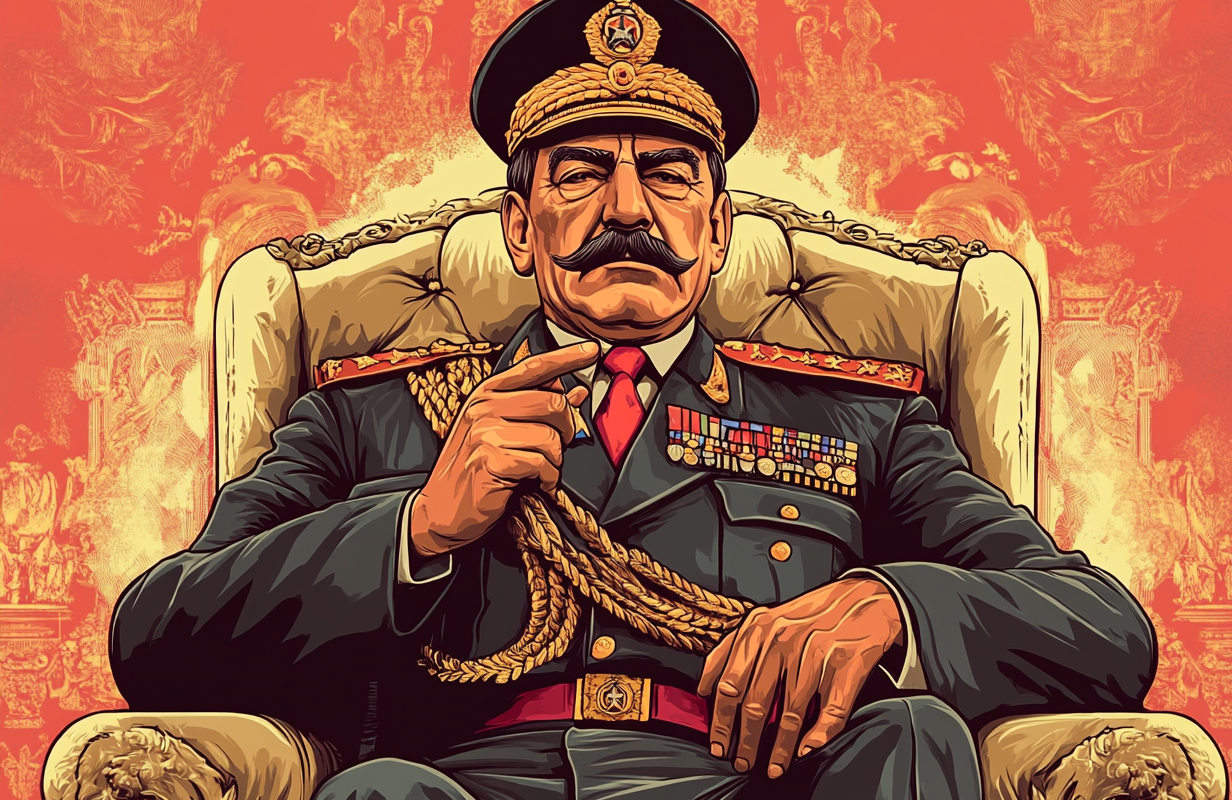
What is a dictator, and what drives the allure of absolute power? How do dictators reshape the political and social landscapes they dominate? This post explores the intricate systems of control underpinning authoritarian governance, tracing its evolution from historical precedents to modern manifestations, and examining the far-reaching consequences for societies caught in its grip.
Dictators: Unraveling the Complexity of Authoritarian Governance
Political power represents a profound and intricate spectrum of human organizational capability, with dictatorships emerging as one of its most complex and destructive manifestations. The journey of understanding dictatorships requires a nuanced exploration that transcends simple categorizations, delving deep into the historical, sociological, and psychological landscapes that enable and sustain authoritarian control.
The Essence of Dictatorial Power
At its core, a dictator represents far more than a mere political leader. These individuals — often demagogues — are architects of comprehensive systems of control, systematically dismantling institutional safeguards and reconstructing societal frameworks to serve their singular vision of governance. Unlike democratically elected leaders constrained by robust institutional checks and balances, a dictatorship operates through a sophisticated network of power consolidation that penetrates every aspect of social and political life.
The hallmark of dictatorial governance lies not just in the concentration of power, but in the systematic elimination of alternative power structures. These leaders do not simply rule; they fundamentally reshape the entire landscape of political possibility, creating environments where opposition becomes not just difficult, but potentially life-threatening.
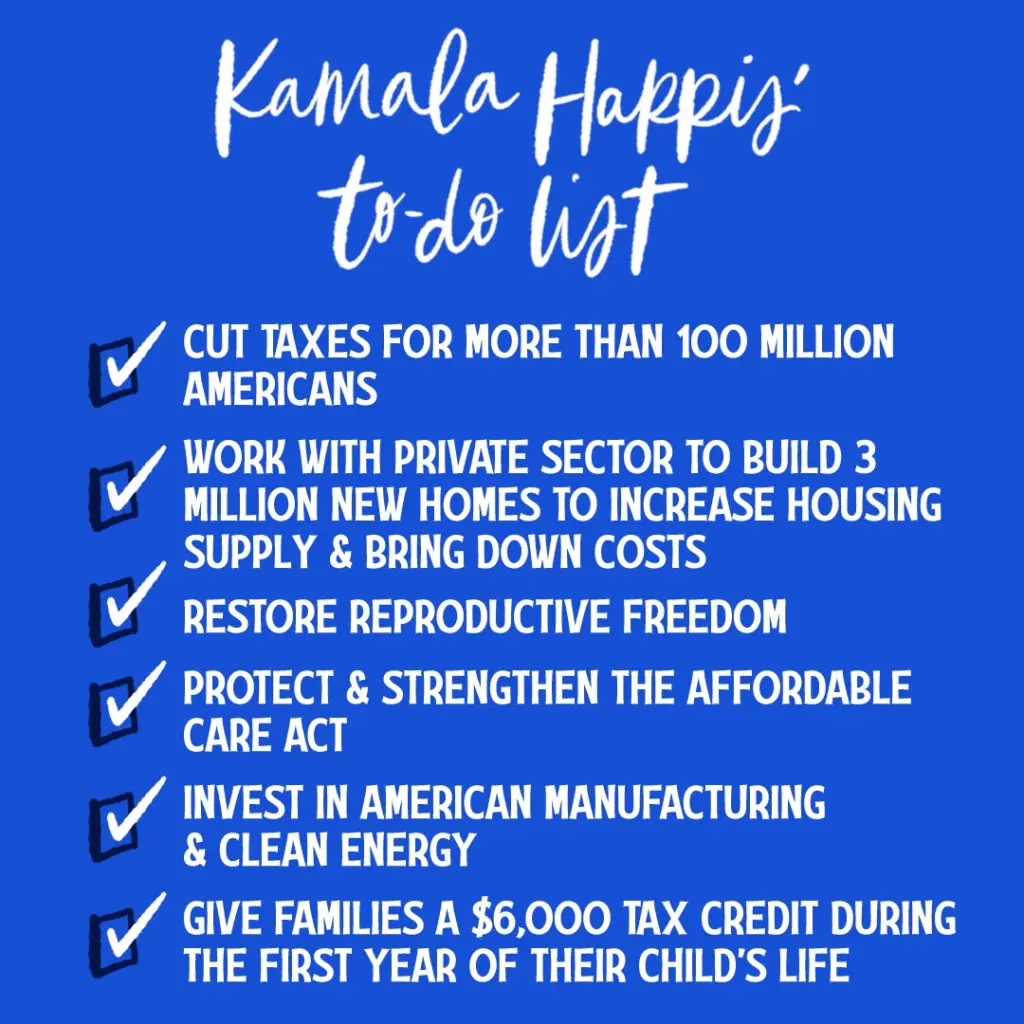
As the 2024 election season heats up, Kamala Harris’s policy platform has begun to shape a forward-thinking blueprint for what she calls an “Opportunity Economy” and a “New Way Forward.” With an approach that blends economic pragmatism and social investment, her policy outline aims to strengthen the middle class while addressing the core issues faced by millions of Americans today. Kamala Harris policies zero in on economic stability, healthcare affordability, and supporting American families through accessible resources, tax cuts, and an intentional focus on civil and reproductive rights.
Though some complain about not knowing what her policies are, she speaks of them in every speech, interview, or discussion and has them freely available on her website. Mainstream media in particular ought to be doing more of their own research vs. entertaining spurious claims that she has outlined no 2024 policy proposals. It’s also a quintessential example of the way women are forced to thread a needle in a way that men simply aren’t — I’m old enough to remember when Hillary Clinton was once famously derided for being too wonky and having too many policy proposals. You really can’t win.
Meanwhile, Harris has a robust economic plan for the middle class as well as fighting staunchly for civil rights, voting rights, reproductive freedom, and democracy in an increasingly multipolar world. Harris’s economic policy combines key strategies designed to lower costs for middle-class families—fighting inflation, tackling price gouging, and expanding Medicare to help the “Sandwich Generation” juggling care for both children and aging parents.
Her policies also encourage entrepreneurship through substantial tax deductions for small businesses and foster a fairer housing market by promoting affordable housing initiatives and cracking down on price fixing. Harris’s vision is one of a sustainable, inclusive future where both family support and economic growth converge to drive lasting change.
Beyond economic reform, her platform emphasizes national security, comprehensive immigration reform, civil rights protections, and an ambitious climate policy. Together, these components create a multifaceted approach intended to protect American values while boosting prosperity. Harris’s policy platform offers voters an actionable vision for a stronger, more equitable America built on accessible opportunities and resilient middle-class foundations.
Kamala Harris economic policy
Kamala Harris has been promoting her economic policy agenda since mid-August — which was a mere 2 weeks since becoming the new top of the ticket suddenly and unexpectedly when Joe Biden decided to withdraw from and race and pass the torch. Her “New Way Forward” for the economy is rooted in a central goal of strengthening the middle class through practical, targeted policies. Aiming to create an “Opportunity Economy,” her platform emphasizes lowering costs for families, capping drug prices, tackling price gouging, and expanding Medicare to better support those juggling elder and child care responsibilities (aka “the Sandwich Generation”).