
defense

doctor paradox right wing wiki knowledge base

Here’s something that has bothered me for nine years: almost everything you need to know about who runs American politics is public.

The FEC filings. The court rulings. The Federal Register. The board seats, the donor networks, the speeches they gave out loud, on camera, to rooms full of people who clapped.

And yet.

Almost nobody can see it. That’s not because it’s hidden. It’s because it’s scattered across thousands of filings, press releases and paywalled archives, and nobody has time to trace Leonard Leo to the Federalist Society, then to a 6–3 Supreme Court, then to the rulings that changed your rights. The information is free. Connecting it costs time, and time is what oligarchy counts on you not having.

So I connected it.

Today I’m opening the Doctor Paradox Wiki: Civics vs. Oligarchy. It’s more than 10,000 linked pages mapping the people, money, ideas and institutions of the modern American right. Every page links to the people, organizations and ideas around it, so following the links is the fastest way to see how the pieces fit.

What’s inside

  • The money. Dark money networks, donor-advised funds, the Koch Network, Citizens United, and a running tracker of what officials say about federal spending compared with what the contracts and filings show.
  • The Tech Right. How Silicon Valley money and ideas moved to the center of right-wing power. It runs from Peter Thiel and Palantir to Curtis Yarvin and the defense-tech pipeline. Start at The Tech Right Hub.
  • The 2026 midterms. With less than three weeks until November 3, the 2026 Midterms Hub covers every Senate and governor’s race, the most competitive House seats, ballot measures, and how the election is actually run and counted.
  • The plumbing. Timelines, court rulings, terminology, and step-by-step maps of things most people never see, such as how a voter gets removed from the rolls between elections.

Where to start

If you have fifteen minutes, go to Start Here. Five pages tell the whole story in order: the plan, who pays for it, the new money, the story that mobilizes the base, and what’s at stake in November. If you have an hour, pick one of six reading tracks.

If you’re coming back, What’s New is refreshed daily. In the past week alone the wiki added 172 new pages and made 121 major updates.

How it’s built

I came up in the Friendster era, back when we really believed the open web would put information in everyone’s hands. Silicon Valley lost that plot. I didn’t.

I built this with heavy AI assistance for research, drafting and cross-linking, plus a separate fact-checking pass. The rules are simple. Claims carry sources. Where sources conflict or a number can’t be confirmed yet, the page says so in a warning box instead of quietly picking a side. Fast-moving pages say when their figures were last checked. Short pages are placeholders, there so a name can be linked, and they fill in over time.

It’s free and has no sponsors. It grows every day.

Its older sibling, Foundations, is still home to the dictionaries and timelines. The two sites are meant to be read together.

None of this was ever secret. Keeping it scattered was the trick.
Go connect the dots.

Read more

Grace Brewster Murray Hopper was a pioneering computer scientist and United States Navy rear admiral who made significant contributions to the field of computer programming and technology. Born on December 9, 1906, in New York City, Hopper’s life was marked by remarkable achievements and innovations that continue to shape the computing world today[1][2]. Who is Grace Hopper as we know her?

Early Life and Education

Hopper demonstrated an early aptitude for mathematics and science. She pursued her passion for these subjects at Vassar College, where she earned a bachelor’s degree in mathematics and physics in 1928[1]. Continuing her academic journey, Hopper went on to obtain both a master’s degree (1930) and a Ph.D. in mathematics (1934) from Yale University[1][2].

Career and Contributions

Naval Service and Early Computing

In 1943, during World War II, Hopper joined the United States Navy Reserve[1]. This decision led her to work on the Harvard Mark I computer, one of the earliest electromechanical computers[1]. Her experience with the Mark I sparked a lifelong passion for computing and programming.

Pioneering Programming Languages

After the war, Hopper remained involved in computer research and development. In 1949, she joined the Eckert-Mauchly Computer Corporation, where she made some of her most significant contributions[1][2]:

  • Developed one of the world’s first compilers, which translated human-readable code into machine language[2].
  • Played a crucial role in the development of COBOL (Common Business-Oriented Language), one of the first high-level programming languages[1][2].
  • Promoted the idea of machine-independent programming languages, making programming more accessible to a broader audience[2].
Continue reading Who is Grace Hopper?
Read more

The concept of a “honeypot” in the realms of cybersecurity and information warfare is a fascinating and complex one, straddling the line between deception and defense. At its core, a honeypot is a security mechanism designed to mimic systems, data, or resources to attract and detect unauthorized users or attackers, essentially acting as digital bait. By engaging attackers, honeypots serve multiple purposes: they can distract adversaries from more valuable targets, gather intelligence on attack methods, and help in enhancing security measures.

Origins and Usage

The use of honeypots dates back to the early days of computer networks, evolving significantly with the internet‘s expansion. Initially, they were simple traps set to detect anyone probing a network. However, as cyber threats grew more sophisticated, so did honeypots, transforming into complex systems designed to emulate entire networks, applications, or databases to lure in cybercriminals.

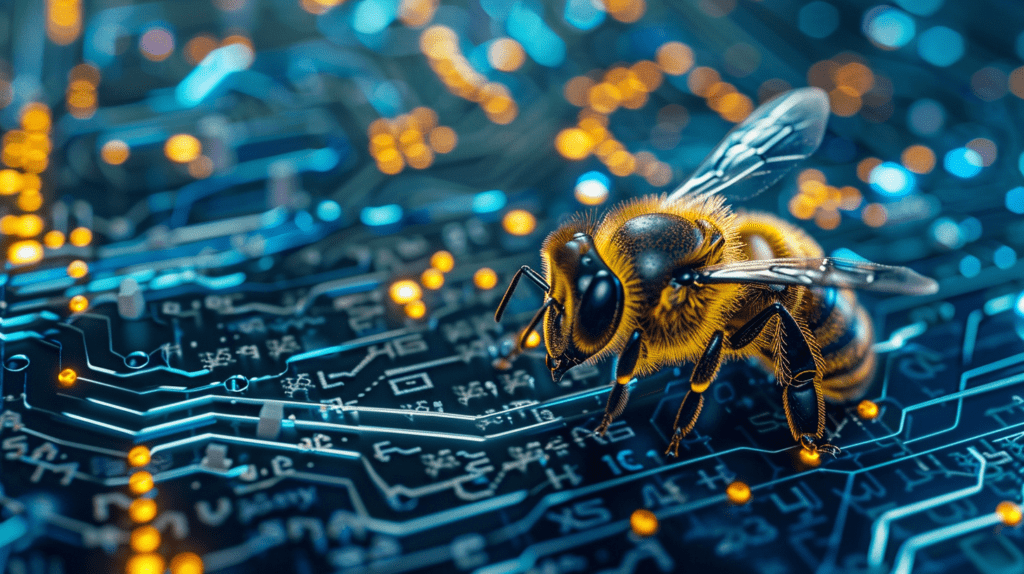
A honeypot illustration with a circuit board beset by a bee, by Midjourney

Honeypots are used by a variety of entities, including corporate IT departments, cybersecurity firms, government agencies, and even individuals passionate about cybersecurity. Their versatility means they can be deployed in almost any context where digital security is a concern, from protecting corporate data to safeguarding national security.

Types and purposes

There are several types of honeypots, ranging from low-interaction honeypots, which simulate only the services and applications attackers might find interesting, to high-interaction honeypots, which are complex and fully-functional systems designed to engage attackers more deeply. The type chosen depends on the specific goals of the deployment, whether it’s to gather intelligence, study attack patterns, or improve defensive strategies.

In the context of information warfare, honeypots serve as a tool for deception and intelligence gathering. They can be used to mislead adversaries about the capabilities or intentions of a state or organization, capture malware samples, and even identify vulnerabilities in the attacker’s strategies. By analyzing the interactions attackers have with these traps, defenders can gain insights into their techniques, tools, and procedures (TTPs), enabling them to better anticipate and mitigate future threats.

Historical effects

Historically, honeypots have had significant impacts on both cybersecurity and information warfare. They’ve led to the discovery of new malware strains, helped dismantle botnets, and provided critical intelligence about state-sponsored cyber operations. For example, honeypots have been instrumental in tracking the activities of sophisticated hacking groups, leading to a deeper understanding of their targets and methods, which, in turn, has informed national security strategies and cybersecurity policies.

One notable example is the GhostNet investigation, which uncovered a significant cyber espionage network targeting diplomatic and governmental institutions worldwide. Honeypots played a key role in identifying the malware and command-and-control servers used in these attacks, highlighting the effectiveness of these tools in uncovering covert operations.

Honeypot hackers and cybercriminals

Ethical and practical considerations

While the benefits of honeypots are clear, their deployment is not without ethical and practical considerations. There’s a fine line between deception for defense and entrapment, raising questions about the legality and morality of certain honeypot operations, especially in international contexts where laws and norms may vary widely.

Moreover, the effectiveness of a honeypot depends on its believability and the skill with which it’s deployed and monitored. Poorly configured honeypots might not only fail to attract attackers but could also become liabilities, offering real vulnerabilities to be exploited.

Cyber attackers and defenders

Honeypots are a critical component of the cybersecurity and information warfare landscapes, providing valuable insights into attacker behaviors and tactics. They reflect the ongoing cat-and-mouse game between cyber attackers and defenders, evolving in response to the increasing sophistication of threats. As digital technologies continue to permeate all aspects of life, the strategic deployment of honeypots will remain a vital tactic in the arsenal of those looking to protect digital assets and information. Their historical impacts demonstrate their value, and ongoing advancements in technology promise even greater potential in understanding and combating cyber threats.

By serving as a mirror to the tactics and techniques of adversaries, honeypots help illuminate the shadowy world of cyber warfare, making them indispensable tools for anyone committed to safeguarding information in an increasingly interconnected world.

Read more