Beliefs

Evangelicals in church raising their hands high for Christian nationalism

Updated November 2026: This timeline now runs through the 2026 midterms, with new entries from 1791 to 2026, corrections to several older ones, and an illustrated tour of eight key moments.

Christian nationalism is the belief that America was founded as a Christian nation and ought to be governed as one. It sells itself as a restoration, a return to what the founders intended.

Here’s the paradox. To get there, the movement has had to spend two centuries working around what the founders actually wrote. The Constitution establishes no church and bans religious tests for office. In 1797 the Senate unanimously ratified a treaty declaring that the government is “not, in any sense, founded on the Christian religion.” And the phrases we’re told are ancient heritage are younger than your parents: “under God” entered the Pledge in 1954, and “In God We Trust” became the national motto in 1956.

Continue reading Christian Nationalism Timeline
Read more

Elon Musk as a clown

Updated November 2026. When I first wrote this in January 2025, Effective Altruism and longtermism looked like one ideology with two names, and the tech billionaires looked like its congregation. Twenty-two months later, the congregation has split, and the split tells us more than the original sermon did. The original argument stands; new sections are marked, and corrections are noted at the bottom.

Effective Altruism and Longtermism are twin philosophical movements, born at Oxford in the late 2000s, that make a seductive claim. If you want to do good, do the most good — and when you run the math, the most good lies in the far future: hundreds, thousands, millions of years from now. Future people will outnumber us so overwhelmingly that, by comparison, our current-day lives start to look like a rounding error.

EA was co-founded by Oxford philosophers Toby Ord and William MacAskill, with Peter Singer’s utilitarianism as its intellectual godfather. Longtermism is the turn MacAskill and Nick Bostrom’s Oxford circle gave it: the argument that shaping the long-run future, above all getting artificial intelligence “right,” outweighs every other moral priority.

It drew powerful admirers among the Silicon Valley elite. Elon Musk called MacAskill’s What We Owe the Future “a close match to my philosophy.” Crypto trader Sam Bankman-Fried became its biggest bankroller. Ethereum founder (and Thiel fellow) Vitalik Buterin gave hundreds of millions to AI-safety work. Asana co-founder Dustin Moskovitz became the movement’s largest funder. Peter Thiel was an early funder of the scene and spoke at the first EA summit in 2013, and OpenAI, the lab Sam Altman now runs, took a $30 million grant from EA’s biggest foundation in 2017. As you’ll see below, those last two have since had a very public falling-out with the movement.

Continue reading Effective Altruism and Longtermism: Twin ideologies driving tech billionaires
Read more

doctor paradox right wing wiki knowledge base

Here’s something that has bothered me for nine years: almost everything you need to know about who runs American politics is public.

The FEC filings. The court rulings. The Federal Register. The board seats, the donor networks, the speeches they gave out loud, on camera, to rooms full of people who clapped.

And yet.

Almost nobody can see it. That’s not because it’s hidden. It’s because it’s scattered across thousands of filings, press releases and paywalled archives, and nobody has time to trace Leonard Leo to the Federalist Society, then to a 6–3 Supreme Court, then to the rulings that changed your rights. The information is free. Connecting it costs time, and time is what oligarchy counts on you not having.

So I connected it.

Today I’m opening the Doctor Paradox Wiki: Civics vs. Oligarchy. It’s more than 10,000 linked pages mapping the people, money, ideas and institutions of the modern American right. Every page links to the people, organizations and ideas around it, so following the links is the fastest way to see how the pieces fit.

What’s inside

  • The money. Dark money networks, donor-advised funds, the Koch Network, Citizens United, and a running tracker of what officials say about federal spending compared with what the contracts and filings show.
  • The Tech Right. How Silicon Valley money and ideas moved to the center of right-wing power. It runs from Peter Thiel and Palantir to Curtis Yarvin and the defense-tech pipeline. Start at The Tech Right Hub.
  • The 2026 midterms. With less than three weeks until November 3, the 2026 Midterms Hub covers every Senate and governor’s race, the most competitive House seats, ballot measures, and how the election is actually run and counted.
  • The plumbing. Timelines, court rulings, terminology, and step-by-step maps of things most people never see, such as how a voter gets removed from the rolls between elections.

Where to start

If you have fifteen minutes, go to Start Here. Five pages tell the whole story in order: the plan, who pays for it, the new money, the story that mobilizes the base, and what’s at stake in November. If you have an hour, pick one of six reading tracks.

If you’re coming back, What’s New is refreshed daily. In the past week alone the wiki added 172 new pages and made 121 major updates.

How it’s built

I came up in the Friendster era, back when we really believed the open web would put information in everyone’s hands. Silicon Valley lost that plot. I didn’t.

I built this with heavy AI assistance for research, drafting and cross-linking, plus a separate fact-checking pass. The rules are simple. Claims carry sources. Where sources conflict or a number can’t be confirmed yet, the page says so in a warning box instead of quietly picking a side. Fast-moving pages say when their figures were last checked. Short pages are placeholders, there so a name can be linked, and they fill in over time.

It’s free and has no sponsors. It grows every day.

Its older sibling, Foundations, is still home to the dictionaries and timelines. The two sites are meant to be read together.

None of this was ever secret. Keeping it scattered was the trick.

Go connect the dots.

Read more

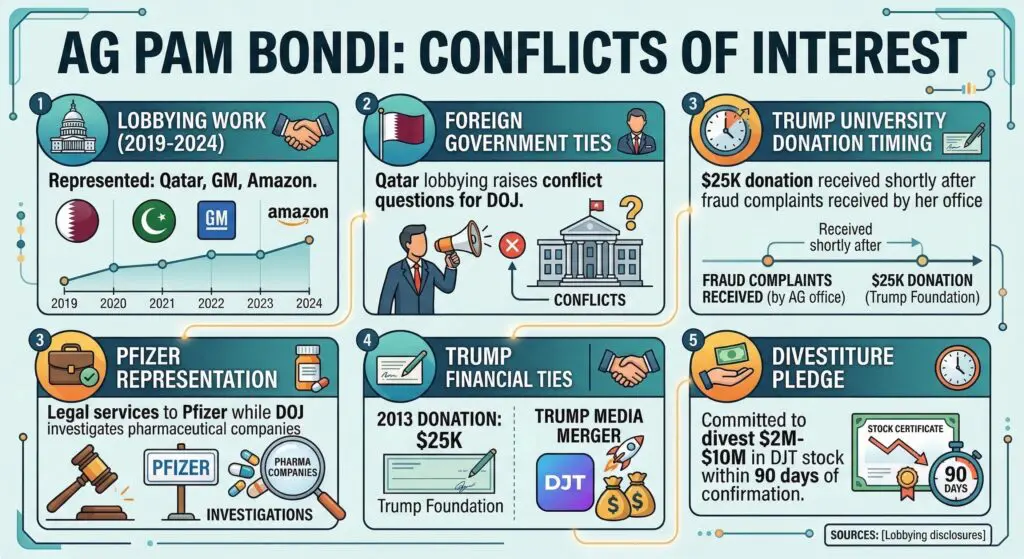
The nation’s top law enforcement officer is supposed to be the people’s lawyer. Instead, we got a corporate lobbyist who spent six years at Ballard Partners repping Qatar, Amazon, GM, private prisons, and Pfizer — then waltzed into the DOJ without disclosing any of it as a potential conflict. She listed exactly two conflicts on her committee paperwork: a policy institute gig and her brother’s law practice. That’s it. Thirty-plus clients and the government of a foreign nation, and Pam Bondi basically said “nothing to see here.”

Since her confirmation, Ballard Partners has become the highest-paid lobbying shop in D.C. and taken on ten new clients with business directly before Bondi’s DOJ — more than they had in the first Trump and Biden administrations combined. One of those clients, American Express Global Business Travel, paid Ballard $200K to lobby Bondi’s DOJ — after which the department conveniently dropped its challenge to a $540 million merger that would have let Amex GBT devour its biggest rival.

Then there’s Qatar. Bondi lobbied for the Qatari government. Then as AG she personally signed a DOJ memo blessing Qatar’s $400 million luxury jet gift to Trump. When the Freedom of the Press Foundation sued for that memo? Her DOJ stonewalled. Meanwhile, Trump announced a shiny new golf resort deal with a Qatari government-owned company. Totally unrelated, surely.

Oh, and remember the Trump University $25K donation her Florida AG office received right around the time fraud complaints landed on her desk — after which she declined to investigate? The IRS literally penalized Trump’s foundation for that one, and yet here she sits.

This isn’t a conflict of interest. It’s a business model.


Keep exploring on Civics vs. Oligarchy

Civics vs. Oligarchy, the free Doctor Paradox wiki, maps the people, groups and ideas in this piece and how they connect. Start with:

Read more

Kristie Noem in her ICE Barbie cosplay outfit, between 2 thugs, saying "The only thing I regret is not being there to shoot the bitch myself"

The shooting in Minneapolis last week of Renee Good, a 37-year-old wife and mom to 3 kids, hit me really hard. It’s not just that she was in a lesbian couple like me, with kids from previous husbands — and that I would be the one in the passenger’s seat. It’s because of the brazenness — pride, even — of the officer who ended her life cavalierly and without remorse.

The smear campaign about this woman nauseates me deeply — it began mere milliseconds after her death when the officer who shot her at point-blank range yelled “fuckin’ bitch!” after her vehicle and escalated extremely quickly to the sitting President, Vice President, and Homeland Security Secretary calling her a “domestic terrorist” despite the physical impossibility of being able to confirm that kind of information so quickly.

It is clear that agent Jonathan Ross escalated the situation himself. He broke DHS policy by putting himself in the path of a moving vehicle. And he should not have had his cellphone out, occupying his other hand, when he drew his weapon — you need the hands to be unobstructed to maximize your ability to handle any situation that may emerge.

He claimed he was afraid for his life — when? Show me on tape at which moment(s) in time this agent appears to behave an a fearful manner, because I do not see it. There are the moments when he’s calmly walking around the entire vehicle recording on his cellphone, moments when he has calmly drawn his gun and is pointing it at Renee Good, and moments where he is shouting and shooting bullets into her head. Where is the fear? He doesn’t run or dive; he doesn’t scream; he doesn’t call for help; he doesn’t show any surprise. He doesn’t seem fearful — he seems in control of the situation at all times, including when he pulls the trigger 3 times to take someone’s life as punishment for being cheeky.

Continue reading The killing of Renee Good
Read more

They do not care about you — you are expendable to them. They do not GAF. Especially now with AI — they are gonna replace you anyway brah! At best they are biding time putting you on a drip feed of murder porn and revenge fan fic until the moment they are completely certain they’ve hijacked the electoral system at which time you too, buddy, will be shown the airlock into a deep space void no one will ever hear you from because they have all the powers of the earth to override whatever puny narrative you may have had for yourself.

You will be crushed like a bug 1000x tinier than Kafka’s roach — millions at a time under the heels of casually sadistic billionaires many of whom were Democrats up until 5 minutes ago when someone offered them a deal to cut their tax bill in exchange for a measley few million dollars. It’s “irrational” to not take the deal. You have to take the deal. Your competitors have taken the deal. You’d be the only chump not taking the deal. It’s the Art of the Deal, right?

Deals are all that matter. Transactionality is all there is — including reducing the beautiful, awe-inspiring teachings of Jesus to a mere materialistic creed, draped in a flag, shouted from a bullhorn, fired into an already capsized boat, and shot into the heads of innocent bystanders if they don’t comply with conflicting directives.

Read more

Jack Smith, Special Prosecutor in two federal cases brought against Donald Trump

Five years ago today, a violent mob stormed the United States Capitol in an attempt to overturn a free and fair election. The man who incited them has since been re-elected president, which scuppered the investigation into him by Special Counsel Jack Smith. If that whiplash isn’t enough to give you vertigo, consider this: we now have sworn testimony, under oath, from the prosecutor who investigated Trump laying out exactly why his office believed they could convict Trump for breaking the law—and why they were stopped.

Former Special Counsel Jack Smith’s December testimony before the House Judiciary Committee is the closest thing we’ll get to the trial that should have happened. In it, Smith methodically dismantles every defense Trump and his allies have offered, explains how the case was built on testimony from Republicans willing to put country over party, and makes clear that the evidence of Trump’s guilt wasn’t circumstantial—it was direct.

In this post, I’m breaking down the key takeaways from Smith’s testimony, sharing one of my AI #MiniHistory videos marking the anniversary, and giving you a way to interrogate the evidence yourself through an interactive NotebookLM bot. Because if there’s one thing the incoming administration is counting on, it’s that you won’t have time to read 255 pages of testimony. Let’s make sure they’re wrong.

January 6 in 40 seconds

But first, a J6 refresher course — again, for busy folks.

I’ve been into making these little AI #MiniHistory videos with Glif agents, trying to tease out important signposts along our road to dictatorship and other interesting moments in history to highlight. Here’s the one I did for today and the 5th anniversary of January 6, 2021:

Continue reading Remembering January 6: Here’s how Jack Smith saw it
Read more

Liberal Tears illustrates the sneering cynicism of the right wing who refuse to articulate political values

There’s something conspicuously absent from American political discourse: actual discussion of values and the morals, ethical choices, and beliefs that go into the creation of good government policy.

Think about the last major political debate you watched, or the last campaign ad that stuck with you. How much of it was about what government should do versus who you should hate? How much was articulating a vision for society versus performing dominance over the out-group?

This isn’t an accident. It’s a strategy.

When your policy positions are wildly unpopular — when majorities oppose you on healthcare, taxation, abortion, climate change, guns, and wages — you don’t engage on the substance. You change the subject. You make politics about identity, grievance, and tribal belonging. You turn every election into a referendum on vibes rather than vision.

The American right has become extraordinarily sophisticated at this evasion. They’ve built an entire media ecosystem designed not to argue for right-wing values, but to ensure those values never have to be argued for at all. And the Trump administration is chock full of people from that media ecosystem.

The Polling Problem

Here’s the uncomfortable reality the modern right has to navigate, and we need to trumpet: their actual policy preferences are not popular.

Exposed to the individual provisions of the Affordable Care Act, majorities supported them — even among Republicans. Majorities support raising taxes on the wealthy, protecting Social Security and Medicare, acting on climate change, keeping abortion legal in most cases, and implementing universal background checks for gun purchases. On issue after issue, when you strip away the partisan framing and ask people what they actually want government to do, the “conservative” position loses.

This creates a strategic problem. You can’t win elections by articulating positions most people reject. So you articulate… something else.

The Retreat from Argument

Meanwhile, the right-wing has indefensible values, which is why they no longer even bother to try to articulate them. Instead, they express them obliquely through “memes” and mores that evince cruelty, bigotry, narcissism, domination, supremacy, greed, selfishness, and contempt for vulnerability — all while maintaining plausible deniability through irony, “just asking questions,” and the ever-ready accusation that anyone who names the pattern is being hysterical or unfair.

This is the function of the perpetual rhetorical shell game: you can’t pin down a position that’s never stated plainly. The cruelty gets expressed through policy and aesthetic, but when challenged, retreats behind procedural objections or “economic anxiety.” The bigotry shows up in who gets mocked and who gets protected, but is never admitted as such — it’s always reframed as “common sense” or “tradition.”

Continue reading The Quiet Part Loud: Why the right stopped talking about values

Read more

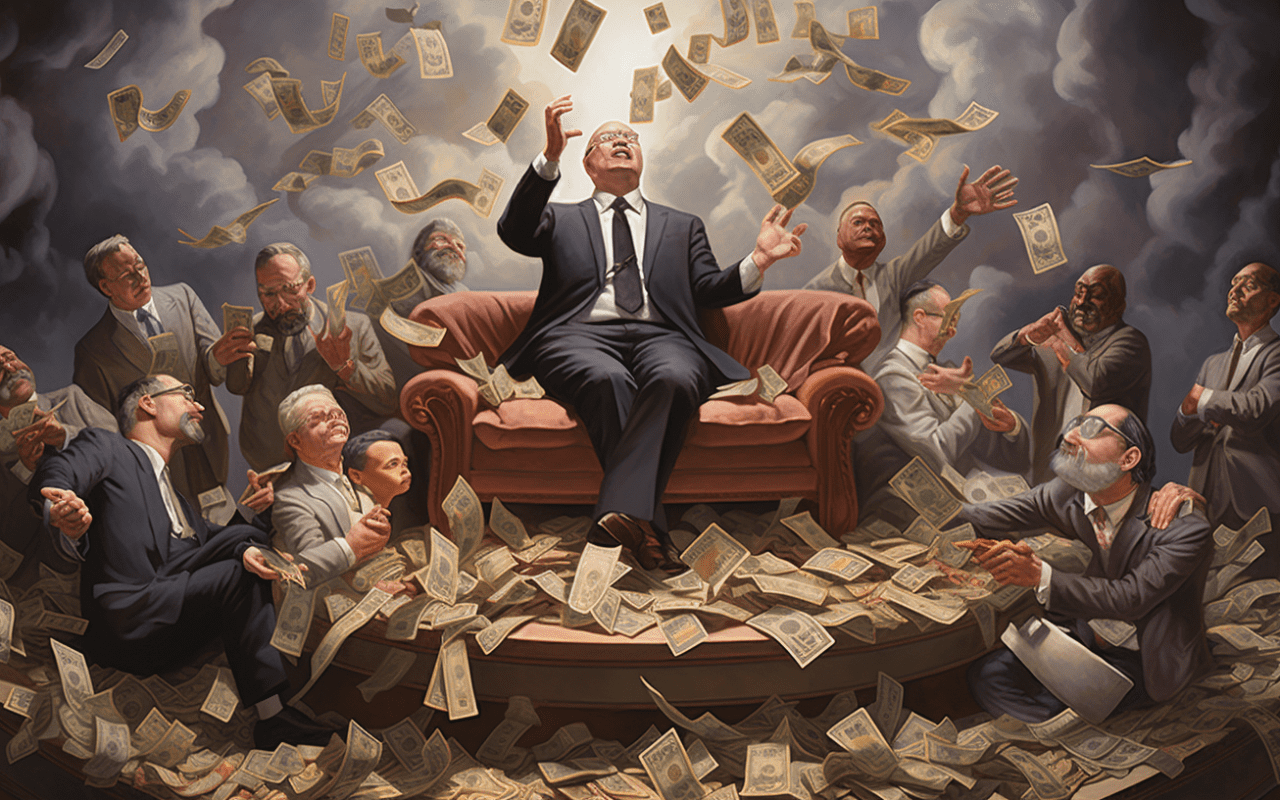
Wealth Cult -- rich men behaving badly, by Midjourney

A network of exceedingly wealthy individuals and organizations have channeled their vast fortunes into influencing American politics, policy, and public opinion — they’ve formed a wealth cult. And they’ve leveraged that cult and its considerable fortune to influence and in many ways dramatically transform American politics.

The most succinct way I have come up with to explain American politics is that the wealthy are dividing us over race and religion. Today far more openly than in the past, where much oligarch shadow influence was delivered via dark money kept intentionally untraceable back to its origins.

The term “dark money” refers to political spending meant to influence the decision-making and critical thinking of the public and lawmakers where the source of the money is not disclosed. This lack of transparency makes it challenging to trace the influence back to its origins, hence the term “dark.”

And, it is dark indeed.

Wealth cult anchors the trench coat

The Wealth Cult is one of 3 primary groups or clusters supporting the right-wing and generally, the Republican Party. It anchors the trench coat by funding the 2 cults above it: the Christian Cult, and the White Cult.

Its story is stealthy and significant.

A bunch of billionaires toast themselves to themselves, by Midjourney

The wealth cult has funded disinformation campaigns, the spread of conspiracy theories, created fake social movements through astroturfing, enabled violent extremists to attack their country’s capitol, aided and abetted a convicted felon, cruelly deprived vulnerable people (especially immigrants, poor people, and women) of the kind of state aid granted generously throughout the developed world, bribed regulators, rigged elections, crashed economies, and on and on in service of their extremist free market ideology beliefs (which, by the way, have resulted in catastrophic market crashes every single time).

They believe in “makers and takers,” or Mudsill Theory, as it was once called by pedophile and racist Senator and slavery enthusiast James Henry Hammond. Some people were born to serve others, they say. Hierarchies are natural, they claim. Wealthy men should make all the decisions — because that’s what’s best for everyone, they say in paternalistic tones.

I don’t buy it. I believe all men are created equal. So did a certain Founder of our country.

Continue reading Wealth Cult: The oligarchs influencing American politics from the shadows
Read more

Slavery was the central question leading to the Civil War according to Abraham Lincoln, depicted here in a mini history video

But you don’t have to take our word for it — just ask the Vice President of the Confederacy what his reasons were in the infamous Cornerstone Speech of 1861, just a few weeks before the Confederates fired on Fort Sumter:

“The new [Confederate] constitution has put at rest, forever, all the agitating questions relating to our peculiar institution — African slavery as it exists amongst us — the proper status of the negro in our form of civilization. This was the immediate cause of the late rupture and present revolution . . . The prevailing ideas entertained by . . . most of the leading statesmen at the time of the formation of the old constitution, were that the enslavement of the African was violation of the laws of nature; that it was wrong in principle, socially, morally, and politically. . . Those ideas, however, were fundamentally wrong. They rested upon the assumption of . . . the equality of races. This was an error . . .

Our new government is founded upon exactly the opposite idea; its foundations are laid, its corner–stone rests upon the great truth, that the negro is not equal to the white man; that slavery — subordination to the superior race — is his natural and normal condition.”

— Alexander H. Stephens, March 21, 1861, reported in the Savannah Republican, emphasis in the original

The “States’ Rights” Contradiction

One of the clearest ways to prove the war was about slavery—and not abstract “states’ rights”—is to look at how the Confederacy treated the rights of Northern states.

  • The Fugitive Slave Act Paradox: Southern leaders explicitly opposed “states’ rights” when Northern states attempted to exercise them. When Northern states passed “Personal Liberty Laws” (exercising their sovereign right to not enforce federal slave-catching laws), Southern states demanded the Federal Government override these state laws.​
  • South Carolina’s Declaration: In its “Declaration of Causes,” South Carolina specifically lists the failure of Northern states to enforce the federal Fugitive Slave Act as a primary grievance. They were not fighting for the right of states to choose their own laws; they were fighting for the federal government to enforce slavery across all states

The Rejection of the “Forever” Amendment (Corwin Amendment)

Perhaps the most damning evidence is the South’s rejection of the Corwin Amendment.

  • The Offer: In a last-ditch effort to prevent war, the Northern-controlled Congress actually passed a Constitutional Amendment (the original 13th Amendment) in early 1861. It would have protected slavery forever in the states where it already existed, guaranteeing the federal government could never abolish it.​
  • The Rejection: If the South were seceding simply to “protect their property” or “defend against Northern aggression,” they would have accepted this victory. Instead, they rejected it. Why? Because the amendment only protected slavery where it was, but did not guarantee its expansion into new western territories. The South seceded not just to keep slavery, but to ensure it could grow into a continental empire
Continue reading Was the Civil War about slavery? Yes.
Read more

You’ll hear a common retort on the extreme right that now holds sway in the mainstream Republican Party, in response to protests about the dismantling of democracy in this country — that we’re “a republic, not a democracy.” Right off the bat, a republic is a form of democracy — so they are claiming something akin to having a Toyota and not a car. It’s a rhetorical trick, in which people who fully know better are hacking the simple ignorance of civics and basic political philosophy of the right-wing political base.

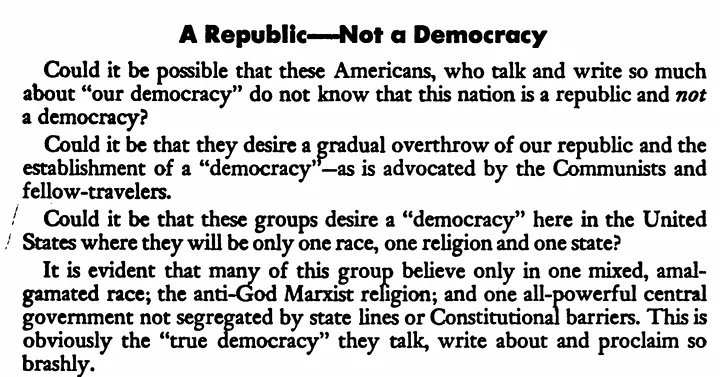
But it manages to get worse — the origins of the bully taunt “a republic, not a democracy” go way back — they’re actually located in the segregationist movement. Specifically, the concept comes from the pro-segregation book You and Segregation, written in 1955 by future Senator Herman E. Talmadge.

John Birch Society loonies laud “a republic, not a democracy”

The “republic, not a democracy” meme would go on to be featured in the John Birch Society Blue Book — an organization so toxically extremist that even conservative darling William F. Buckley distanced himself from them. They feared the idea that increasing democratization would be a shifting balance of power away from white conservative men, and they spun numerous conspiracy theories to explain this as the result of nefarious undercover plot to overthrow Western Civilization.

In reality, the trend towards greater democracy is something the Founders themselves envisioned — though they likely could not have imagined how it would turn out. They believed fiercely in self-governance, and a clear separation from the tyranny of kings.

Continue reading “A republic, not a democracy” came from segregationists
Read more

the golden rule as a key moral compass

Watch: The Golden Rule — A Deep Dive into the Ethic of Reciprocity

Video Length: 6:36

⏱️ CHAPTERS:

  • 0:00 – Introduction: One Rule to Guide Us All?
  • 1:15 – Golden vs Silver: The Critical Distinction
  • 1:54 – Around the World in 7 Religions
  • 3:10 – Love as Action: The Good Samaritan & Rabbi Weiser
  • 4:38 – Where the Rule Breaks Down (Shaw & Kant’s Challenges)
  • 5:39 – Why It Still Matters: The Empathy Engine

What Is the Golden Rule?

The Golden Rule is a moral maxim that transcends religious, cultural, and philosophical boundaries. At its core, this essential mental model for the world states: “Treat others as you would like to be treated.” This deceptively simple principle serves as a moral compass that has guided human interactions across millennia and continents.

The Critical Distinction: Golden vs. Silver

Not all versions of this rule are created equal. The key difference lies in whether the rule commands action or restraint:

The Golden Rule (Positive Form):

  • “Do unto others as you would have them do unto you”
  • Demands proactive kindness and active good
  • Found in Christianity and Islam’s teachings
  • Requires you to get up and act

The Silver Rule (Negative Form):

  • “Do not do unto others what you would not have them do unto you”
  • Advocates restraint from harmful actions
  • Found in Confucianism, Judaism, Hinduism, and Buddhism
  • Can be followed through non-action

This distinction is crucial: you can follow the Silver Rule perfectly by sitting on your couch and doing nothing. The Golden Rule demands that you actively engage with the world.

A Universal Code: The Rule Across Cultures

What makes the ethic of reciprocity so remarkable is its near-universal appearance across human civilization:

Judaism: Hillel the Elder declared this the entire Torah in a nutshell—the negative version focused on avoiding harm.

Christianity: Jesus framed it as the Greatest Commandment, the positive version demanding active love.

Continue reading The Golden Rule
Read more

Peter Thiel sits in a far future, under an all-watchful digital eye

Peter Thiel FAQ: The Contradictions of Silicon Valley’s Dark Philosopher

Peter Thiel occupies a rarefied place in the modern pantheon of tech billionaires — less the tinkerer or engineer than the theorist-king of the movement. A venture capitalist, PayPal co-founder, Facebook’s first major outside investor, and the billionaire backer of numerous reactionary causes, Thiel has built a career at the intersection of money, ideology, and myth. He is the financier of futuristic dreams — and dystopian nightmares.

Born in Frankfurt and raised in California, Thiel studied philosophy at Stanford, where he was captivated by the writings of Leo Strauss and René Girard. These thinkers — one obsessed with the hidden logic of political elites, the other with the contagious nature of human desire — shaped Thiel’s enduring worldview: that civilization is locked in cycles of envy and collapse, and only an enlightened few can see beyond the herd. In this sense, Thiel has always seen himself less as a businessman and more as a philosopher of power.

His ventures, from PayPal to Palantir, form a kind of metaphysical architecture of control. PayPal, the proto-financial infrastructure of the internet, made Thiel his fortune. Palantir, as explored deeper in What Is Palantir?, has monetized the surveillance state. In between, Thiel cultivated a cadre of disciples — the so-called PayPal Mafia — that went on to dominate Silicon Valley. His investments in companies like Facebook gave him not only wealth but leverage: a front-row seat in the grand experiment of data-driven social engineering.

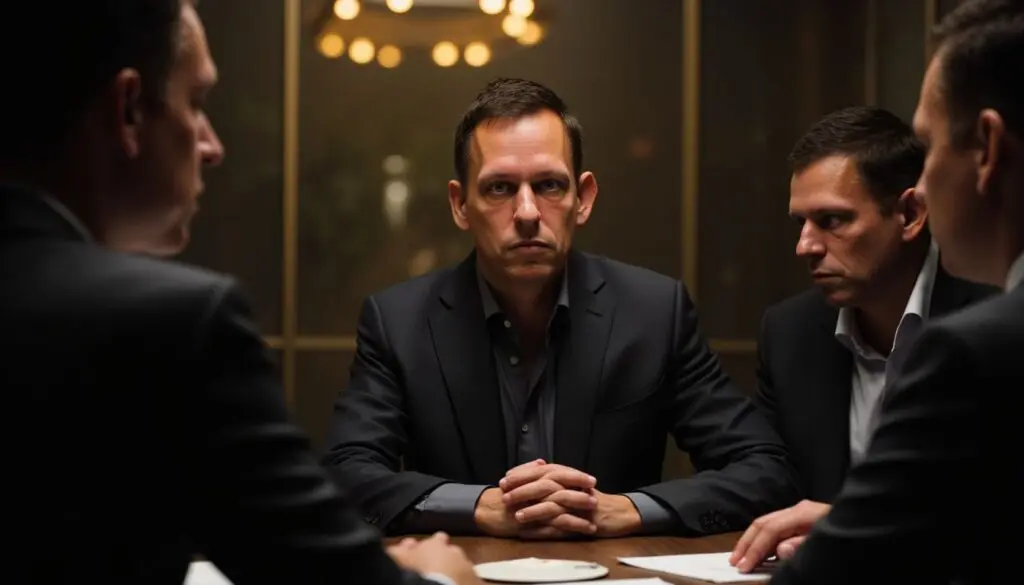
Peter Thiel at an imaginary round table of Peter Thiels

But Thiel’s influence extends far beyond technology. He bankrolls candidates, think tanks, and movements aimed at reshaping our very democracy itself. In Peter Thiel and the Antichrist, I explored how Thiel’s quasi-religious futurism blends techno-eschatology with authoritarian politics — a longing for an end-times “reset” that he sees as necessary for renewal. His protégés, like Palmer Luckey and J.D. Vance, carry forward the same paradoxical ethos: rebellion against democracy in the name of “freedom.” As I argued in Palmer Luckey, Peter Thiel, and the Welfare Queens of Defense, his ventures often feed off the very government systems they publicly scorn.

Continue reading Peter Thiel FAQ
Read more

What is fascism, and what are the signs of fascism? The fascist form of government is a complex and multi-faceted ideology that can manifest in various ways, making it challenging to pin down with a single definition.

Fascism resists simple definition precisely because it’s a syncretic ideology—adaptable to different contexts while maintaining core structural features. Rather than a fixed doctrine, it operates as a political methodology characterized by specific power dynamics, rhetorical strategies, and institutional patterns.

Structural characteristics of fascism

These are the ideological foundations and belief systems that define fascist movements—not merely policy positions but the fundamental orientations toward power, identity, and social organization that shape how fascism understands the world and its place in it.

  1. Authoritarian Consolidation: Fascism centralizes power through the dismantling of horizontal accountability structures, typically concentrating authority in a charismatic executive who positions themselves above institutional constraints.
  2. Ultranationalism as Identity Politics: Goes beyond patriotism to assert inherent civilizational superiority or racial supremacy, often manifesting as collective narcissism where national mythmaking replaces historical accuracy.
  3. Militarized Social Order: Valorization of martial virtues, hierarchical discipline, and violence as political tools. Fascist movements frequently draw from veteran communities and paramilitary traditions.
  4. Anti-Intellectualism and Epistemic Closure: Systematic devaluation of expertise, academic inquiry, and empirical reasoning in favor of intuition, emotion, and revealed truth. The “coastal elite” or “ivory tower” becomes a rhetorical enemy.
  5. Ethno-Nationalism and Boundary Enforcement: Xenophobia operating through strict in-group/out-group categorization, often targeting immigrants, religious minorities, or racialized “others.”
  6. Reactionary Temporal Orientation: Deployment of a mythologized past as political program—the promise to restore a golden age that never existed, weaponizing nostalgia against pluralism.
  7. Anti-Leftist Mobilization: Positioning communism, socialism, and progressive movements as existential threats, often conflating disparate left ideologies to create a unified enemy.

The Us vs. Them Architecture: In-group/Out-group dynamics as core infrastructure

Fascism doesn’t just exploit social divisions—it requires their constant production and intensification as its primary source of political energy. While most political movements contain some degree of group identity, fascism is structurally dependent on a stark binary between insiders and outsiders, making this dynamic its foundational operating system rather than an incidental feature. The movement coheres not around shared policy goals or governance philosophy, but around the ongoing project of boundary maintenance: defining, defending, and purifying the “us” against an ever-present “them.”

Continue reading Warning Signs of Fascism
Read more

Peter Thiel at Isengaard looking into the Palantir

Peter Thiel has a plan to save the world, and it looks like a nightmare. He’s casting around for scapegoats, but perhaps Peter Thiel and the Antichrist are one and the same.

The PayPal co-founder, Facebook‘s first outside investor, and Silicon Valley‘s most influential political operator has spent years developing a political philosophy so strange that most people assume it can’t be serious. Democracy and freedom are incompatible, he says. Global cooperation is the Antichrist. The only hope for civilization is absolute monarchy modeled on tech startups. And he’s not just theorizing—he’s building it.

Thiel has poured millions into political campaigns, funded think tanks, mentored a generation of “New Right” intellectuals and alt-Right screeders, and cultivated politicians who share his vision. He’s amplified fringe thinkers like Curtis Yarvin (the blogger behind “Neoreaction” who openly advocates abolishing democracy), but Thiel’s worldview is uniquely his own—a bizarre synthesis of Christian eschatology, corporate governance theory, and techno-authoritarianism that’s far more sophisticated and disturbing than anything coming from the intellectual dark web.

This isn’t just eccentric billionaire philosophy. Thiel’s protégés include a sitting Vice President (J.D. Vance) and multiple Republican senators. His ideas circulate through conservative think tanks and Trump‘s inner circle. What sounds like science fiction is increasingly becoming Republican policy doctrine.

The media often portrays Thiel as an enigmatic libertarian or contrarian thinker. But that framing misses what’s actually happening. This is a systematic rejection of 250 years of democratic governance, wrapped in theological language and corporate efficiency rhetoric. And it’s weirder and more methodical than most people realize.

Peter Thiel and the Antichrist in 8 minutes (video)

This NotebookLM video does a great job explaining the background and impact of Thiel’s dangerously apocalyptic rhetoric inspired by Nazi theorist Carl Schmitt — and below it you can find a deeper explanation of all major points:

Here are the five interlocking beliefs that form Thiel’s vision—and why each one should terrify you.

1. Democracy Is the Bug, Not the Feature—Replace It With a Tech Startup Dictatorship

Thiel doesn’t just critique democracy—he’s concluded it’s fundamentally incompatible with freedom. In a 2009 essay, he wrote: “I no longer believe that freedom and democracy are compatible.” Not ideal partners; not in tension — but incompatible.

His alternative is coldly corporate: run countries like founders run startups. One CEO. One vision. Absolute authority. No consensus. No debate. No democracy.

Continue reading Peter Thiel and the Antichrist: 5 Weirdo beliefs driving the new tech right
Read more