2026 midterms

Democrats sweep the 2026 midterms in historic night of firsts

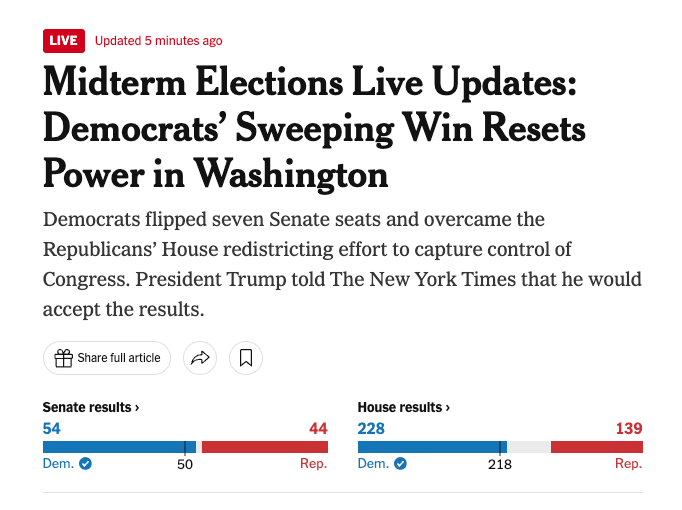
In a massive blue wave so sweeping that Donald Trump could only stop on a dime to start blaming his hand-picked Republican candidates for losing so decisively, Democrats took control of both chambers of Congress in the 2026 midterm elections yesterday. With votes still being counted in many western states, the final tally won’t be known for possibly days to come — but as of this morning Democratic candidates have flipped at least 7 seats in the Senate and secured 25 pickups in the House.

Not only was it a night of undeniably forceful repudiation of Trump and the GOP’s governance over the past 2 years, but also a night signaling demographic and generational change in the United States. James Talarico will take the title of youngest serving Senator as he heads to Washington DC to represent Texas — the first time the Lone Star state has sent a Democrat to the Senate since before Talarico was born — grabbing the baton from Jon Ossoff, re-elected handily for a second term as the senior Senator from Georgia.

Elsewhere, many other historic firsts unfolded across the country — including 4 states electing their first ever Black governors, a number that exceeds the totality of Black governors ever elected prior to this year. With potentially more still to come, we’re kicking off this list of historic firsts in American politics and hoping to add more in the coming days as the final races are called:

National firsts

  • Keisha Lance Bottoms (D), Georgia governor: the first Black woman elected governor in U.S. history, and Georgia’s first governor of color.
  • Deb Haaland (D), New Mexico governor: the first Native American woman elected governor.
  • Peggy Flanagan (D), Minnesota Senate: the first Native American woman elected to the U.S. Senate.
  • Chris Pappas (D), New Hampshire Senate: the first openly gay man elected to the U.S. Senate.
  • Abdul El-Sayed (D), Michigan Senate: the first Muslim elected to the U.S. Senate.
  • Josh Turek (D), Iowa Senate: the first Paralympian elected U.S. Senator.
  • Byron Donalds (R), Florida governor: Florida’s first Black governor, and CBS Miami calls him the first Black Republican elected governor in U.S. history.
  • Juliana Stratton (D), Illinois Senate: makes Illinois the first state represented by two women of color in the Senate, alongside Tammy Duckworth.
  • Georgia and Florida together: with Bottoms and Donalds, two Deep South states will be governed by Black leaders at the same time for the first time.

State firsts

  • Gina Hinojosa (D), Texas governor: Texas’s first Latina governor.
  • Aaron Ford (D), Nevada governor: Nevada’s first Black governor.
  • Amy Acton (D), Ohio governor: Ohio’s first woman governor.
  • Amy Klobuchar (D), Minnesota governor: Minnesota’s first woman governor.
  • Marsha Blackburn (R), Tennessee governor: Tennessee’s first woman governor.
  • David Crowley (D), Wisconsin governor: Wisconsin’s first Black governor.
  • Annie Andrews (D), South Carolina Senate: the first woman elected to the Senate from South Carolina. Darline Graham, whom she beat, was appointed, not elected.
  • Denise Powell (D), NE-02: the first woman and first Latina elected to represent the district.
  • Phil Scott (R), Vermont governor: a record sixth term.

Long droughts ended

  • Kansas Senate (Adam Hamilton): the first Democrat Kansas has elected to the Senate since 1932.
  • Texas governor (Hinojosa): the first Democrat elected governor since Ann Richards in 1990.
  • Texas Senate (James Talarico): the first Democratic Senate win in Texas in decades. The last one was Lloyd Bentsen in 1988.
  • South Carolina Senate (Andrews): the first Democrat South Carolina has elected to the Senate in 28 years.
  • Georgia governor (Bottoms): the first time the office has flipped in 24 years, according to NBC.
  • Iowa governor (Rob Sand): the first Democrat to win since Chet Culver in 2006.
  • Ohio governor (Acton): the first Democrat in 20 years.
  • MO-02 (Fred Wellman): the first Democrat to win the seat since 1990.
  • WI-01 (Mitchell Berman): the first Democrat to represent the district in more than 30 years.
  • UT-01 (Ben McAdams): Utah’s first Democrat in Congress since he left in 2021.
Read more

the incredibly true story of how boringly methodical elections are supposed to be

Less than two weeks out. Here’s where to learn the part of the midterms nobody puts on screen.

Here’s the paradox of November 3: the number you’ll stare at all night, the one in the corner of the screen with the little checkmark beside it, is the least official number in American democracy.

It has no legal status. None. It’s a private news organization’s running total, pieced together from county websites, state feeds and reporters in the field. This cycle, every major broadcast network reads from the same one. ABC, CBS, NBC, CNN and Fox News all buy their 2026 results data from the Associated Press, the first time since the 2016 election that all the major broadcast networks have used a single vendor. The call desks are still separate. The numbers feeding them aren’t.

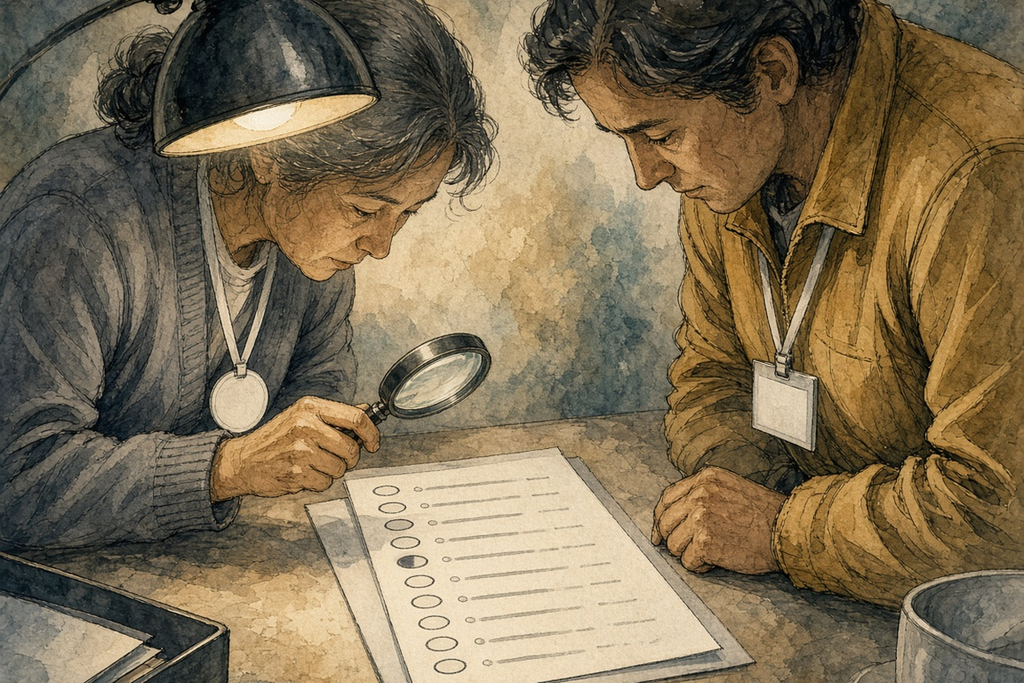
Meanwhile, the actual election happens somewhere far less telegenic. In county offices. In rooms where election workers decide what a half-filled oval meant. In Pennsylvania, where counties can’t even start processing mail ballots before 7 a.m. on Election Day. That’s why the mail vote there lands last, and why the margin β€œmoves” overnight. That’s not the count shifting. That’s the calendar.

And when somebody loses? The National Archives has a stock answer to the question of what a concession speech does to the process. It begins with one word: β€œNone.”

So on November 4th someone will tell you the late-counted ballots are suspicious. Or that a race was over because a candidate said so on TV. You’ll want to know how the machine actually works.

That’s what we built.

The 2026 Midterms Hub

The 2026 Midterms Hub is the front door to the whole cycle:

And the part I’m proudest of: a shelf of step-by-step maps of the plumbing. How a Ballot Is Counted. How Election Results Are Transmitted and Reported. How a Provisional Ballot Is Cast and Counted. How a Midterm Election Is Certified. How a Conceded Election Is Finalized.

It moves fast. In the past week alone, close to 100 midterm pages were added or updated: new race pages, new super PAC money, new court rulings. A β€œLatest midterm updates” feed at the top of the hub refreshes every morning, so you can see what changed since your last visit. And if reading isn’t enough, the hub will point you to volunteer shifts near you.

The bigger map

The midterms section is one corner of something bigger. The Civics vs. Oligarchy Knowledge Base is more than 10,000 linked pages mapping the people, money, ideas and institutions of the modern American right: who funds what, who knows whom, and where the receipts are. New here? Begin at Start Here, with a 15-minute tour and six one-hour reading tracks. Election season is track one.

Then follow the links. That’s the whole trick. Every page connects to the people and the money around it.

It’s free, and there’s no paywall. Send it to the friend who’s planning to doomscroll through election night.

Because election night is a broadcast. The election is a process: slow, local, deeply unglamorous. When the numbers lurch at 2 a.m., the system isn’t broken. It’s working exactly as designed.

The people who want you to panic are counting on you not knowing the difference.

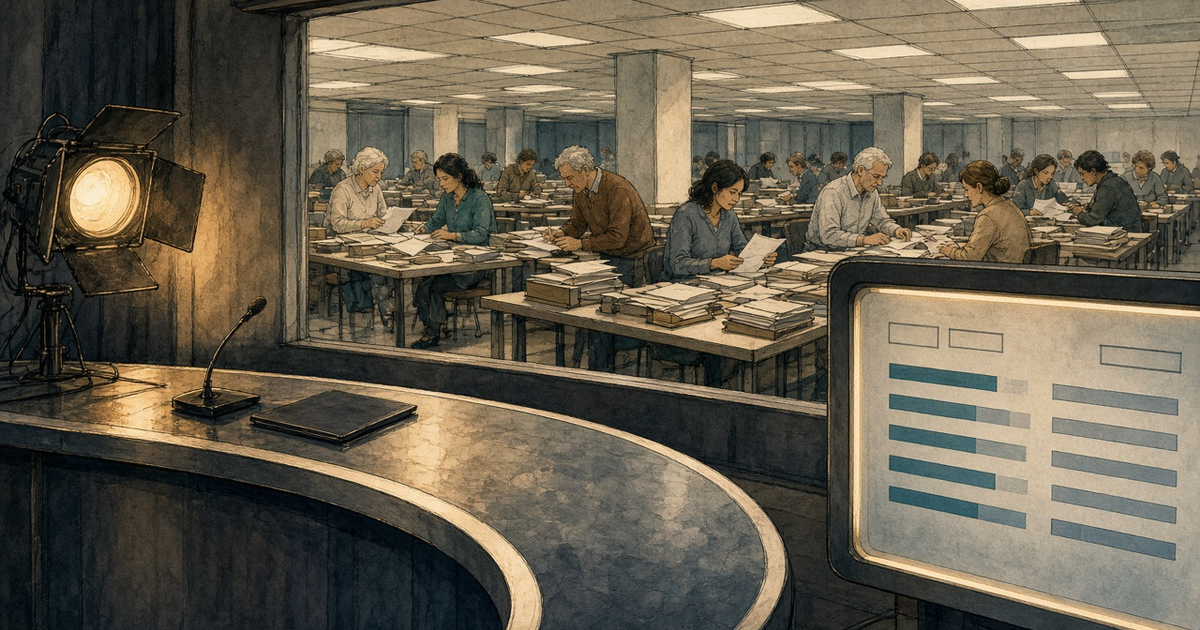
civil servant election workers quietly and humbly going about doing their jobs
Read more

congress ascii maps project

Who Runs Congress: An ASCII Maps Project

Here’s a paradox for you: the most powerful people in Congress are the ones most Americans have never heard of.

Cable news covers the floor β€” the speeches, the walkouts, the C-SPAN theater. But the floor is the last stop, not the first. By the time a bill gets a floor vote, the real decisions have already been made in committee: what gets a hearing, what gets marked up, what gets quietly buried, who gets subpoenaed, and who never has to answer a single question under oath. The committee gavel is where the power lives. Everybody in Washington knows this. Almost nobody outside of it does.

So let’s map it. All of it.

This is the full committee and subcommittee leadership of the 119th Congress as of mid-2026: both chambers, every standing committee, every select and special committee, the four joint committees, and β€” the part nobody bothers to compile β€” every subcommittee, with its Republican chair and Democratic ranking member. Over 100 panels. Because Republicans hold both chambers, every gavel is a Republican hand; every ranking member is a Democrat (or an independent caucusing with them β€” hi, Bernie!).

It comes in two flavors:

  • The infographic (above) β€” the visual overview for scanning who holds what.
  • The ASCII tree β€” a plain-text, monospace map with the complete roster down to the subcommittee level, including mid-Congress successions and the seats I couldn’t verify (flagged, not guessed). It’s diffable, terminal-friendly, and pasteable anywhere. Check it out below the break, and in my Github plain-gov repository where I’ll be adding more of these “just the facts, ma’am” maps.
Continue reading Who Actually Runs Congress?
Read more

gerrymandering -- an illustrated guide to its effects

A new long-form data brief on how representativeness has been gerrymandered away β€” and the first installment of a series on how American democracy was engineered to stop being competitive.

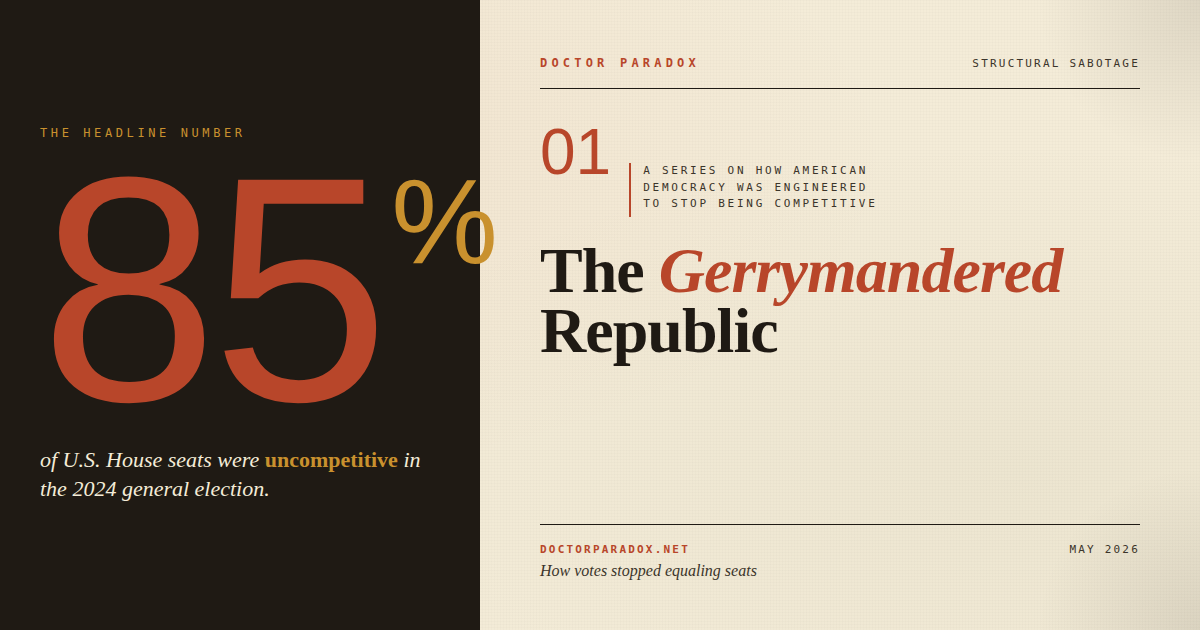
In 2024, Americans went to the polls to elect 435 members of the U.S. House of Representatives. 366 of those races were over before a single ballot was cast.

Not “predictable.” Not “incumbent advantage.” Decided β€” by maps drawn years earlier, with software, by politicians choosing their voters instead of the other way around. According to the Cook Political Report‘s 2024 ratings, only 69 of 435 House seats β€” 15% β€” were genuinely competitive in the general election. The other 85% were already in the Republican or Democratic column before campaigning began.

That’s the headline of the new Doctor Paradox data brief, The Gerrymandered Republic, and it’s the launch piece for a new series: Structural Sabotage, on the ways American democracy has been engineered to stop being competitive.

This first installment is the receipt-collection edition. It covers:

  • The vote-share vs. seat-share gap in Wisconsin, North Carolina, Ohio β€” and Maryland as the Democratic counter-example, because honesty matters
  • Packing and cracking β€” the two techniques every gerrymandered map uses, unchanged since 1812
  • The efficiency gap β€” the metric that quantifies how badly a map cheats
  • The collapse of swing seats from 164 in 1999 to 82 today β€” a 50% loss of competitive districts in 25 years
  • What actually works β€” independent commissions draw 19% of America’s districts and produce 41% of its toss-up races, a four-to-one ratio in favor of taking the pen out of politicians’ hands
  • The Supreme Court’s 2019 Rucho v. Common Cause decision, which closed the only federal door left

Click the image below to open the new mini-magazine style format:

gerrymandering -- an illustrated guide to its effects

Stay tuned for part 2 of the Structural Sabotage series β€” on how primaries weaponize safe seats β€” that will be coming next. If 85% of seats are decided before the general election, then who actually decides them? The answer is a much smaller and more ideological electorate than most Americans realize.

Please share. The cover-up that worked is still working, and the least we can do is make sure people can see the map.


Read the wider story on Civics vs. Oligarchy

Civics vs. Oligarchy, the free Doctor Paradox wiki, maps the people, groups and ideas in this piece and how they connect. Start with:

Read more