Confederates

Introduction to the Doctor Paradox Mini History Series

An Introduction to Doctor Paradox Mini Histories

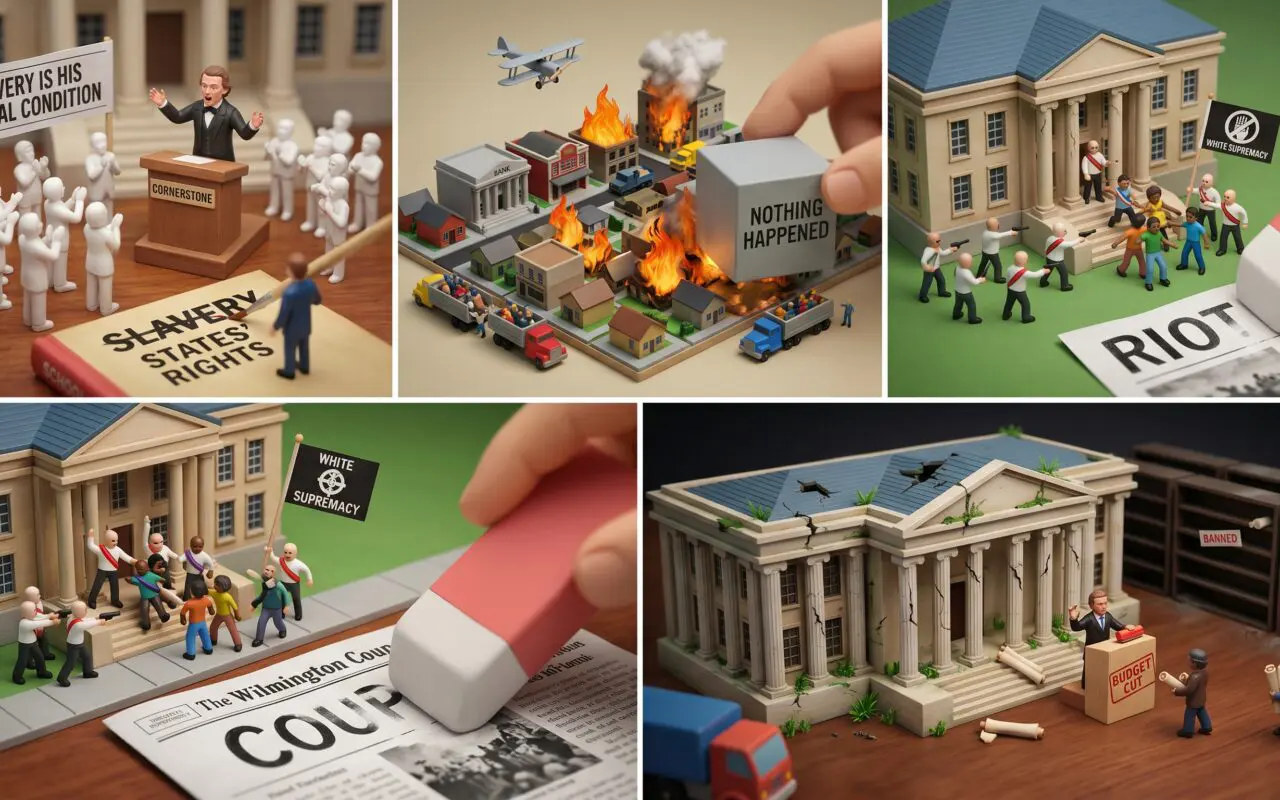
On March 21, 1861, the Vice President of the Confederacy stood up in Savannah, Georgia and said the quiet part out loud.

Alexander Stephens told a packed house in his Cornerstone Speech that the new Southern government’s “cornerstone rests upon the great truth that the negro is not equal to the white man; that slavery, subordination to the superior race, is his natural and normal condition.” He didn’t whisper it. He didn’t code it. He printed it. The newspapers carried it. The crowd applauded.

A century later, Americans were being taught that the Civil War was about states’ rights. That tariffs played a starring role. That slavery was, you know, part of it β€” but really it was about “Northern aggression” and economic anxiety and the noble agrarian way of life. The most explicit confession in American political history got memory-holed so thoroughly that to this day, polite people at dinner parties will tell you the war’s causes are “complicated.”

That isn’t historical drift. That’s organized forgetting.

And it’s the reason this series exists.

The lie at the foundation: The Lost Cause

The Lost Cause wasn’t a passive misremembering. It was an active, well-funded, multi-generational rewriting project β€” pushed by the United Daughters of the Confederacy, baked into Southern schoolbooks, cemented in marble on courthouse lawns, sentimentalized by Hollywood from Birth of a Nation to Gone With the Wind. They built the cover-up the same way you build any successful piece of infrastructure: deliberately, expensively, and over a long enough timeline that most people forget it was ever built at all.

Continue reading The Cover-Ups That Worked: Doctor Paradox Mini Histories
Read more

Slavery was the central question leading to the Civil War according to Abraham Lincoln, depicted here in a mini history video

But you don’t have to take our word for it — just ask the Vice President of the Confederacy what his reasons were in the infamous Cornerstone Speech of 1861, just a few weeks before the Confederates fired on Fort Sumter:

“The new [Confederate] constitution has put at rest, forever, all the agitating questions relating to our peculiar institution β€” African slavery as it exists amongst us β€” the proper status of the negro in our form of civilization. This was the immediate cause of the late rupture and present revolution . . . The prevailing ideas entertained by . . . most of the leading statesmen at the time of the formation of the old constitution, were that the enslavement of the African was violation of the laws of nature; that it was wrong in principle, socially, morally, and politically. . . Those ideas, however, were fundamentally wrong. They rested upon the assumption of . . . the equality of races. This was an error . . .

Our new government is founded upon exactly the opposite idea; its foundations are laid, its corner–stone rests upon the great truth, that the negro is not equal to the white man; that slavery β€” subordination to the superior race β€” is his natural and normal condition.”

β€” Alexander H. Stephens, March 21, 1861, reported in the Savannah Republican, emphasis in the original

The “States’ Rights” Contradiction

One of the clearest ways to prove the war was about slaveryβ€”and not abstract “states’ rights”β€”is to look at how the Confederacy treated the rights of Northern states.

  • The Fugitive Slave Act Paradox:Β Southern leaders explicitly opposed “states’ rights” when Northern states attempted to exercise them. When Northern states passed “Personal Liberty Laws” (exercising their sovereign right to not enforce federal slave-catching laws), Southern states demanded theΒ Federal GovernmentΒ override these state laws.​
  • South Carolina’s Declaration:Β In its “Declaration of Causes,” South Carolina specifically lists theΒ failureΒ of Northern states to enforce the federal Fugitive Slave Act as a primary grievance. They were not fighting for the right of states to choose their own laws; they were fighting for the federal government to enforce slavery acrossΒ allΒ states

The Rejection of the “Forever” Amendment (Corwin Amendment)

Perhaps the most damning evidence is the South’s rejection of the Corwin Amendment.

  • The Offer:Β In a last-ditch effort to prevent war, the Northern-controlled Congress actuallyΒ passedΒ a Constitutional Amendment (the original 13th Amendment) in early 1861. It would have protected slaveryΒ foreverΒ in the states where it already existed, guaranteeing the federal government could never abolish it.​
  • The Rejection:Β If the South were seceding simply to “protect their property” or “defend against Northern aggression,” they would have accepted this victory. Instead, they rejected it. Why? Because the amendment only protected slaveryΒ where it was, but did not guarantee itsΒ expansionΒ into new western territories. The South seceded not just to keep slavery, but to ensure it could grow into a continental empire
Continue reading Was the Civil War about slavery? Yes.
Read more

Or capital vs. labor, oligarchs vs. plebes, plutocrats vs. proles, rich vs. poor — however you want to narrate it, the property vs. people struggle continues on in new and old ways, each and ere day.

Here in America, the plutocrats have devised many clever methods of hiding the class struggle behind a race war smokescreen, that is both real and manufactured — instigated, exacerbated, agitated by the likes of schlubby wife abusers like Sloppy Steve Bannon, wrinkly old Palpatines like Rupert Murdoch, and shady kleptocrats like Trump and Putin.

The United States has nursed an underground Confederacy slow burning for centuries, for sociopathic demagogues to tap into and rekindle for cheap and dangerous political power. Like The Terminator, racist and supremacist troglodytes seem always to reconstitute themselves into strange and twisted new forms, from slavery to the Black Codes to sharecropping to convict leasing to Jim Crow to Jim Crow 2.0 — the psychopaths want their homeland.

The political left loves people, and our extremists for the most part destroy capital or property that insurance companies will pay to make shiny and new again — unlike the right wing extremists who bomb federal buildings, killing hundreds of people and costing taxpayers’ money to replace.

Meanwhile, the right wing claims to be the righteous party for its extreme fixation on life before birth, yet its regulation-allergic capitalists destroy people and the natural world more broadly, from factory farming to deforestation, the destruction of habitats, strip-mining and other toxic extraction practices, and on into climate change itself. Being in fact the chief architects of manmade atmospheric devastation, they have managed to make themselves invisible from the deed by simply (wink wink!) denying it exists.

WWJD?!

Certainly, not anything the Republican Party is up to. Jesus would be sad.

Read more

On May 31, 1921, a mob of murderous whites descended on the Greenwood neighborhood of Tulsa, Oklahoma dubbed Black Wall Street, and razed it to the ground. They dropped homemade bombs in the first ever domestic aerial attack on American soil, during the Tulsa Race Massacre following the end of World War I.

Over three hundred Blacks were murdered and hastily buried or burned. Police and other state officials were complicit; no one was ever charged for the crimes and insurance companies refused to honor Black business owner’s claims from the destruction of their livelihood and senseless slaughter of their friends, families, and community. A generation of wealth was wiped out overnight, with deep economic repercussions passing down to ensuing descendants.

Whitewashing, literally

The Confederates managed to memory hole the Tulsa Race Massacre event clean out of history for the most part, until the 100-year anniversary of the event — arriving at a time of perhaps maximum racial polarization and most extreme partisanship in this country since the civil rights era. Nor is it the only example of mass murder and destruction of Black property and assets — there are plenty others we’ve never heard about in school. That’s why it’s so important to bear witness, and to remember, and to tell and retell the stories of our past — even the painful ones. Especially the painful ones.

Read more

The whitewashing of the Civil War to assuage white Southern guilt, Lost Cause refers to the historical gaslighting of the former Confederates. New mythology reinvented our nation’s greatest internal conflict as if it had been more of a technocratic war over states’ rights and the limits of federal power, instead of the truth — which is that the seditionists first seceded, then started a war against the northern states, to preserve their right to own human beings as slaves.

When they lost the war, they never accepted defeat, or put down their conviction that white people (conveniently, them) ought to “naturally” rule over the dark people (conveniently, not them) because, you know, God said so. It is known. Many people are saying.

The Ghost Confederacy

Nevertheless, the South did have to put up with the ignomy of federal occupation for several years before they were able to expel the godless globalists and return to their safe, secure, sadistic ways of slavering. It sent the Confederates’ sense of wounded pride soaring when they could finally recreate slavery under other names, after the short-lived era of Reconstruction gave way to the terrifying age of southern “Redemption.”

Peonage, convict leasing, sharecropping, and other forms of neoslavery persisted all the way through at least 1954, when the Sumter slavery case was one of the last judicial prosecutions of involuntary servitude in the United States.

1954.

The Confederacy, and with it the idea of Black servitude, stayed alive in the hearts and minds of the former Confederates — many of whom were pardoned and later went on to sit in Congress making decisions about the direction of the “union,” all the while harboring seditious views, biding their time, and awaiting the next opportunity to viciously strike. This sort of “fantasy football” fanfic version of a hallucinatory alternate history where the South won the Civil War is not just alarming, but very very dangerous.

That the Confederates were given only light slaps on the wrist before being allowed to reassume the mantle of legitimate power is bad enough. But worse — they lashed white supremacy to the mast of white southern Christianity in efforts to shore them both up, forever interweaving and corrupting a certain strain of red state Evangelical zealotry into something consciously or unconsciously celebrating white supremacy and harboring fever dreams of a white theocracy in America.

Read more