You learned the fairy tale in civics class. The ballot box is the one clean machine — the sacred mechanism, the great equalizer, the place where the powerful and the powerless cancel each other out one vote at a time. The peaceful transfer of power is American scripture. We even built a little ritual around it: the concession call, the inauguration, the loser standing on the dais clapping for the winner.
It’s a lovely story. The documentary record just doesn’t back it up — especially after the 2020 election and the events of January 6, 2021.
This is part of my daily Mini Histories series — 40-second tilt-shift AI-created video dives into the moments American memory conveniently misplaced, each one built around a thesis that runs against the grain of what you were taught. (You can find the whole archive on the channel.)
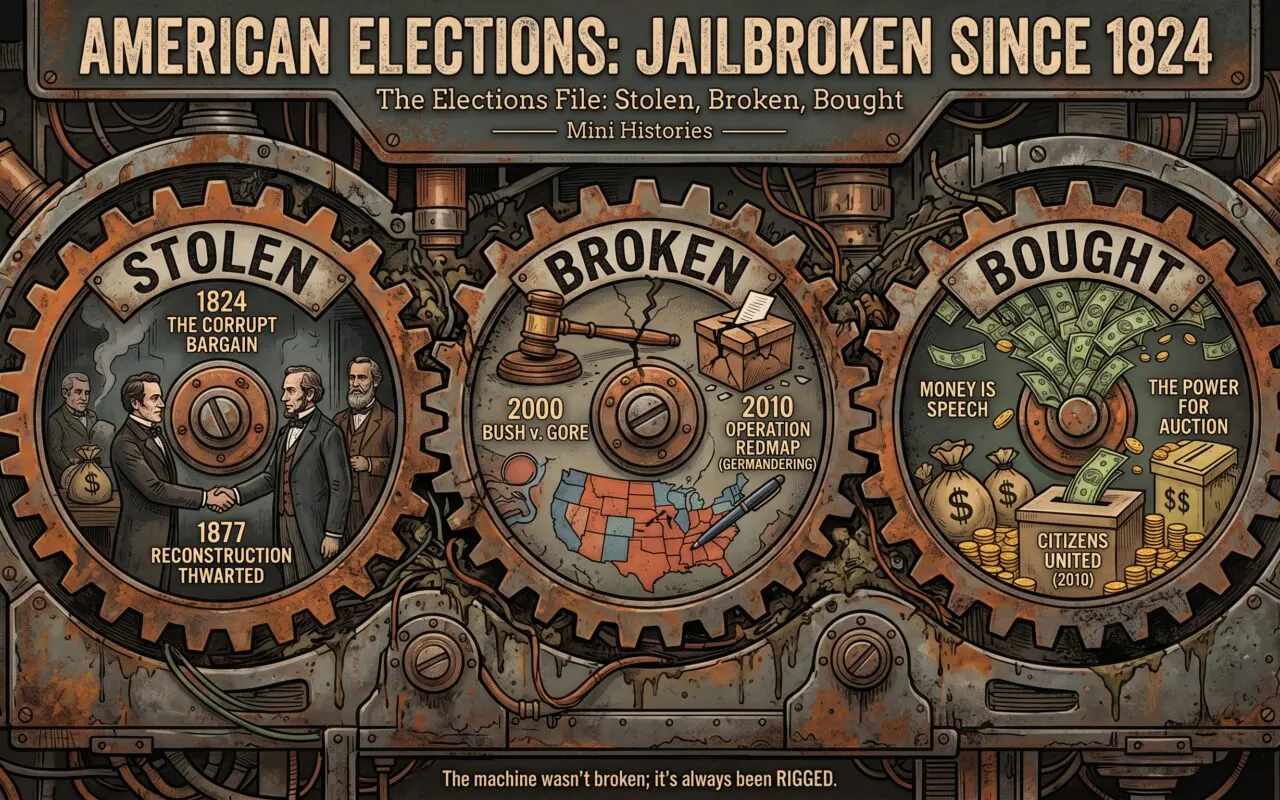
And the elections file is one of the thickest, because the thing the fairy tale leaves out is that American elections don’t get stolen on election day, via so-called voter fraud. They get stolen before it, broken around it, or bought after it — by the very elites who cry big crocodile tears about the unfairness of elections as they rig them in their favor (sometimes, with the blessing of SCOTUS including recently). Election denial becomes a whole grift in itself for the unpopular party that cheats. Using three failure modes, over two hundred years, one remarkably consistent cast of beneficiaries emerges again and again to wield power against the will of the people.
Let’s go to the tape.
Stolen: the backroom
Long before anyone “stopped the steal,” the steal was a gentleman’s arrangement — the proverbial smoke-filled back rooms where deals were made amongst men of influence.
The Corrupt Bargain (1824)
The first stolen presidential election happened earlier than you think — Andrew Jackson won the most votes and the most electors, and still walked away with nothing after the contest got thrown to the House and the runners-up cut a deal.
Reconstruction, Thwarted (1877)
A half-century later they did it again, only this time the price was an entire people’s freedom. To settle a disputed election, the parties traded away Reconstruction itself — federal troops out of the South, the door held open for Jim Crow.
A new long-form data brief on how representativeness has been gerrymandered away — and the first installment of a series on how American democracy was engineered to stop being competitive.
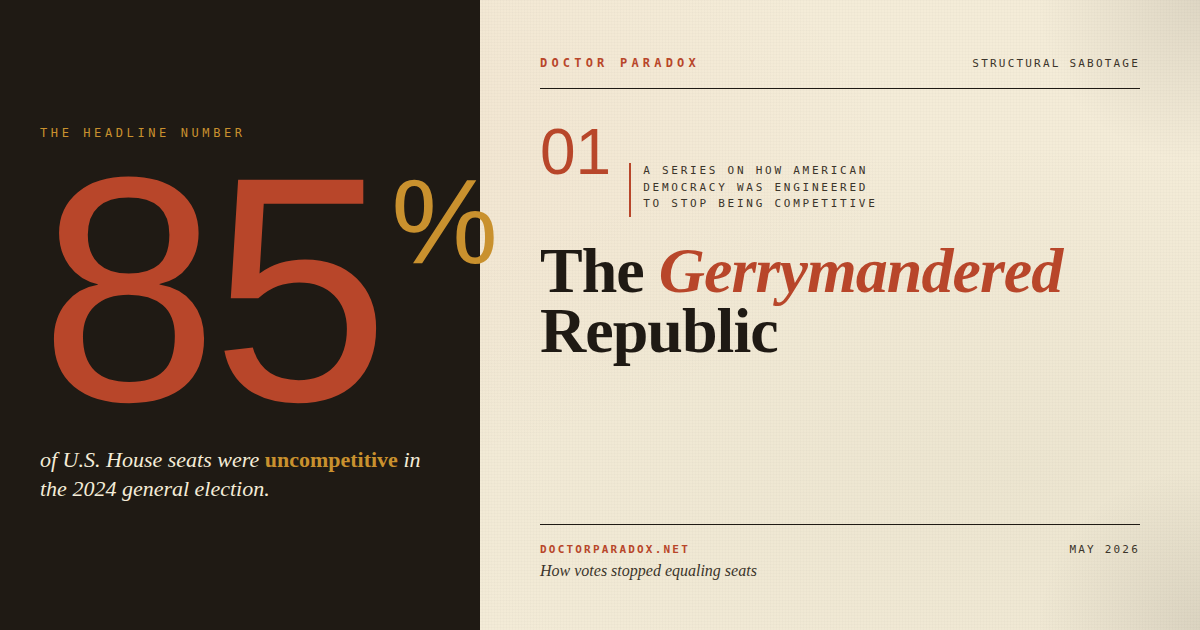
In 2024, Americans went to the polls to elect 435 members of the U.S. House of Representatives. 366 of those races were over before a single ballot was cast.
Not “predictable.” Not “incumbent advantage.” Decided — by maps drawn years earlier, with software, by politicians choosing their voters instead of the other way around. According to the Cook Political Report‘s 2024 ratings, only 69 of 435 House seats — 15% — were genuinely competitive in the general election. The other 85% were already in the Republican or Democratic column before campaigning began.
That’s the headline of the new Doctor Paradox data brief, The Gerrymandered Republic, and it’s the launch piece for a new series: Structural Sabotage, on the ways American democracy has been engineered to stop being competitive.
This first installment is the receipt-collection edition. It covers:
The vote-share vs. seat-share gap in Wisconsin, North Carolina, Ohio — and Maryland as the Democratic counter-example, because honesty matters
Packing and cracking — the two techniques every gerrymandered map uses, unchanged since 1812
The efficiency gap — the metric that quantifies how badly a map cheats
The collapse of swing seats from 164 in 1999 to 82 today — a 50% loss of competitive districts in 25 years
What actually works — independent commissions draw 19% of America’s districts and produce 41% of its toss-up races, a four-to-one ratio in favor of taking the pen out of politicians’ hands
The Supreme Court’s 2019 Rucho v. Common Cause decision, which closed the only federal door left
Click the image below to open the new mini-magazine style format:
Stay tuned for part 2 of the Structural Sabotage series — on how primaries weaponize safe seats — that will be coming next. If 85% of seats are decided before the general election, then who actually decides them? The answer is a much smaller and more ideological electorate than most Americans realize.
Please share. The cover-up that worked is still working, and the least we can do is make sure people can see the map.
The Kansas Prophecy: We Already Ran This Experiment and the SAVE Act in Kansas Was a Disaster
When Kansas tried its early version of the SAVE Act, a whopping 31,089 eligible American citizens were blocked from voting. Meanwhile only 39 noncitizens were “caught”… over 19 years. And many of them turned out to be administrative errors.
That’s the final score from Kansas’s proof-of-citizenship experiment — the same core policy the SAVE America Act would impose on all 50 states. Republicans are selling it as “election security.” Kansas already has the receipts on what it actually is.
Been There, Done That
In 2011, Kansas passed a law requiring documentary proof of citizenship to register to vote — a birth certificate, passport, or naturalization papers. It was the brainchild of then-Secretary of State Kris Kobach, who styled himself as America’s foremost crusader against the specter of rampant illegal voting. The law went into effect in 2013 and immediately went sideways.
DMV clerks weren’t allowed to request the new documents — or even tell people the requirement existed. Voter registration drives cratered: one effort at Washburn University collected 400 applications but managed to fully register roughly 75 people. A process that used to take five minutes stretched to an hour. Steven Fish, a warehouse worker born on a now-closed Air Force base in Illinois, couldn’t produce an acceptable birth certificate. Multiple plaintiffs in the lawsuit that followed were military veterans. All were U.S. citizens. None were the noncitizen bogeymen the law was supposed to stop.
The federal courts annihilated it. A 118-page district court ruling struck it down as unconstitutional. The 10th Circuit affirmed. The Supreme Court declined to hear it. The judge sanctioned Kobach personally and ordered him to take remedial legal education — a humiliation nearly without precedent for a sitting state official. Kansas paid $1.9 million in attorneys’ fees to the winning parties. The state’s current Republican Secretary of State, Scott Schwab — who voted for the law as a legislator — delivered the epitaph: “It didn’t work out so well.”
The “Problem” Rounds to Zero
And it’s not just Kansas. Everywhere officials have looked for the noncitizen voting crisis, they’ve found a rounding error:
The Heritage Foundation itself — which advocates for the SAVE Act — found 68 documented cases of noncitizen voting since the 1980s out of over a billion ballots cast; a rate of 0.0000001% (!). Utah reviewed its entire voter list of two million registrants and found one noncitizen registration and zero noncitizen votes. Georgia audited 8.2 million voters and found 20 noncitizens. The Brennan Center found 30 suspected cases across 23.5 million votes. This isn’t a policy responding to a problem. It’s a solution in search of a pretext.
The bill is also set to take effect immediately, which is fairly insane to think about such a radical change to the rules of voting mere months before an election. I’m old enough to remember when supposedly Good Governance dictated that we leave a Supreme Court seat empty for an entire year — allegedly so “The People” could have their say on this important lifetime appointment. If the precedent is supposed to be that no major structural changes happen during an election year, then how does the right wing justify the sudden about face? It’s okay only when a Republican is in office, no doubt.
Kansas at Scale
The SAVE America Act is Kansas’s disaster, federalized and supercharged. In addition to the proof-of-citizenship registration requirements, it would force states to hand voter roll data to DHS with no safeguards on how it’s used, criminalize election workers who register someone without the right paperwork — even if that person is a citizen — and effectively eliminate online registration, mail registration, and automatic voter registration programs used by millions.
It passed the House in February 2026. The Senate opened debate March 17. Prediction markets give it roughly an 11% chance of becoming law. Trump has threatened to block all other legislation — including DHS funding during a partial shutdown — until it passes. A leaked 17-page executive order draft would require all 211 million registered Americans to re-register in person if the Senate doesn’t comply.
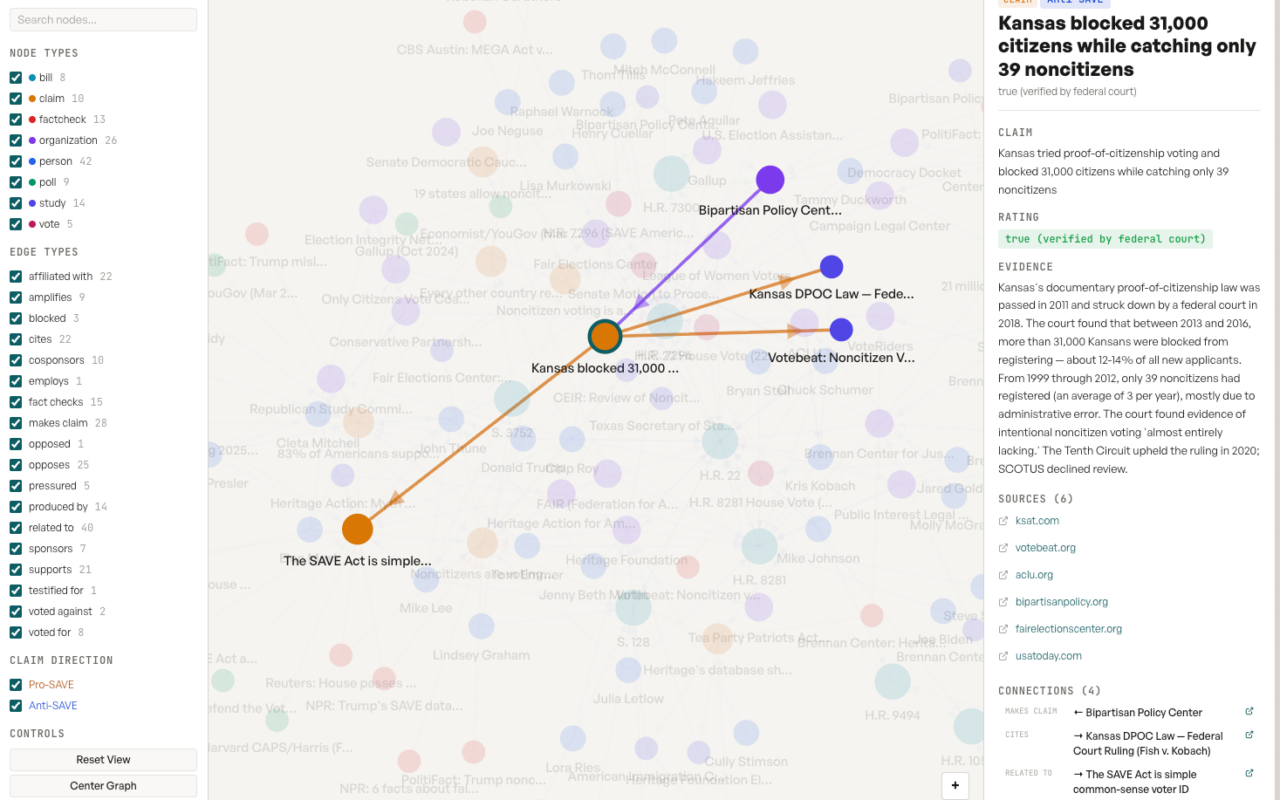
SAVE Act Network Graph Explorer
Explore the web of people, organizations, and money behind the push.
Kansas proved that proof-of-citizenship laws don’t catch noncitizen voters. They catch citizens. The 31,000-to-39 ratio isn’t a bug — it’s the feature. And the bill doesn’t need to pass the Senate to serve its real purpose: manufacturing a narrative that “Democrats are blocking election security,” setting the stage for executive overreach, filibuster destruction, or post-election delegitimization.
The Kansas cautionary tale isn’t that the policy is flawed. It’s that it works exactly as intended — just the opposite of the way they’re selling it.
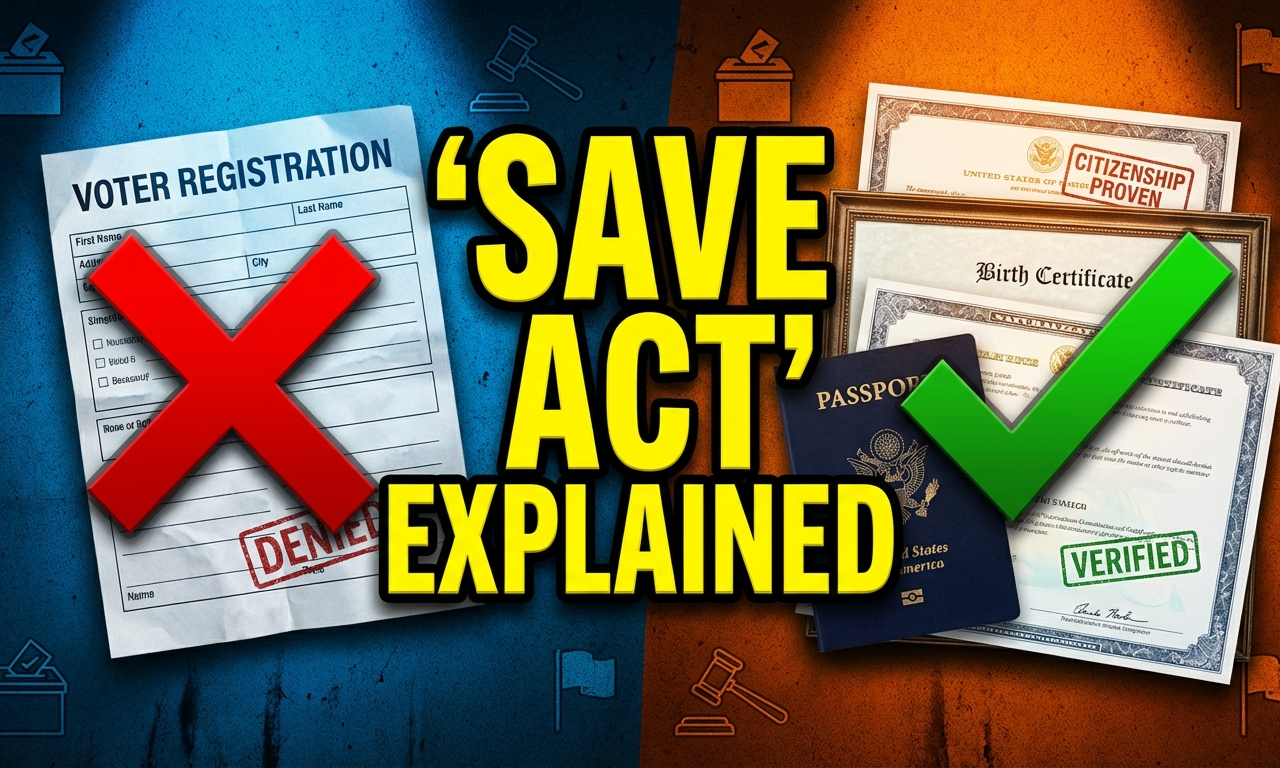
In this video, we break down the SAVE Act (H.R. 22) — a bill that demands documentary proof of U.S. citizenship just to register to vote in federal elections. It sounds reasonable for about 3 seconds, until you realize it’s a voter suppression machine dressed up in a flag pin. It is the legislative endrun around democracy that Trump promised when he told voters on the campaign trail that “you won’t have to vote anymore!”
What is the SAVE Act?
The “Safeguard American Voter Eligibility Act” amends the National Voter Registration Act of 1993 to require a passport or birth certificates paired with photo ID before you can register. For the roughly 21 million eligible citizens who don’t have easy access to those documents — disproportionately elderly, low-income, rural, Indigenous, and minority voters — it’s a wall. By design.
Election denialism, the refusal to accept credible election outcomes, has significantly impacted U.S. history, especially in recent years. This phenomenon is not entirely new; election denial has roots that stretch back through various periods of American history. However, its prevalence and intensity have surged in the contemporary digital and political landscape, influencing public trust, political discourse, and the very fabric of democracy.
Historical context
Historically, disputes over election outcomes are as old as the U.S. electoral system itself. For instance, the fiercely contested 1800 election between Thomas Jefferson and John Adams resulted in a constitutional amendment (the 12th Amendment) to prevent similar confusion in the future. The 1876 election between Rutherford B. Hayes and Samuel J. Tilden was resolved through the Compromise of 1877, which effectively ended Reconstruction and had profound effects on the Southern United States.
Yet these instances, while contentious, were resolved within the framework of existing legal and political mechanisms, without denying the legitimacy of the electoral process itself. Over time, claims of election fraud would come to be levied against the electoral and political system itself — with dangerous implications for the peaceful transfer of power upon which democracy rests.
The 21st century and digital influence
Fast forward to the 21st century, and election denialism has taken on new dimensions, fueled by the rapid dissemination of disinformation (and misinformation) through digital media and a polarized political climate. The 2000 Presidential election, with its razor-thin margins and weeks of legal battles over Florida’s vote count, tested the country’s faith in the electoral process.
Although the Supreme Court‘s decision in Bush v. Gore was deeply controversial, Al Gore’s concession helped to maintain the American tradition of peaceful transitions of power.
The 2020 Election: A flashpoint
The 2020 election, marked by the COVID-19 pandemic and an unprecedented number of mail-in ballots, became a flashpoint for election denialism. Claims of widespread voter fraud and electoral malfeasance were propagated at the highest levels of government, despite a lack of evidence substantiated by multiple recounts, audits, and legal proceedings across several states.
The refusal to concede by President Trump and the storming of the U.S. Capitol on January 6, 2021, marked a watershed moment in U.S. history, where election denialism moved from the fringes to the center of political discourse, challenging the norms of democratic transition. Widely referred to as The Big Lie, the baseless claims of election fraud that persist in the right-wing to this day are considered themselves to be a form of election fraud by justice officials, legal analysts, and a host of concerned citizens worried about ongoing attempts to overthrow democracy in the United States.
Implications, public trust, and voter suppression
The implications of this recent surge in election denialism are far-reaching. It has eroded public trust in the electoral system, with polls indicating a significant portion of the American populace doubting the legitimacy of election results. This skepticism is not limited to the national level but has trickled down to local elections, with election officials facing threats and harassment. The spread of misinformation, propaganda, and conspiracy theories about electoral processes and outcomes has become a tool for political mobilization, often exacerbating divisions within the American society.
Moreover, election denialism has prompted legislative responses at the state level, with numerous bills introduced to restrict voting access in the name of election security. These measures have sparked debates about voter suppression and the balance between securing elections and ensuring broad electoral participation. The challenge lies in addressing legitimate concerns about election integrity while avoiding the disenfranchisement of eligible voters.
Calls for reform and strengthening democracy
In response to these challenges, there have been calls for reforms to strengthen the resilience of the U.S. electoral system. These include measures to enhance the security and transparency of the voting process, improve the accuracy of voter rolls, and counter misinformation about elections. There’s also a growing emphasis on civic education to foster a more informed electorate capable of critically evaluating electoral information.
The rise of election denialism in recent years highlights the fragility of democratic norms and the crucial role of trust in the electoral process. While disputes over election outcomes are not new, the scale and impact of recent episodes pose unique challenges to American democracy. Addressing these challenges requires a multifaceted approach, including legal, educational, and technological interventions, to reinforce the foundations of democratic governance and ensure that the will of the people is accurately and fairly represented.