authoritarian

Alex Pretti just before he died at the hands of federal agents in Minneapolis

There was a weird controversy that set in after the events of the white nationalist Unite the Right rally in Charlottesville, VA in which a neo-Nazi 8chan bottomfeeder killed Heather Heyer by running her over with his car, while injuring 19 others. It was a shocking moment for the nation and all Trump had to say about it was they condemned violence “on many sides, on many sides” — though there were only two sides, and only one of those two sides had killed someone.

A couple of days later he managed to get through a scripted teleprompter statement explicitly condemning white supremacists and neo-Nazis only to walk it back again and then double down on it the following day, saying “The statement I made on Saturday, the first statement, was a fine statement… What I’m saying is this: You had a group on one side and you had a group on the other, and they came at each other with clubsβ€”and it was vicious and it was horrible. You had some very bad people in that group, but you also had people that were very fine people, on both sides.”

First of all, both sides did not have clubs. One side had tiki torches and a car that killed someone while the other side was armed with hymnals and homemade signage. Secondly — where were those “other” fine people? The vagueness allows for almost any interpretation — were some of the people with clubs “very fine” despite beating others about the head? Were some of the people who didn’t have clubs themselves but were cheering on the people with clubs “fine people”? Maybe there was a gathering of small invisible fairies merely caught up in the shuffle and Trump wanted to just make sure that possibility didn’t get overlooked and this innocent group of delicate souls unnecessarily besmirched?

The primary chosen “debunk” that detractors ended up going with from the wet clay of Trump’s stilted statement alleges that the *other* side Trump meant by “both” were simply innocent local townsfolk objecting to the removal of a statue of their beloved hero Robert E. Lee. Besides the fact that the right-wing has failed to this day to produce a shred of evidence that such people were even there, and the inconvenient reality that the rally was openly marketed as a white supremacist event, organized by avowed white nationalist organizations, it doesn’t even matter if they could produce such evidence — because those people are still not very fine! Robert E. Lee was a traitor to the United States and exalting him is not good!

In fact, Robert E. Lee was a terrible human being whose noble cause was maintaining his ownership of other human beings — as well as a shitty general who paid zero attention to the battle after giving a set of static orders and hoping God would sort out the rest. All he had to do was defend the borders of his baby white homeland, but he was an arrogant showboat who couldn’t keep it in his pants and had to go attacking Pennsylvania for no good reason.

He was also a senseless butcher who had the highest casualty rate of the entire war, being so reckless with his soldiers’ lives that he may as well have fed them into a woodchipper. He chewed through his entire army of 100,000 only 14 months into the campaign and by the war’s end had effectively annihilated his original army multiple times over through cumulative losses, as well as obliterating a whopping 30% of the total Confederate forces overall despite leading only one army in one theater.

He was overconfident and mean-spirited like the rest of his Confederate compadres, feeling that his natural superiority would win the day without much effort. He was trounced and the moral bankruptcy of the Confederacy defeated, but to this day the spirit of the “Lost Cause” animates an unholy miasma of sadistic trolls, anti-government whackjobs (who nevertheless guzzle Trump’s emissions), and stone cold psychopaths who feel the “Cause” — aka white supremacy — is still worth fighting for.

The Confederacy lost. But the ideology β€” the conviction that some people are simply born to rule over others, that cruelty is strength, that losing doesn’t mean you were wrong β€” has never died. It just went underground, waiting, simmering. And in Charlottesville, it walked openly in the streets again — wearing khakis and carrying torches, feeling emboldened enough to show its face.

This movement of treasonous trolls had to lick its wounds and bide(n) its time between 2021 and 2025, but true to his word (for once), when Senile Orange Grandpa conned enough noobs to retake the White House in 2024, he pardoned all the January 6 rioters on day one. Including, of course, hundreds of avowed white nationalists from groups he had claimed — fleetingly — to disavow. Including their leaders, among the rare breed of individuals who have ever been convicted of seditious conspiracy in the history of this country, each serving up to 20-year sentences. And including violent thugs who beat Capitol police officers with bats, flagpoles, their own stolen shields, and numerous blunt objects on hand.

People who maced, pepper sprayed, bear sprayed, and electrocuted law enforcement with their own tasers. Folks who committed the obvious crime, broadcast live to the whole world, of breaking and entering at multiple entry points, including overwhelming a line of officers with a physical siege — then rampaged through the halls of Congress defiling, destroying, and stealing irreplaceable historical objects and defecating on lawmakers’ desks. And after all this, they fled the scene and hid from law enforcement — despite having collectively livestreamed the entiretiy of it and posting thousands of “trophy shots” on social media themselves, on top of being filmed by TV cameras from news organizations around the globe.

Then they lied about it. They continue to lie about it. President Trump continues to lie about it. The Republican Party continues to lie about it. A day which resulted in the deaths of 5 law enforcement officers and injuries to 150 more members of the “blue line.”

And yet.

We are to believe.

That Alex Pretti deserved to die because law enforcement found him “threatening.”

While standing at the side of the road, with a hand waved in a gesture of surrender, and looking away from the scene over his shoulder out of concern for an individual in distress.

No. We call bullshit. We know these ghost skins have no trouble killing one of their own from the killing of Renee Good, regardless of whatever Great Replacement idiocracy they espouse about the white race — if you get in their way, killing you is perhaps the one unbiased act they will perform free of bigotry to anyone who disagrees with them. Because if they happen to possess an ounce of shame, they never let a molecule of it leak out in public.

People with no shame may skirt the technical bounds of the law at times in order to prolong their abuse of the system, but completely disrespecting the spirit of the law inevitably leads them to break it. If they get away with it, they do it more. If they get caught, they double down. Blame the victim. Blame the media. Blame Biden. Blame Obama. Blame Clinton. Assert absurd moral authority based on a trash heap ideology that shifts like a toxic oil spill and makes no sense. State that plainly true facts are wrong and obviously thin lies are inarguable truths. Behave like the most morally depraved psychopaths online and in public, exalting violence and relishing petty revenge, smearing the names of random bystanders they shot in the street mere minutes ago, and generally treating human life as political toys for them to play with, or a casual game of Call of Duty IRL — all in the name of Jesus.

It is vile. It is a blackened pile of steaming horseshit smeared across the nation. It is a moral stain being done in our name that we will never, ever, ever, ever in the history of history live down — that this is happening here. That we allowed this to happen here. That we are allowing this to happen here. We must not allow this to happen here.

Read more

Kristie Noem in her ICE Barbie cosplay outfit, between 2 thugs, saying "The only thing I regret is not being there to shoot the bitch myself"

The shooting in Minneapolis last week of Renee Good, a 37-year-old wife and mom to 3 kids, hit me really hard. It’s not just that she was in a lesbian couple like me, with kids from previous husbands — and that I would be the one in the passenger’s seat. It’s because of the brazenness — pride, even — of the officer who ended her life cavalierly and without remorse.

The smear campaign about this woman nauseates me deeply — it began mere milliseconds after her death when the officer who shot her at point-blank range yelled “fuckin’ bitch!” after her vehicle and escalated extremely quickly to the sitting President, Vice President, and Homeland Security Secretary calling her a “domestic terrorist” despite the physical impossibility of being able to confirm that kind of information so quickly.

It is clear that agent Jonathan Ross escalated the situation himself. He broke DHS policy by putting himself in the path of a moving vehicle. And he should not have had his cellphone out, occupying his other hand, when he drew his weapon — you need the hands to be unobstructed to maximize your ability to handle any situation that may emerge.

He claimed he was afraid for his life — when? Show me on tape at which moment(s) in time this agent appears to behave an a fearful manner, because I do not see it. There are the moments when he’s calmly walking around the entire vehicle recording on his cellphone, moments when he has calmly drawn his gun and is pointing it at Renee Good, and moments where he is shouting and shooting bullets into her head. Where is the fear? He doesn’t run or dive; he doesn’t scream; he doesn’t call for help; he doesn’t show any surprise. He doesn’t seem fearful — he seems in control of the situation at all times, including when he pulls the trigger 3 times to take someone’s life as punishment for being cheeky.

Continue reading The killing of Renee Good
Read more

They do not care about you — you are expendable to them. They do not GAF. Especially now with AI — they are gonna replace you anyway brah! At best they are biding time putting you on a drip feed of murder porn and revenge fan fic until the moment they are completely certain they’ve hijacked the electoral system at which time you too, buddy, will be shown the airlock into a deep space void no one will ever hear you from because they have all the powers of the earth to override whatever puny narrative you may have had for yourself.

You will be crushed like a bug 1000x tinier than Kafka’s roach — millions at a time under the heels of casually sadistic billionaires many of whom were Democrats up until 5 minutes ago when someone offered them a deal to cut their tax bill in exchange for a measley few million dollars. It’s “irrational” to not take the deal. You have to take the deal. Your competitors have taken the deal. You’d be the only chump not taking the deal. It’s the Art of the Deal, right?

Deals are all that matter. Transactionality is all there is — including reducing the beautiful, awe-inspiring teachings of Jesus to a mere materialistic creed, draped in a flag, shouted from a bullhorn, fired into an already capsized boat, and shot into the heads of innocent bystanders if they don’t comply with conflicting directives.

Read more

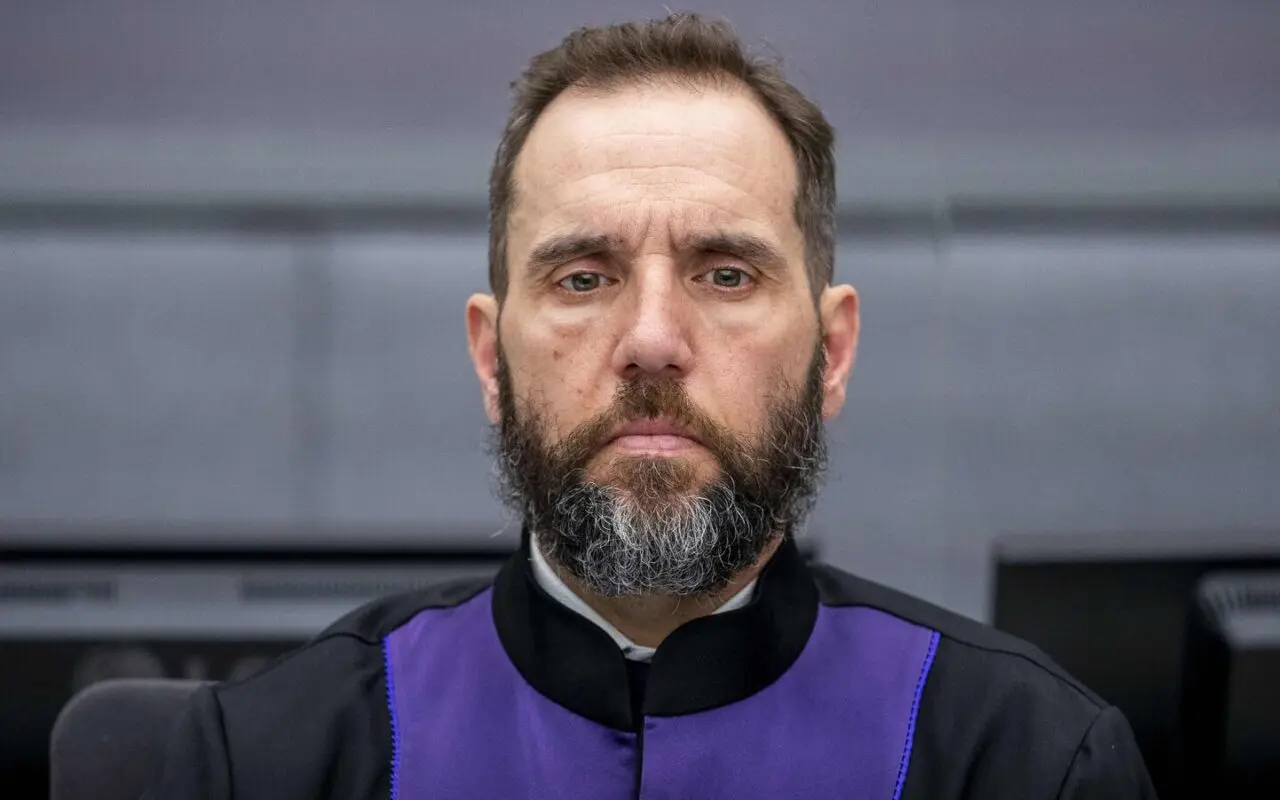
Jack Smith, Special Prosecutor in two federal cases brought against Donald Trump

Five years ago today, a violent mob stormed the United States Capitol in an attempt to overturn a free and fair election. The man who incited them has since been re-elected president, which scuppered the investigation into him by Special Counsel Jack Smith. If that whiplash isn’t enough to give you vertigo, consider this: we now have sworn testimony, under oath, from the prosecutor who investigated Trump laying out exactly why his office believed they could convictβ€”and why they were stopped.

Former Special Counsel Jack Smith’s December testimony before the House Judiciary Committee is the closest thing we’ll get to the trial that should have happened. In it, Smith methodically dismantles every defense Trump and his allies have offered, explains how the case was built on testimony from Republicans willing to put country over party, and makes clear that the evidence of Trump’s guilt wasn’t circumstantialβ€”it was direct.

In this post, I’m breaking down the key takeaways from Smith’s testimony, sharing one of my AI #MiniHistory videos marking the anniversary, and giving you a way to interrogate the evidence yourself through an interactive NotebookLM bot. Because if there’s one thing the incoming administration is counting on, it’s that you won’t have time to read 255 pages of testimony. Let’s make sure they’re wrong.

January 6 in 40 seconds

But first, a J6 refresher course — again, for busy folks.

I’ve been into making these little AI #MiniHistory videos with Glif agents, trying to tease out important signposts along our road to dictatorship and other interesting moments in history to highlight. Here’s the one I did for today and the 5th anniversary of January 6, 2021:

Trump has still never been held accountable for his actions that day — the election of 2024 put a boot in the face of any hope for justice prevailing against the Chief Insurrectionist. Nevertheless, Jack Smith replanted a tendril of hope in his mid-December testimony to Congress with a scathingly clear broken record message that Trump was guilty and they had all the receipts they needed to prove it and then some. It lays down new tracks in the Congressional record that will be impossible to expunge, regardless of whatever trash MAGA fairy tale of J6 the right-wing goons decide to slather on the White House website.

Jack Smith testifies to Trump’s guilt “beyond a reasonable doubt”

In eight hours of testimony before the House Judiciary Committee on December 17, 2025, former Special Counsel Jack Smith laid out why his office was prepared to convict Donald Trump on federal charges. Speaking under oath in a closed-door deposition β€” the Republicans who now hold the gavel had denied his request to testify publicly (after crying decades of crocodile tears over ‘transparency’?? truly?) β€”Smith called Trump “the most culpable and most responsible person” in the criminal conspiracy to overturn the 2020 election.

Continue reading Remembering January 6: Here’s how Jack Smith saw it
Read more

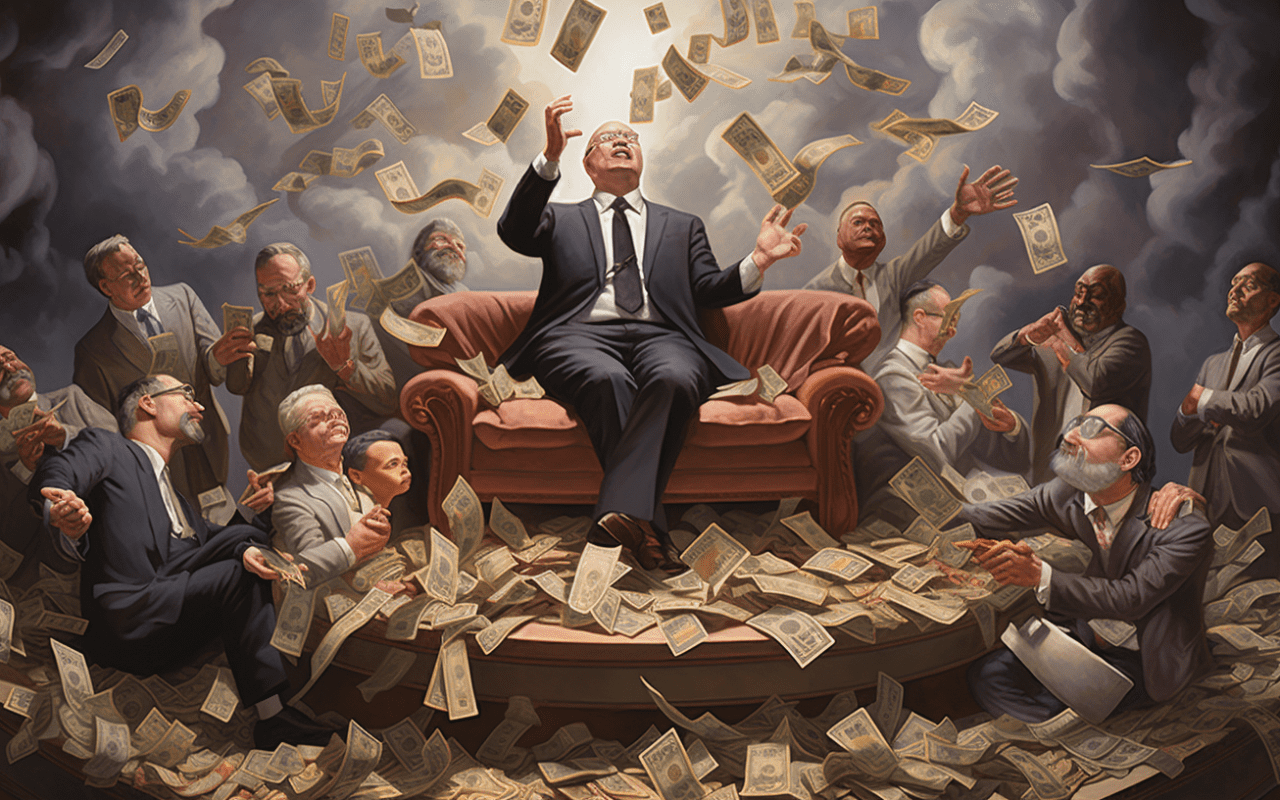
Wealth Cult -- rich men behaving badly, by Midjourney

A network of exceedingly wealthy individuals and organizations have channeled their vast fortunes into influencing American politics, policy, and public opinion — they’ve formed a wealth cult. And they’ve leveraged that cult and its considerable fortune to influence and in many ways dramatically transform American politics.

The most succinct way I have come up with to explain American politics is that the wealthy are dividing us over race and religion. Today far more openly than in the past, where much oligarch shadow influence was delivered via dark money kept intentionally untraceable back to its origins.

The term “dark money” refers to political spending meant to influence the decision-making and critical thinking of the public and lawmakers where the source of the money is not disclosed. This lack of transparency makes it challenging to trace the influence back to its origins, hence the term “dark.”

And, it is dark indeed.

Wealth cult anchors the trench coat

The Wealth Cult is one of 3 primary groups or clusters supporting the right-wing and generally, the Republican Party. It anchors the trench coat by funding the 2 cults above it: the Christian Cult, and the White Cult.

Its story is stealthy and significant.

A bunch of billionaires toast themselves to themselves, by Midjourney

The wealth cult has funded disinformation campaigns, the spread of conspiracy theories, created fake social movements through astroturfing, enabled violent extremists to attack their country’s capitol, aided and abetted a convicted felon, cruelly deprived vulnerable people (especially immigrants, poor people, and women) of the kind of state aid granted generously throughout the developed world, bribed regulators, rigged elections, crashed economies, and on and on in service of their extremist free market ideology beliefs (which, by the way, have resulted in catastrophic market crashes every single time).

They believe in “makers and takers,” or Mudsill Theory, as it was once called by pedophile and racist Senator and slavery enthusiast James Henry Hammond. Some people were born to serve others, they say. Hierarchies are natural, they claim. Wealthy men should make all the decisions — because that’s what’s best for everyone, they say in paternalistic tones.

I don’t buy it. I believe all men are created equal. So did a certain Founder of our country.

Continue reading Wealth Cult: The oligarchs influencing American politics from the shadows
Read more

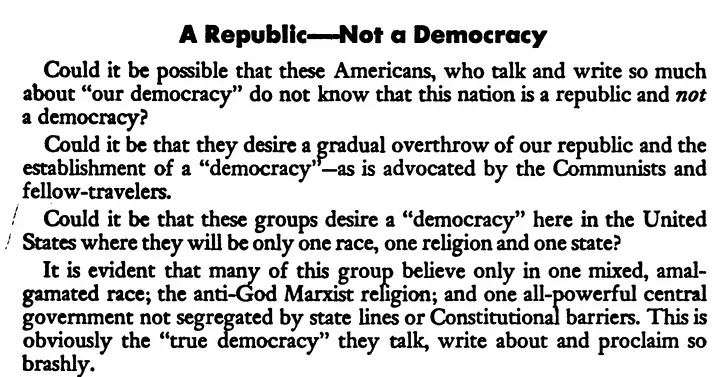
You’ll hear a common retort on the extreme right that now holds sway in the mainstream Republican Party, in response to protests about the dismantling of democracy in this country — that we’re “a republic, not a democracy.” Right off the bat, a republic is a form of democracy — so they are claiming something akin to having a Toyota and not a car. It’s a rhetorical trick, in which people who fully know better are hacking the simple ignorance of civics and basic political philosophy of the right-wing political base.

But it manages to get worse — the origins of the bully taunt “a republic, not a democracy” go way back — they’re actually located in the segregationist movement. Specifically, the concept comes from the pro-segregation book You and Segregation, written in 1955 by future Senator Herman E. Talmadge.

John Birch Society loonies laud “a republic, not a democracy”

The “republic, not a democracy” meme would go on to be featured in the John Birch Society Blue Book — an organization so toxically extremist that even conservative darling William F. Buckley distanced himself from them. They feared the idea that increasing democratization would be a shifting balance of power away from white conservative men, and they spun numerous conspiracy theories to explain this as the result of nefarious undercover plot to overthrow Western Civilization.

In reality, the trend towards greater democracy is something the Founders themselves envisioned — though they likely could not have imagined how it would turn out. They believed fiercely in self-governance, and a clear separation from the tyranny of kings.

Continue reading “A republic, not a democracy” came from segregationists
Read more

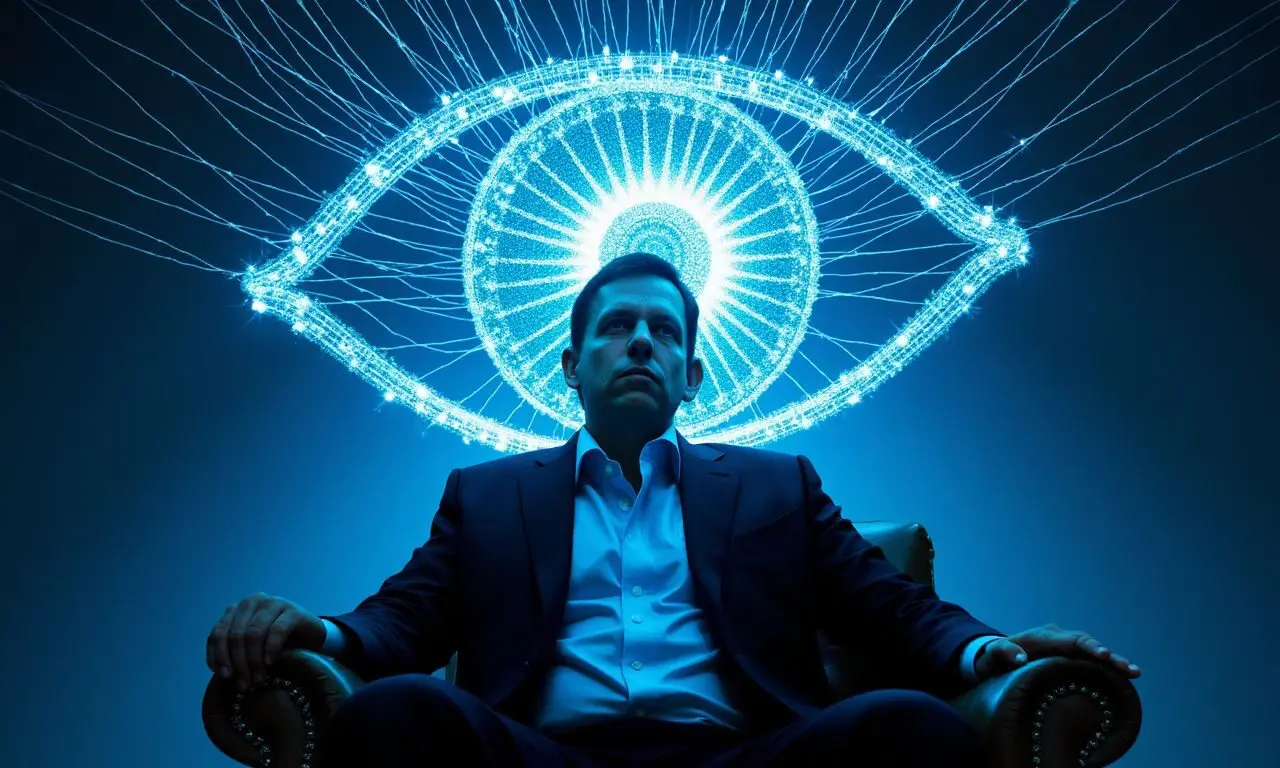
Peter Thiel sits in a far future, under an all-watchful digital eye

Peter Thiel FAQ: The Contradictions of Silicon Valley’s Dark Philosopher

Peter Thiel occupies a rarefied place in the modern pantheon of tech billionaires β€” less the tinkerer or engineer than the theorist-king of the movement. A venture capitalist, PayPal co-founder, Facebook’s first major outside investor, and the billionaire backer of numerous reactionary causes, Thiel has built a career at the intersection of money, ideology, and myth. He is the financier of futuristic dreams β€” and dystopian nightmares.

Born in Frankfurt and raised in California, Thiel studied philosophy at Stanford, where he was captivated by the writings of Leo Strauss and RenΓ© Girard. These thinkers β€” one obsessed with the hidden logic of political elites, the other with the contagious nature of human desire β€” shaped Thiel’s enduring worldview: that civilization is locked in cycles of envy and collapse, and only an enlightened few can see beyond the herd. In this sense, Thiel has always seen himself less as a businessman and more as a philosopher of power.

His ventures, from PayPal to Palantir, form a kind of metaphysical architecture of control. PayPal, the proto-financial infrastructure of the internet, made Thiel his fortune. Palantir, as explored deeper in What Is Palantir?, has monetized the surveillance state. In between, Thiel cultivated a cadre of disciples β€” the so-called PayPal Mafia β€” that went on to dominate Silicon Valley. His investments in companies like Facebook gave him not only wealth but leverage: a front-row seat in the grand experiment of data-driven social engineering.

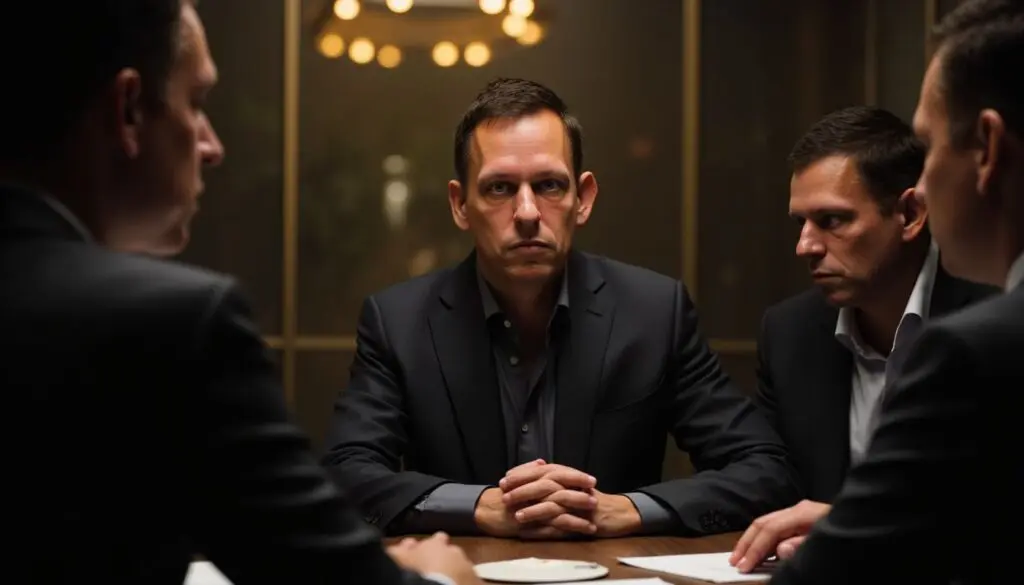
Peter Thiel at an imaginary round table of Peter Thiels

But Thiel’s influence extends far beyond technology. He bankrolls candidates, think tanks, and movements aimed at reshaping our very democracy itself. In Peter Thiel and the Antichrist, I explored how Thiel’s quasi-religious futurism blends techno-eschatology with authoritarian politics β€” a longing for an end-times β€œreset” that he sees as necessary for renewal. His protΓ©gΓ©s, like Palmer Luckey and J.D. Vance, carry forward the same paradoxical ethos: rebellion against democracy in the name of β€œfreedom.” As I argued in Palmer Luckey, Peter Thiel, and the Welfare Queens of Defense, his ventures often feed off the very government systems they publicly scorn.

Continue reading Peter Thiel FAQ
Read more

What is fascism, and what are the signs of fascism? The fascist form of government is a complex and multi-faceted ideology that can manifest in various ways, making it challenging to pin down with a single definition.

Fascism resists simple definition precisely because it’s a syncretic ideologyβ€”adaptable to different contexts while maintaining core structural features. Rather than a fixed doctrine, it operates as a political methodology characterized by specific power dynamics, rhetorical strategies, and institutional patterns.

Structural characteristics of fascism

These are the ideological foundations and belief systems that define fascist movementsβ€”not merely policy positions but the fundamental orientations toward power, identity, and social organization that shape how fascism understands the world and its place in it.

  1. Authoritarian Consolidation: Fascism centralizes power through the dismantling of horizontal accountability structures, typically concentrating authority in a charismatic executive who positions themselves above institutional constraints.
  2. Ultranationalism as Identity Politics: Goes beyond patriotism to assert inherent civilizational superiority or racial supremacy, often manifesting as collective narcissism where national mythmaking replaces historical accuracy.
  3. Militarized Social Order: Valorization of martial virtues, hierarchical discipline, and violence as political tools. Fascist movements frequently draw from veteran communities and paramilitary traditions.
  4. Anti-Intellectualism and Epistemic Closure: Systematic devaluation of expertise, academic inquiry, and empirical reasoning in favor of intuition, emotion, and revealed truth. The “coastal elite” or “ivory tower” becomes a rhetorical enemy.
  5. Ethno-Nationalism and Boundary Enforcement: Xenophobia operating through strict in-group/out-group categorization, often targeting immigrants, religious minorities, or racialized “others.”
  6. Reactionary Temporal Orientation: Deployment of a mythologized past as political programβ€”the promise to restore a golden age that never existed, weaponizing nostalgia against pluralism.
  7. Anti-Leftist Mobilization: Positioning communism, socialism, and progressive movements as existential threats, often conflating disparate left ideologies to create a unified enemy.

The Us vs. Them Architecture: In-group/Out-group dynamics as core infrastructure

Fascism doesn’t just exploit social divisionsβ€”it requires their constant production and intensification as its primary source of political energy. While most political movements contain some degree of group identity, fascism is structurally dependent on a stark binary between insiders and outsiders, making this dynamic its foundational operating system rather than an incidental feature. The movement coheres not around shared policy goals or governance philosophy, but around the ongoing project of boundary maintenance: defining, defending, and purifying the “us” against an ever-present “them.”

Continue reading Warning Signs of Fascism
Read more

Peter Thiel at Isengaard looking into the Palantir

Peter Thiel has a plan to save the world, and it looks like a nightmare. He’s casting around for scapegoats, but perhaps Peter Thiel and the Antichrist are one and the same.

The PayPal co-founder, Facebook‘s first outside investor, and Silicon Valley‘s most influential political operator has spent years developing a political philosophy so strange that most people assume it can’t be serious. Democracy and freedom are incompatible, he says. Global cooperation is the Antichrist. The only hope for civilization is absolute monarchy modeled on tech startups. And he’s not just theorizingβ€”he’s building it.

Thiel has poured millions into political campaigns, funded think tanks, mentored a generation of “New Right” intellectuals and alt-Right screeders, and cultivated politicians who share his vision. He’s amplified fringe thinkers like Curtis Yarvin (the blogger behind “Neoreaction” who openly advocates abolishing democracy), but Thiel’s worldview is uniquely his ownβ€”a bizarre synthesis of Christian eschatology, corporate governance theory, and techno-authoritarianism that’s far more sophisticated and disturbing than anything coming from the intellectual dark web.

This isn’t just eccentric billionaire philosophy. Thiel’s protΓ©gΓ©s include a sitting Vice President (J.D. Vance) and multiple Republican senators. His ideas circulate through conservative think tanks and Trump‘s inner circle. What sounds like science fiction is increasingly becoming Republican policy doctrine.

The media often portrays Thiel as an enigmatic libertarian or contrarian thinker. But that framing misses what’s actually happening. This is a systematic rejection of 250 years of democratic governance, wrapped in theological language and corporate efficiency rhetoric. And it’s weirder and more methodical than most people realize.

Peter Thiel and the Antichrist in 8 minutes (video)

This NotebookLM video does a great job explaining the background and impact of Thiel’s dangerously apocalyptic rhetoric inspired by Nazi theorist Carl Schmitt — and below it you can find a deeper explanation of all major points:

Here are the five interlocking beliefs that form Thiel’s visionβ€”and why each one should terrify you.

1. Democracy Is the Bug, Not the Featureβ€”Replace It With a Tech Startup Dictatorship

Thiel doesn’t just critique democracyβ€”he’s concluded it’s fundamentally incompatible with freedom. In a 2009 essay, he wrote: “I no longer believe that freedom and democracy are compatible.” Not ideal partners; not in tension — but incompatible.

His alternative is coldly corporate: run countries like founders run startups. One CEO. One vision. Absolute authority. No consensus. No debate. No democracy.

Continue reading Peter Thiel and the Antichrist: 5 Weirdo beliefs driving the new tech right
Read more

The Founders knew acutely the pains of centuries of religious warfare in modern Europe and resoundingly did not want that for their new nation. Many of them moreover knew religious persecution intimately — some whose families fled the Church of England for fear of being imprisoned, burned at the stake, or worse. Is America a Christian nation? Although many Christians certainly have come here, in a legal and political sense the nation’s founders wanted precisely the opposite of the “Christian nation” they were breaking with by pursuing independence from the British.

Contrary to the disinformation spread by Christian nationalists today, the people who founded the United States explicitly saw religious zealotry as one of the primary dangers to a democratic republic. They feared demagoguery and the abuse of power that tilts public apparatus towards corrupt private interest. The Founders knew that religion could be a source of strife for the fledgling nation as easily as it could be a strength, and they took great pains to carefully balance the needs of religious expression and secular interests in architecting the country.

James Madison: 1803

Americans sought religious freedom

The main impetus for a large percentage of the early colonists who came to the Americas was the quest for a home where they could enjoy the free exercise of religion. The Protestant Reformation had begun in Europe about a century before the first American colonies were founded, and a number of new religious sects were straining at the bonds of the Catholic Church’s continued hegemony. Puritans, Mennonites, Quakers, Jesuits, Huguenots, Dunkers, Jews, Amish, Lutherans, Moravians, Schwenkfeldians, and more escaped the sometimes deadly persecutions of the churches of Europe to seek a place to worship God in their own chosen ways.

By the late 18th century when Thomas Jefferson wrote the Declaration of Independence, many religious flowers were blooming within the 13 colonies. He had seen for himself the pitfalls of the experiments in which a unitary control of religion by one church or sect led to conflict, injustice, and violence. Jefferson and the nation’s other founders were staunchly against the idea of establishing a theocracy in America:

  • The founding fathers made a conscious break from the European tradition of a national state church.
  • The words Bible, Christianity, Jesus, and God do not appear in our founding documents.
  • The handful of states who who supported “established churches” abandoned the practice by the mid-19th century.
  • Thomas Jefferson wrote that his Virginia Statute on Religious Freedom was written on behalf of “the Jew and the gentile, the Christian and the Mahometan, the Hindu and the infidel of every denomination.” In the text he responds negatively to VA’s harassment of Baptist preachers — one of many occasions on which he spoke out sharply against the encroachment of religion upon political power.
  • The Constitution explicitly forbids a religious test for holding foreign office.
  • The First Amendment in the Bill of Rights guarantees that “Congress shall make no law respecting the establishment of religion, or prohibiting the free exercise thereof.”
  • There is a right-wing conspiracy theory aiming to discredit the phrase “wall of separation between church and state” by claiming that those exact words aren’t found in the Constitution.
    • The phrase comes from Thomas Jefferson’s 1802 letter to the Danbury Baptists, wherein he is describing the thinking of the Founders about the meaning of the First Amendment’s Establishment Clause, which Jefferson contemplates “with sovereign reverence.”
    • The phrase is echoed by James Madison in an 1803 letter opposing the building of churches on government land: “The purpose of separation of Church and State is to keep forever from these shores the ceaseless strife that has soaked the soil of Europe with blood for centuries.”
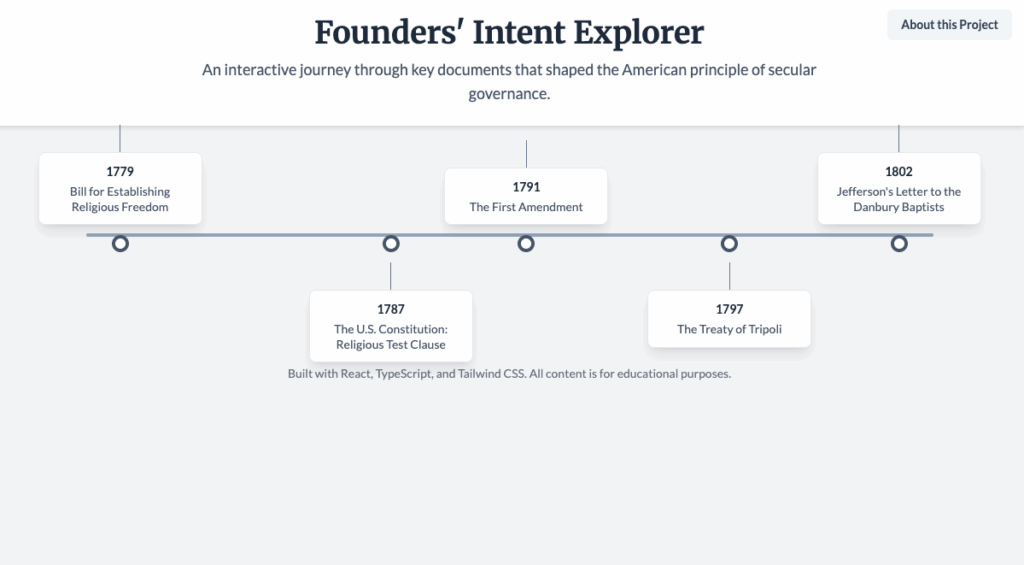
  • The 1796 Treaty of Tripoli states in Article 11: “As the government of the United States of America is not in any sense founded on the Christian Religion,-as it has in itself no character of enmity against the laws, religion or tranquility of Musselmen,-and as the said States never have entered into any war or act of hostility against any Mehomitan nation, it is declared by the parties that no pretext arising from religious opinions shall ever produce an interruption of the harmony existing between the two countries.” — President George Washington first ordered the negotiation of a treaty in 1795, and President John Adams sent the treaty to the Senate for ratification in 1797, with this article widely interpreted to mean a reiteration of the purpose of the Establishment Clause to create a secular state, i.e. one that would not ever be going to holy war with Tripoli.

Critical Dates for Religious Freedom in America

From the very beginning the Founders made clear they did not want to repeat the mistakes of Old Europe. They established a secular government that offered religious freedom to many who had felt persecuted in their homelands — for generations to come.

Get a quick overview of some of the most important moments in American history and its founding documents with our interactive timeline below.

The Founders were deists

Moreover, the majority of the prominent Founders were deists — they recognized the long tradition of Judeo-Christian order in society, but consciously broke from it in their creation of the legal entity of the United States, via the Establishment Clause and numerous other devices. The founders were creatures of The Enlightenment, and were very much influenced by the latest developments of their day including statistics, empiricism, numerous scientific advancements, and the pursuit of knowledge and logical decision-making.

What Deism Actually Meant: Deism in the 18th century was a rationalist religious philosophy that accepted the existence of a creator God based on reason and observation of the natural world, but rejected supernatural revelation, miracles, and divine intervention in human affairs. Think of it as “God as clockmaker” β€” God designed the universe with rational laws, set it in motion, and then stepped back. This was a radical departure from traditional Christianity.

The Enlightenment Context:

The Founders were steeped in Enlightenment philosophy β€” Locke, Montesquieu, Voltaire, Hume. They believed in:

  • Empiricism over revelation β€” knowledge comes from observation and reason, not scripture
  • Natural rights derived from human nature and reason, not divine command
  • Social contract theory β€” government legitimacy comes from consent of the governed, not God’s anointing
  • Scientific method β€” Newton’s physics showed that the universe operated by discoverable natural laws

This was a revolutionary shift. They were designing a government based on Enlightenment principles in an era when most of the world still operated under divine-right monarchy.

The European Church-State Problem They Rejected:

The Founders had vivid historical examples of why mixing religion and state power was dangerous:

  • The Thirty Years’ War (1618-1648) killed roughly 8 million Europeans in religious conflict
  • The English Civil War was fought partly over church governance
  • The Spanish Inquisition showed what happens when church and state merge
  • Various European states still had official churches that persecuted religious minorities — prompting many of them to consider a new line in the American colonies

They saw how “established” (government-sponsored) religions inevitably led to:

  • Religious tests for public office
  • Tax support for churches people didn’t believe in
  • Legal persecution of dissenters
  • Corruption of both religion and government

Thomas Paine’s Radical Vision:

Paine went even further than most Founders. In “The Age of Reason” (1794), he argued:

  • All national churches are “human inventions set up to terrify and enslave mankind”
  • Revelation is meaningless β€” “it is revelation to the first person only, and hearsay to every other”
  • True religion is simply “to do justice, love mercy, and endeavor to make our fellow-creatures happy”
  • He predicted that as education and reason spread, traditional organized religion would wither

This was considered extremely radical β€” even scandalous β€” at the time. Yet Paine was celebrated as a hero of the Revolution and widely read. He once lamented that “Persecution is not an original feature in any religion; but it is always the strongly marked feature of all religions established by law.”

The Structural Safeguards They Built:

This wasn’t just philosophy β€” they built specific mechanisms:

  • No religious test for office (Article VI)
  • Establishment Clause β€” no official national religion
  • Free Exercise Clause β€” no prohibition of religious practice
  • Disestablishment at state level β€” states gradually abandoned their established churches (Massachusetts was last in 1833)

The framers of our Constitution who established this nation distrusted the concept of divine right of kings that existed in Europe under its historical monarchies. We fought a revolution to leave all that behind for good reason. They were adamantly against the idea of a national church, and were clear and insistent about the necessity of keeping the realms of religion and politics independent of each other.

It is the Christian nationalists who have it backwards — America was never a Christian nation that lost its way. Rather, the United States was founded as a secular nation and has become truer to fulfilling that mission over the centuries. It is the Project 2025 folks who are engaging in revisionist history, inventing a mythical past for the country that simply didn’t exist.

Read more

national debt of the united states

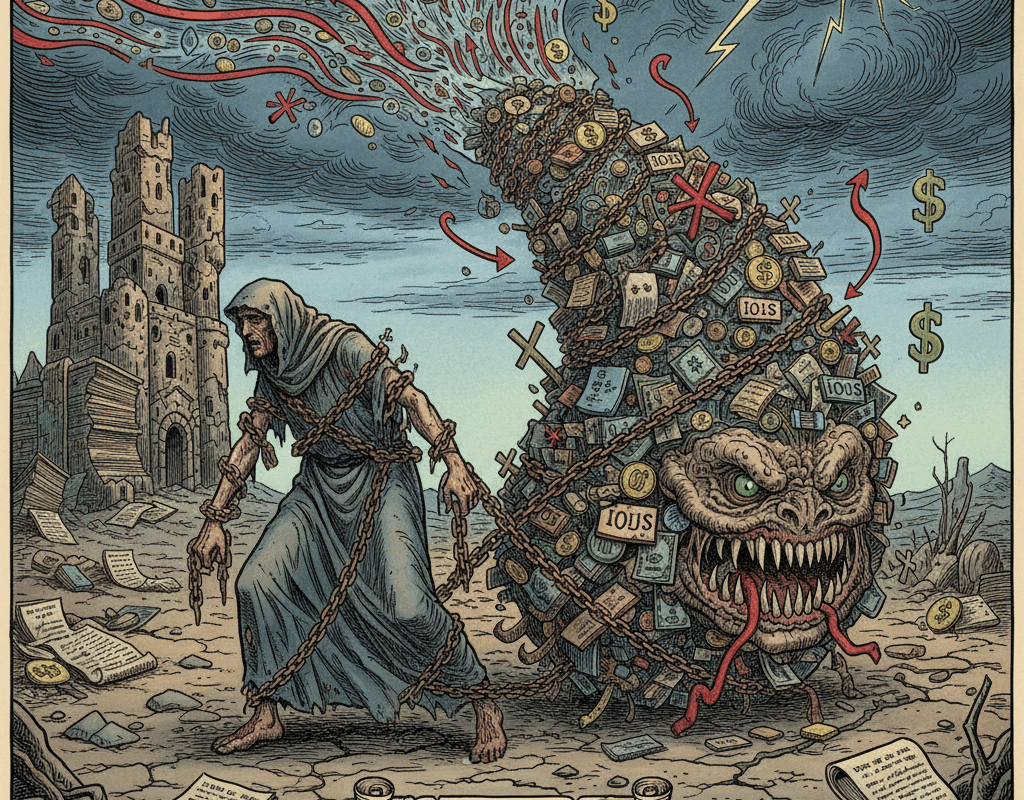
In fact, not only are we going further into debt for no good reason, but we’re going further into debt for a bad one — actually, two very bad ones.

The same fiscal hawks that yelled histrionically about refusing to take on debt — even in times of crisis — let the GOP budget bill for FY2026 sail through without a peep despite it adding a debt burden of almost $4 trillion over the next 10 years.

And for what? The first terrible reason is so that a gaggle of wealthy donors can get even wealthier, have more lavish weddings, build ever more elaborate doomsday bunkers, recreate company towns from The Jungle, cavalierly flit off to space, and so on. Never could I have imagined Gilded Age 2.0 would be so dumb.

After screaming bloody murder for literal decades and lecturing Democrats about reckless spending and balanced budgets, the Republicans simply let this gigantic albatross sail right through without so much as a debate. It’s as if the national debt were suddenly the Epstein files — something you should weirdly be ashamed of still caring about after being whipped into a frenzy about it for years (including being cajoled to the Capitol to break the law on behalf of someone who is above the law).

“Reckless spending” is fine when my team does it, seems to be GOP orthodoxy. Future generations be damned — we only think about them under Democratic Presidents. Suddenly, it has become desirable to saddle the nation with more debt for no good reason.

Establishment of a police state

The second terrible rationale for taking the US further into debt is to create a police state in America, with literal concentration camps. Despite campaigning on deporting the alleged set of violent criminals within the undocumented immigrant demographic, Trump and his slavering goon squad have been picking up fathers, landscapers, students who posted things they don’t like on social media, random South Koreans, and anyone Tom Homan thinks looks a little bit too brown. In other words, the government is spending billions and billions of your tax dollars to get rid of hardworking taxpayers — a hateful Dunning-Kruger approach that is toxic both politically and economically.

This GOP tax and spending bill will also empower the federal government to take over Democratic cities — despite the fact that red states have more crime. And to deploy America’s federal law enforcement staff away from national and international crimes like sex trafficking and fraud, and turning them towards’ providing photo ops in DC. Because appearances are all that matter to this particular president and his regime.

All this to create the kind of police state with standing army that the Founders would have laughed out of the room — because they had just fought a bloody war to defeat that kind of autocratic nonsense. With its cash infusion of an eye-popping $171 billion across federal agencies and other new border security and detention facility funding, ICE is poised to become the 4th largest branch of the military — but deployed on home soil, increasingly against Americans.

The GOP Budget Bill in 7 Minutes

Ask the Bill: An HR1 NotebookLM

But you don’t have to take my word for it — here you can talk directly to the bill in natural language, in NotebookLM:

the HR1 GOP tax and spending budget bill for fiscal year 2026, in an interactive NotebookLM

GOP budget bill winners

See a full table of the winners and the new lay of the land and the immense growth of the administrative state that the GOP claims it is trying to eradicate:

Continue reading The GOP budget bill takes the US further into debt for no good reason
Read more

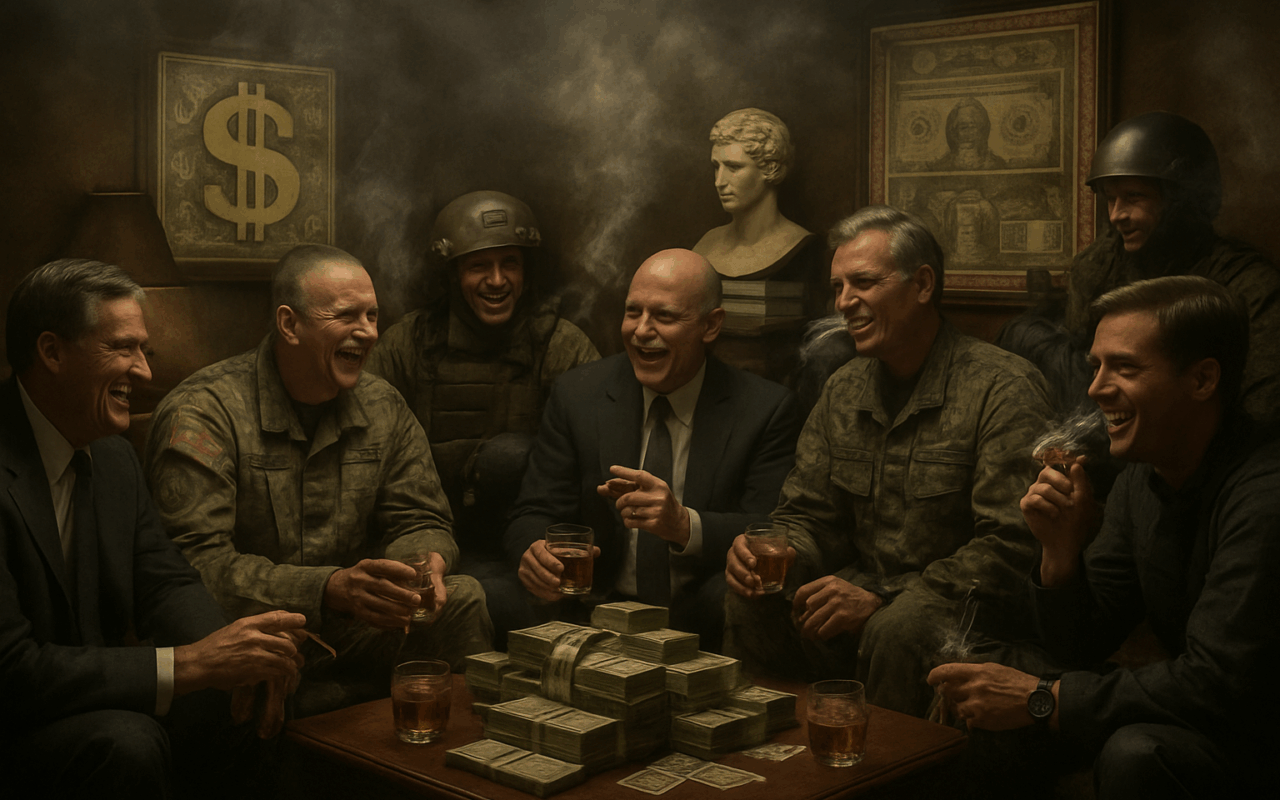
US Republican Senators cavorting with military personnel, drinking and laughing and celebrating the orgy of money they are rolling in

The GOP just passed their budget reconciliation bill for FY2026 — a squeaker, but over the line and now signed into law. Looking at this staggering compilation of budget line items, we’re witnessing what can only be described as the construction of an unprecedented domestic security apparatus that should alarm anyone who values civil liberties and fiscal responsibility. What’s in the Republican spending bill? A massive financial allocation to create a new branch of the military — essentially a militarized standing army of the type the Founders feared most deeply (for example Hamilton, in Federalist No. 29).

This Republican budget bill represents a breathtaking $300+ billion commitment to militarizing America’s borders and expanding the surveillance state under the guise of “national security.” The numbers tell a chilling story: nearly $57 billion for border walls and barriers, $45 billion for immigrant detention facilities that will rival the size of the entire prison system, and almost $30 billion to supercharge ICE into a paramilitary force with expanded powers to raid communities nationwide.

What we’re seeing here isn’t border securityβ€”it’s the systematic transformation of immigration enforcement into a militarized occupation force. The bill allocates billions for “family detention centers” (a euphemism for camps where children will be imprisoned), grants to states for building more walls, and funding for “relocation of unlawfully present aliens” that sounds disturbingly like it will require the use of violent force.

Perhaps most troubling is how this massive expansion of domestic enforcement capabilities comes wrapped in the flag of military spending. Hundreds of billions flow to weapons manufacturers and defense contractors while basic human services are starved of funding. The message is clear: this administration views immigrants not as people seeking opportunity, but as enemy combatants requiring a military response.

The infrastructure being built hereβ€”the surveillance technology, detention facilities, militarized personnel, and coordination between local and federal enforcementβ€”creates the scaffolding for authoritarianism that could easily be turned against any group deemed “undesirable” by future administrations. Once you’ve normalized this level of militarized domestic enforcement, the definition of who deserves to be targeted has a way of expanding.

This isn’t about border securityβ€”it’s about power, control, and the profits that flow to contractors building America’s emerging police state.

Here is a comprehensive list of all the line items in the bill that add budget to law enforcement, border protection, national security, or military-related functions or agencies, ranked by size descending, drawing directly from the text of the bill:

  • $46,550,000,000 appropriated to the Commissioner of U.S. Customs and Border Protection for the Border Infrastructure and Wall System, including construction, installation, or improvement of new or replacement primary, waterborne, and secondary barriers; access roads; barrier system attributes (cameras, lights, sensors, detection technology); and any work necessary to prepare the ground at or near the border to allow U.S. Customs and Border Protection to conduct its operations.
  • $45,000,000,000 appropriated to U.S. Immigration and Customs Enforcement for single adult alien detention capacity and family residential center capacity. A “family residential center” is defined as a facility used by the Department of Homeland Security to detain alien family units, including children who are not unaccompanied, encountered or apprehended by the Department.
  • $29,850,000,000 appropriated to the Secretary of Homeland Security for U.S. Immigration and Customs Enforcement for fiscal year 2025, to remain available through September 30, 2029. These funds are designated for: hiring and training additional ICE personnel (officers, agents, investigators, and support staff), prioritizing and streamlining the hiring of retired ICE personnel; providing performance, retention, and signing bonuses to qualified ICE personnel; facilitating recruitment, hiring, and onboarding of additional ICE personnel (including investing in IT, recruitment, and marketing); transportation costs and related costs for alien departure or removal operations; information technology investments to support enforcement and removal operations (including fee collections); facility upgrades to support enforcement and removal operations; fleet modernization to support enforcement and removal operations; promoting family unity by maintaining care and custody of aliens charged only with a misdemeanor offense who entered with their child under 18 and detaining such an alien with their child; expanding, facilitating, and implementing 287(g) agreements; hiring and training additional staff for the Victims of Immigration Crime Engagement Office and providing nonfinancial assistance to victims of crimes perpetrated by unauthorized aliens; and hiring additional attorneys and support staff within the Office of the Principal Legal Advisor to represent DHS in immigration enforcement and removal proceedings.
  • $10,000,000,000 appropriated to the Department of Homeland Security for the State Border Security Reinforcement Fund. These funds are for grants to eligible States and units of local government for purposes including: construction or installation of a border wall, border fencing, other barriers, or buoys along the southern border of the United States (including planning, procurement of materials, and personnel costs); any work necessary to prepare the ground at or near land borders to allow construction and maintenance of a border wall or other barrier fencing; detection and interdiction of illicit substances and aliens who have unlawfully entered the United States and committed a crime, and their transfer or referral to DHS; and relocation of unlawfully present aliens from small population centers to other domestic locations.
  • $10,000,000,000 appropriated to the Secretary of Homeland Security for reimbursement of costs incurred in undertaking activities in support of the Department of Homeland Security’s mission to safeguard the borders of the United States.
Continue reading What’s in the massive Republican spending bill?
Read more

Christian nationalism illustration

The term Christian nationalists brings together a number of radical religious sects seeking to overthrow the democratic republic of the United States and installing a strict theocracy, from dominionists to orthodox Catholics to Evangelicals and many more. Christian nationalist organizations work to increase the influence of religion on politics, under the invented mythology that the largely Deist founders meant to establish a Christian state.

Who are the Christian nationalists? They are people, groups, and congregations who tend to believe in Strict Father Morality, and Christian nationalist leaders desire to establish some sort of Christian fascist theocratic state in America. Nevermind that religious freedom and the ability to worship as one pleases was precisely one of the major founding ideals of the United States, as we know from the many, many outside writings of the founders at that time — these folks consider that context “irrelevant” to the literal text of the founding documents.

Getting “separation of state” backwards

Prominent Christian nationalist David Barton re-interprets the famous 1802 Thomas Jefferson letter to the Danbury Baptists to allege support for a “one-way wall” between church and state. Barton contends that Jefferson’s metaphor of a “wall of separation” was intended to protect religious institutions from government interference rather than ensuring the government’s secular nature. By advocating for this one-directional barrier, Barton seeks to justify the integration of religious principles into public policy and government actions — improbably, given the First Amendment to the Constitution.

Barton and his fellow Christian nationalists are either intentionally or unfathomably not taking the logical next step in the chain of power and authority: if the government is informed, infused, or even consumed by religious dogma and doctrine, then is that government not by definition infringing on the rights of any citizens that happens not to believe in that code or creed?

The answer, as we well know from the colonization of America itself, is YES. We left the Church of England in large part to worship of our own accord — and to make money, of course. Madison, Jefferson, Franklin, Adams, and Washington were especially concerned about religious liberty and the neutrality of government in religious matters.

Thus, in large part, the ideas of the Christian nationalists are misinterpretations at best, and willful invention at worst. In some it is clearly a naked power grab and not much more — think of Trump holding an upside-down Bible in Lafayette Square. In general, Christian nationalism doesn’t actually seem very Christian at all.

Whether they are True Believers or Opportunistic Cynics, the Christian nationalist organizations and right wing groups on this list — as well as a number of prominent individuals within these organizations — represent a threat to democracy as we know it — especially with Project 2025 so close to coming to fruition in a second Trump administration. Best we get a look at who they are.

Christian nationalists abstract
Continue reading Christian Nationalist Organizations and Groups
Read more

The Cathedral concept of Curtis Yarvin, controversial right-wing philosopher

Understanding Neoreaction (NRx): The Dark Enlightenment’s Growing Influence

In the landscape of contemporary political thought, few movements have generated as much intrigue and controversy as Neoreaction (NRx). Emerging from the darkest corners of the internet and gradually infiltrating mainstream discourse, this philosophical movement represents one of the most comprehensive rejections of modern liberal democracy. Here we’ll explore the origins, key figures, core beliefs, and growing influence of Neoreaction in both Silicon Valley and Republican politics.

Origins and Key Figures

Neoreaction emerged in the mid-to-late 2000s as an online philosophical and political movement, primarily through blog posts and forum discussions. The movement’s foundational texts were written by Curtis Yarvin (writing under the pseudonym Mencius Moldbug), a software engineer by day and political theorist by night who began publishing his critiques of modern democracy in 2007-2008 through his blog “Unqualified Reservations.”

Yarvin’s verbose, citation-heavy writing style attracted a small but dedicated following of readers who were drawn to his radical critique of contemporary political systems. His work was further developed and popularized by British philosopher Nick Land, who coined the term “Dark Enlightenment” in his 2012 essay of the same name. Land, formerly associated with the Cybernetic Culture Research Unit at Warwick University, added accelerationist elements to Neoreactionary thought, emphasizing the role of capitalism and technology in destabilizing existing political structures.

While Yarvin and Land are considered the primary architects of Neoreactionary thought, the movement draws inspiration from earlier thinkers. These include 19th-century writer Thomas Carlyle, who advocated for authoritarian governance; Julius Evola, an Italian traditionalist philosopher; and American economist Hans-Hermann Hoppe, known for his critiques of democracy from a libertarian perspective.

Core Beliefs

At its heart, Neoreaction represents a fundamental rejection of Enlightenment values and the modern liberal democratic order. Its adherents advocate for several interconnected beliefs:

Continue reading What is Neoreaction (NRx) ideology?
Read more

What is RT.com? If you’ve been following international news in recent years, you’ve likely encountered content from RT β€” the state-owned Russian news service formerly known as Russia Today. But what exactly is this network, and why does it matter in our global information landscape?

The Birth of a Propaganda Powerhouse

RT didn’t emerge out of nowhere. Back in 2005, the Russian government launched “Russia Today” with a substantial $30 million in state funding. The official mission? To counter what the Kremlin perceived as Western media dominance and improve Russia’s global image.

What’s fascinating is how they approached this mission. Margarita Simonyan, appointed as editor-in-chief at just 25 years old, strategically recruited foreign journalists to give the network an air of international credibility. By 2009, they rebranded to the sleeker “RT” β€” a deliberate move to distance themselves from their obvious Russian state origins.

While RT initially focused on cultural diplomacy (showcasing Russian culture and perspectives), its mission shifted dramatically after the 2008 Russia-Georgia war. The network increasingly pivoted toward anti-Western narratives β€” a strategy that continues to this day.

How RT Spreads Disinformation

RT’s playbook is both sophisticated and concerning. The network regularly promotes conspiracy theories about everything from COVID-19 origins to U.S. election fraud. It strategically amplifies divisive issues in Western societies, particularly racial tensions in America.

The coverage of the Ukraine war offers a perfect case study in RT’s propaganda techniques. Their reporting consistently and erroneously:

  • Blames NATO for the conflict
  • Denies Russian war crimes (despite Hague warrant for Putin’s arrest)
  • Frames the invasion as a “special operation” to “denazify” Ukraine (led by a Jewish president)

What makes RT particularly effective is its tailored regional messaging. In Africa, they operate “African Stream,” a covert platform promoting pro-Russian sentiment. In the Balkans, RT Balkan (based in Serbia) helps circumvent EU sanctions while spreading Kremlin-aligned content. Meanwhile, their Spanish-language expansion targets Latin American audiences with anti-Western narratives.

Beyond Media: Covert Operations

Perhaps most concerning is evidence suggesting RT extends far beyond conventional media operations. U.S. officials have alleged that RT funneled $10 million to pro-Trump influencers ahead of the 2024 election, leading to Department of Justice indictments of RT staff.

The network reportedly recruits social media influencers under fake accounts to obscure Russian involvement. More alarmingly, RT-associated platforms allegedly supply equipment (including drones, radios, and body armor) to Russian forces in Ukraine, with some materials sourced from China.

According to U.S. intelligence assessments, RT hosts a clandestine unit focused on global influence operations β€” blurring the line between media and intelligence work.

Money and Organization

As with any major operation, following the money tells an important story. RT’s annual funding has grown exponentially β€” from $30 million at its founding to $400 million by 2015. For the 2022-2024 period, the Russian government allocated a staggering 82 billion rubles.

The network’s organizational structure is deliberately complex. RT operates under ANO TV-Novosti (a nonprofit founded by RIA Novosti) and Rossiya Segodnya (a state media conglomerate established in 2013). Its subsidiaries include Ruptly (a video agency), Redfish, and Maffick (digital media platforms).

Staying One Step Ahead of Sanctions

Despite being banned in the EU and U.S. following Russia’s 2022 invasion of Ukraine, RT continues to expand its reach in Africa, Latin America, and Serbia. The network has proven remarkably adaptable at circumventing restrictions β€” using proxy outlets like “Red” in Germany and RT Balkan in Serbia to bypass sanctions.

The international response has been significant but inconsistent. The U.S. designated RT a foreign agent in 2017, the EU banned it in 2022, and Meta removed RT from its platforms in 2024. The U.S. has also launched campaigns to expose RT’s ties to Russian intelligence and limit its global operations.

Why This Matters

RT exemplifies modern hybrid warfare β€” blending traditional state media with covert influence operations and intelligence activities to advance Kremlin interests globally. Despite sanctions and increasing awareness of its true nature, RT’s adaptability and substantial funding ensure its continued reach.

For those of us concerned about information integrity and democratic resilience, understanding RT’s operations isn’t just academic β€” it’s essential for navigating our increasingly complex media landscape.

Read more