immigration

Results from the Kansas experiment with SAVE Act rules -- 99.9% of the voter registrations blocked were US citizens

The Kansas Prophecy: We Already Ran This Experiment and the SAVE Act in Kansas Was a Disaster

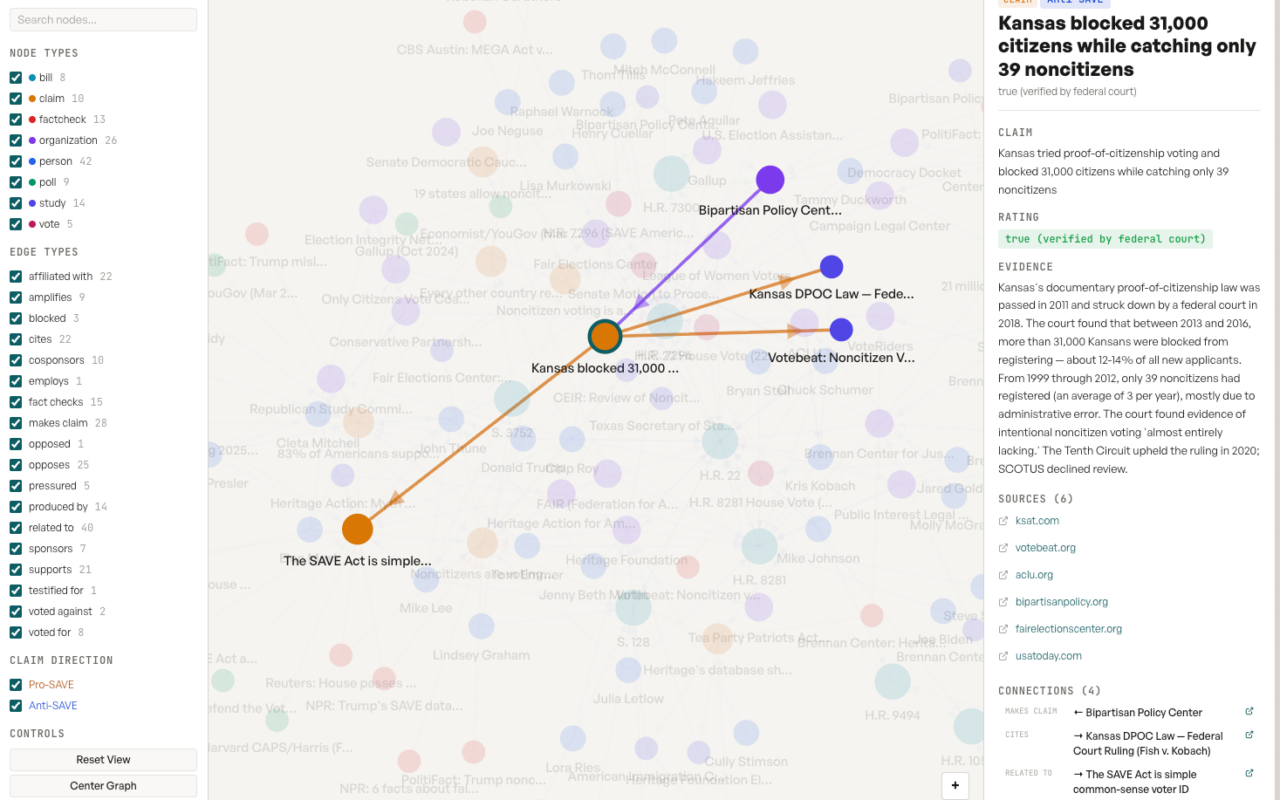
When Kansas tried its early version of the SAVE Act, a whopping 31,089 eligible American citizens were blocked from voting. Meanwhile only 39 noncitizens were “caught”… over 19 years. And many of them turned out to be administrative errors.

That’s the final score from Kansas’s proof-of-citizenship experiment β€” the same core policy the SAVE America Act would impose on all 50 states. Republicans are selling it as “election security.” Kansas already has the receipts on what it actually is.

Been There, Done That

In 2011, Kansas passed a law requiring documentary proof of citizenship to register to vote β€” a birth certificate, passport, or naturalization papers. It was the brainchild of then-Secretary of State Kris Kobach, who styled himself as America’s foremost crusader against the specter of rampant illegal voting. The law went into effect in 2013 and immediately went sideways.

DMV clerks weren’t allowed to request the new documents β€” or even tell people the requirement existed. Voter registration drives cratered: one effort at Washburn University collected 400 applications but managed to fully register roughly 75 people. A process that used to take five minutes stretched to an hour. Steven Fish, a warehouse worker born on a now-closed Air Force base in Illinois, couldn’t produce an acceptable birth certificate. Multiple plaintiffs in the lawsuit that followed were military veterans. All were U.S. citizens. None were the noncitizen bogeymen the law was supposed to stop.

The federal courts annihilated it. A 118-page district court ruling struck it down as unconstitutional. The 10th Circuit affirmed. The Supreme Court declined to hear it. The judge sanctioned Kobach personally and ordered him to take remedial legal education β€” a humiliation nearly without precedent for a sitting state official. Kansas paid $1.9 million in attorneys’ fees to the winning parties. The state’s current Republican Secretary of State, Scott Schwab β€” who voted for the law as a legislator β€” delivered the epitaph: “It didn’t work out so well.”

The “Problem” Rounds to Zero

And it’s not just Kansas. Everywhere officials have looked for the noncitizen voting crisis, they’ve found a rounding error:

The Heritage Foundation itself β€” which advocates for the SAVE Act β€” found 68 documented cases of noncitizen voting since the 1980s out of over a billion ballots cast; a rate of 0.0000001% (!). Utah reviewed its entire voter list of two million registrants and found one noncitizen registration and zero noncitizen votes. Georgia audited 8.2 million voters and found 20 noncitizens. The Brennan Center found 30 suspected cases across 23.5 million votes. This isn’t a policy responding to a problem. It’s a solution in search of a pretext.

The bill is also set to take effect immediately, which is fairly insane to think about such a radical change to the rules of voting mere months before an election. I’m old enough to remember when supposedly Good Governance dictated that we leave a Supreme Court seat empty for an entire year — allegedly so “The People” could have their say on this important lifetime appointment. If the precedent is supposed to be that no major structural changes happen during an election year, then how does the right wing justify the sudden about face? It’s okay only when a Republican is in office, no doubt.

Kansas at Scale

The SAVE America Act is Kansas’s disaster, federalized and supercharged. In addition to the proof-of-citizenship registration requirements, it would force states to hand voter roll data to DHS with no safeguards on how it’s used, criminalize election workers who register someone without the right paperwork β€” even if that person is a citizen β€” and effectively eliminate online registration, mail registration, and automatic voter registration programs used by millions.

It passed the House in February 2026. The Senate opened debate March 17. Prediction markets give it roughly an 11% chance of becoming law. Trump has threatened to block all other legislation β€” including DHS funding during a partial shutdown β€” until it passes. A leaked 17-page executive order draft would require all 211 million registered Americans to re-register in person if the Senate doesn’t comply.

SAVE Act Network Graph Explorer

Explore the web of people, organizations, and money behind the push.

Open full screen β†—

The Quiet Part Out Loud

Kansas proved that proof-of-citizenship laws don’t catch noncitizen voters. They catch citizens. The 31,000-to-39 ratio isn’t a bug β€” it’s the feature. And the bill doesn’t need to pass the Senate to serve its real purpose: manufacturing a narrative that “Democrats are blocking election security,” setting the stage for executive overreach, filibuster destruction, or post-election delegitimization.

The Kansas cautionary tale isn’t that the policy is flawed. It’s that it works exactly as intended β€” just the opposite of the way they’re selling it.

Read more

US Republican Senators cavorting with military personnel, drinking and laughing and celebrating the orgy of money they are rolling in

The GOP just passed their budget reconciliation bill for FY2026 — a squeaker, but over the line and now signed into law. Looking at this staggering compilation of budget line items, we’re witnessing what can only be described as the construction of an unprecedented domestic security apparatus that should alarm anyone who values civil liberties and fiscal responsibility. What’s in the Republican spending bill? A massive financial allocation to create a new branch of the military — essentially a militarized standing army of the type the Founders feared most deeply (for example Hamilton, in Federalist No. 29).

This Republican budget bill represents a breathtaking $300+ billion commitment to militarizing America’s borders and expanding the surveillance state under the guise of “national security.” The numbers tell a chilling story: nearly $57 billion for border walls and barriers, $45 billion for immigrant detention facilities that will rival the size of the entire prison system, and almost $30 billion to supercharge ICE into a paramilitary force with expanded powers to raid communities nationwide.

What we’re seeing here isn’t border securityβ€”it’s the systematic transformation of immigration enforcement into a militarized occupation force. The bill allocates billions for “family detention centers” (a euphemism for camps where children will be imprisoned), grants to states for building more walls, and funding for “relocation of unlawfully present aliens” that sounds disturbingly like it will require the use of violent force.

Perhaps most troubling is how this massive expansion of domestic enforcement capabilities comes wrapped in the flag of military spending. Hundreds of billions flow to weapons manufacturers and defense contractors while basic human services are starved of funding. The message is clear: this administration views immigrants not as people seeking opportunity, but as enemy combatants requiring a military response.

The infrastructure being built hereβ€”the surveillance technology, detention facilities, militarized personnel, and coordination between local and federal enforcementβ€”creates the scaffolding for authoritarianism that could easily be turned against any group deemed “undesirable” by future administrations. Once you’ve normalized this level of militarized domestic enforcement, the definition of who deserves to be targeted has a way of expanding.

This isn’t about border securityβ€”it’s about power, control, and the profits that flow to contractors building America’s emerging police state.

Here is a comprehensive list of all the line items in the bill that add budget to law enforcement, border protection, national security, or military-related functions or agencies, ranked by size descending, drawing directly from the text of the bill:

  • $46,550,000,000 appropriated to the Commissioner of U.S. Customs and Border Protection for the Border Infrastructure and Wall System, including construction, installation, or improvement of new or replacement primary, waterborne, and secondary barriers; access roads; barrier system attributes (cameras, lights, sensors, detection technology); and any work necessary to prepare the ground at or near the border to allow U.S. Customs and Border Protection to conduct its operations.
  • $45,000,000,000 appropriated to U.S. Immigration and Customs Enforcement for single adult alien detention capacity and family residential center capacity. A “family residential center” is defined as a facility used by the Department of Homeland Security to detain alien family units, including children who are not unaccompanied, encountered or apprehended by the Department.
  • $29,850,000,000 appropriated to the Secretary of Homeland Security for U.S. Immigration and Customs Enforcement for fiscal year 2025, to remain available through September 30, 2029. These funds are designated for: hiring and training additional ICE personnel (officers, agents, investigators, and support staff), prioritizing and streamlining the hiring of retired ICE personnel; providing performance, retention, and signing bonuses to qualified ICE personnel; facilitating recruitment, hiring, and onboarding of additional ICE personnel (including investing in IT, recruitment, and marketing); transportation costs and related costs for alien departure or removal operations; information technology investments to support enforcement and removal operations (including fee collections); facility upgrades to support enforcement and removal operations; fleet modernization to support enforcement and removal operations; promoting family unity by maintaining care and custody of aliens charged only with a misdemeanor offense who entered with their child under 18 and detaining such an alien with their child; expanding, facilitating, and implementing 287(g) agreements; hiring and training additional staff for the Victims of Immigration Crime Engagement Office and providing nonfinancial assistance to victims of crimes perpetrated by unauthorized aliens; and hiring additional attorneys and support staff within the Office of the Principal Legal Advisor to represent DHS in immigration enforcement and removal proceedings.
  • $10,000,000,000 appropriated to the Department of Homeland Security for the State Border Security Reinforcement Fund. These funds are for grants to eligible States and units of local government for purposes including: construction or installation of a border wall, border fencing, other barriers, or buoys along the southern border of the United States (including planning, procurement of materials, and personnel costs); any work necessary to prepare the ground at or near land borders to allow construction and maintenance of a border wall or other barrier fencing; detection and interdiction of illicit substances and aliens who have unlawfully entered the United States and committed a crime, and their transfer or referral to DHS; and relocation of unlawfully present aliens from small population centers to other domestic locations.
  • $10,000,000,000 appropriated to the Secretary of Homeland Security for reimbursement of costs incurred in undertaking activities in support of the Department of Homeland Security’s mission to safeguard the borders of the United States.
Continue reading What’s in the massive Republican spending bill?
Read more

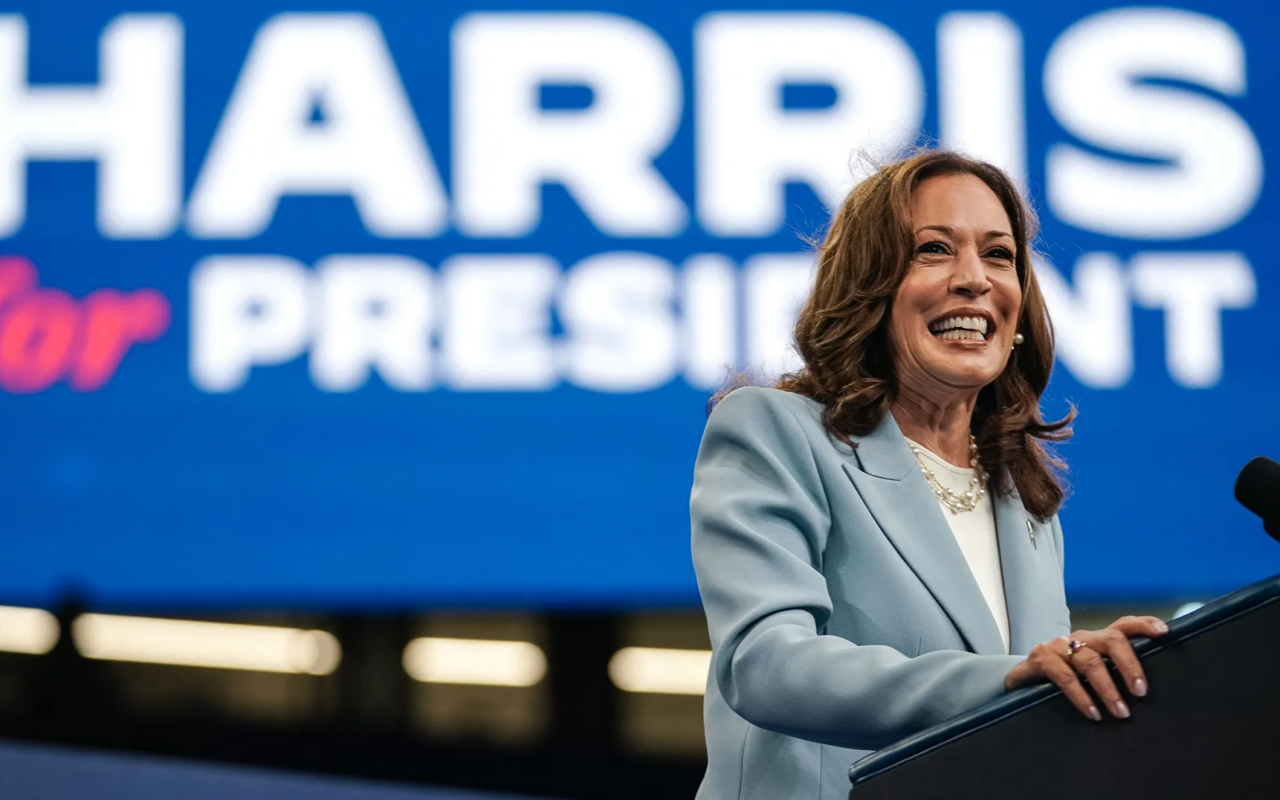
Kamala Harris for President

As the 2024 election season heats up, Kamala Harris’s policy platform has begun to shape a forward-thinking blueprint for what she calls an β€œOpportunity Economy” and a “New Way Forward.” With an approach that blends economic pragmatism and social investment, her policy outline aims to strengthen the middle class while addressing the core issues faced by millions of Americans today. Kamala Harris policies zero in on economic stability, healthcare affordability, and supporting American families through accessible resources, tax cuts, and an intentional focus on civil and reproductive rights.

Though some complain about not knowing what her policies are, she speaks of them in every speech, interview, or discussion and has them freely available on her website. Mainstream media in particular ought to be doing more of their own research vs. entertaining spurious claims that she has outlined no 2024 policy proposals. It’s also a quintessential example of the way women are forced to thread a needle in a way that men simply aren’t — I’m old enough to remember when Hillary Clinton was once famously derided for being too wonky and having too many policy proposals. You really can’t win.

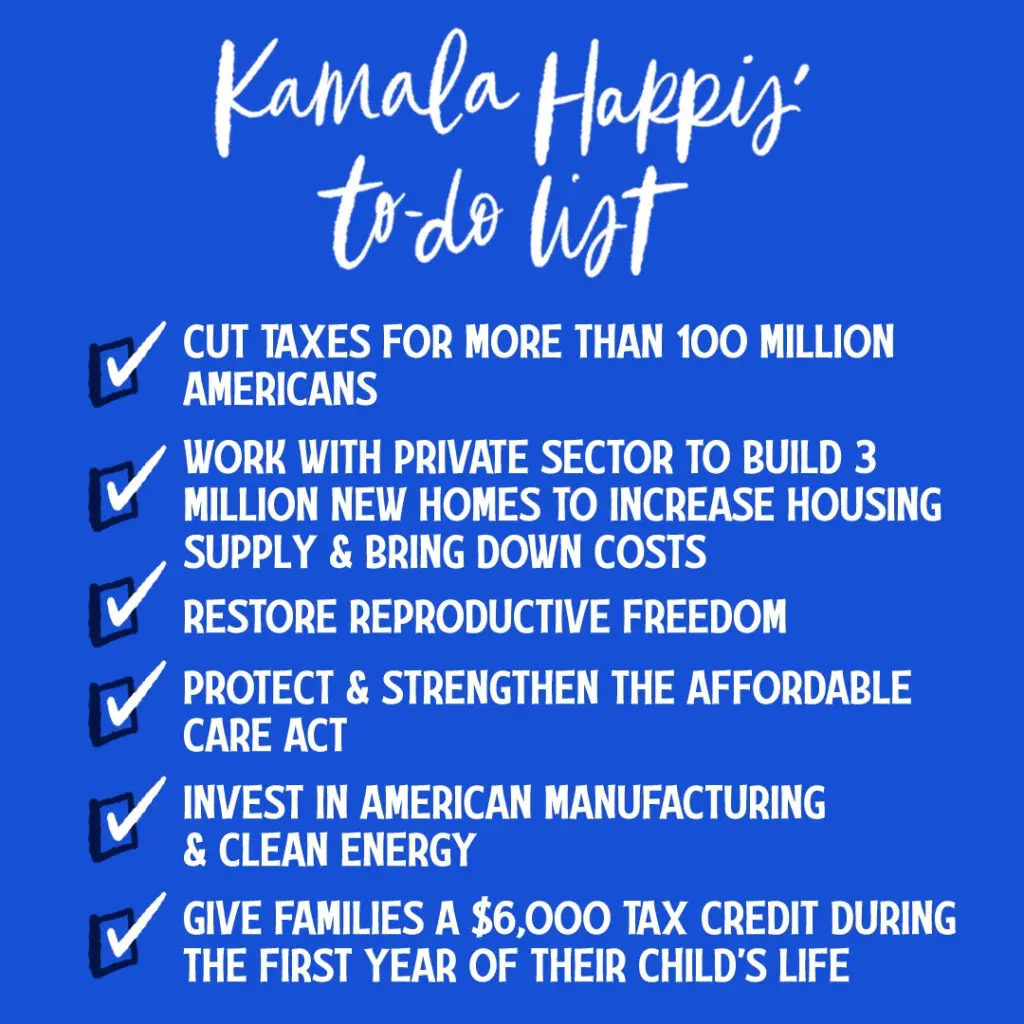
Kamala Harris policy to-do list

Meanwhile, Harris has a robust economic plan for the middle class as well as fighting staunchly for civil rights, voting rights, reproductive freedom, and democracy in an increasingly multipolar world. Harris’s economic policy combines key strategies designed to lower costs for middle-class familiesβ€”fighting inflation, tackling price gouging, and expanding Medicare to help the β€œSandwich Generation” juggling care for both children and aging parents.

Her policies also encourage entrepreneurship through substantial tax deductions for small businesses and foster a fairer housing market by promoting affordable housing initiatives and cracking down on price fixing. Harris’s vision is one of a sustainable, inclusive future where both family support and economic growth converge to drive lasting change.

Beyond economic reform, her platform emphasizes national security, comprehensive immigration reform, civil rights protections, and an ambitious climate policy. Together, these components create a multifaceted approach intended to protect American values while boosting prosperity. Harris’s policy platform offers voters an actionable vision for a stronger, more equitable America built on accessible opportunities and resilient middle-class foundations.

Kamala Harris economic policy

Kamala Harris has been promoting her economic policy agenda since mid-August — which was a mere 2 weeks since becoming the new top of the ticket suddenly and unexpectedly when Joe Biden decided to withdraw from and race and pass the torch. Her β€œNew Way Forward” for the economy is rooted in a central goal of strengthening the middle class through practical, targeted policies. Aiming to create an β€œOpportunity Economy,” her platform emphasizes lowering costs for families, capping drug prices, tackling price gouging, and expanding Medicare to better support those juggling elder and child care responsibilities (aka “the Sandwich Generation”).

Continue reading Kamala Harris policies
Read more

SOTU 2024 Joe Biden Presidential address

Strong economic messages of the Keynesian buttressing of the middle class that is Bidenomics were everywhere in evidence at last night’s State of the Union address, Biden’s third since taking office in 2021. In SOTU 2024 he spoke about stabbing trickle-down economics in its gasping heart as a repeated failure to the American people. Instead of giving another $2 trillion tax cuts to billionaires, Biden wants to give back to the people who he says built America: the middle class.

The President delivered strong, sweeping language and vision reminiscent of LBJ’s Great Society and FDR‘s New Deal. He also delivered a heartwarming sense of unity and appeal to put down our bickering and get things done for the American people.

“We all come from somewhere — but we’re all Americans.”

This while lambasting the Republicans for scuttling the deal over the popular bipartisan immigration bill thanks to 11th hour interference from TFG (“my predecessor” as JRB called him). “This bill would save lives!” He is really effective at calling out the GOP‘s hypocrisy on border security with this delivery.

“We can fight about the border or we can fix the border. Send me a bill!”

He is taking full advantage of being the incumbent candidate here. He has the power and the track record to do all these things he is promising, and he’s telling the exact truth about the Republican obstructionism preventing the American people from having their government work for them.

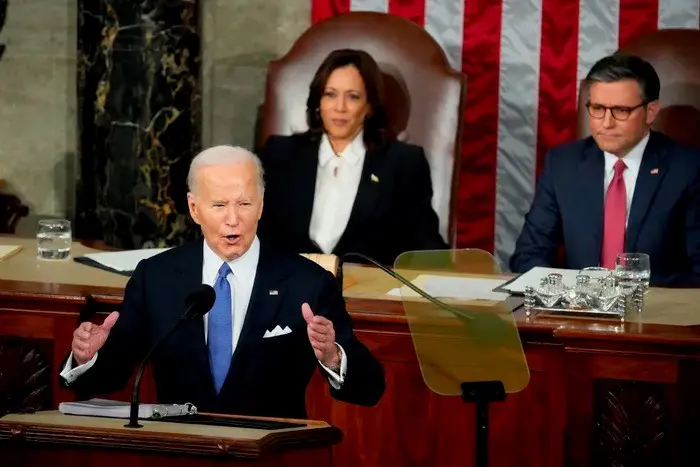
SOTU 2024 Joe Biden fiery speech with Kamala Harris and Mike Johnson in the background behind him

I love that he calls out Trump in this speech, without naming names — almost a kind of Voldemort effect. He who must not be named — because giving him the dignity even of a name is more than he deserves.

He says that Trump and his cabal of anti-democratic political operatives have ancient ideas (hate, revenge, reactionary, etc.) — and that you can’t lead America with ancient ideas. In America, we look towards the future — relentlessly. Americans wants a president who will protect their rights — not take them away.

“I see a future… for all Americans!” he ends with, in a segment reminiscent of the great Martin Luther King’s “I Have a Dream” speech, with its clear vision of power and authority flowing from what is morally right and just, instead of what is corrupt and cronyish. It gave me hope for the future — that Americans will make the right choice, as we seem to have done under pressure, throughout our history. 🀞🏽

Continue reading Biden SOTU 2024: Success stories and big policy ideas
Read more

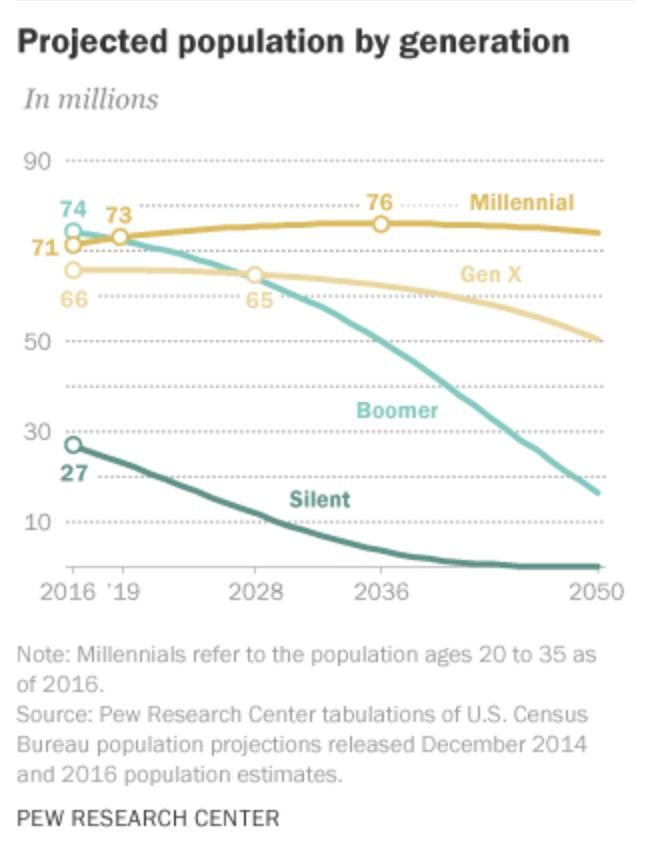
We have endured much together these past 2-3 years, Team America. Thankfully our civil society is incredibly robust — and time is accelerating demographic gains in an inexorably democratic direction. As Boomers give way to Millennials — slated to happen as early as this year — we are experiencing a seismic shift in the national consciousness.

Look out, Boomers!

Our values as a nation-state have always been evolving as the political consciousness and cultural landscapes shift, but in recent political times the changes have been radical, seemingly sudden, and jarring in a way that collective memory does not easily recall. I believe we are witnessing the swan song of a generation — the largest post-WWII generation dominant demo for decades, now facing only the long decline.

Much is said of the Hillbilly Elegies of our country, but to be fair these elders are legitimately terrified: of the U.S. they see around them today — bearing little resemblance to the nation of their boomingly patriarchal childhoods; of the world outside our borders and the immigrants (theoretically; allegedly) streaming into them illegally; of long disused portions of America drying up and economically (and in some cases literally) tumbleweeding away; of their own impending mortality.

We go high

Michelle Obama was right. Is right. We should make ourselves aware of the kinds of games the other side is willing to employ, but endeavor not to play them ourselves as much as we can. But beyond a moral reason to love thy neighbor, there’s the practical matter that we may find common cause in surprising territories. Non-wealthy elder whites and young Millennials who struggled through the 2008 housing and banking crash both have reason to want a robust safety net, for example. This is the essence of democratic politics done well: coalition-building — not among special interests, but among elected leaders representing their constituents in good faith.

The arc of justice

…goes at its own pace, or something like that. Fascism has a creep (or at the moment, more of an open stride), and justice has a methodical process of evidence-gathering and weighing; we can have some solid faith in the latter to do its work. Regardless of the levels of bitter partisanship in the air, we have an enormous cadre of professional civil servants who do their often thankless jobs tirelessly for years and decades out of the limelight, for sub-private sector pay and little recognition. This cohort works tirelessly for us now, investigating the many tentacles of the Trump corruption operation stretching back years and decades into American life and foreign investment.

Mr Mueller, do your worst. By which I mean your best. We understand each other, I think. πŸ‘πŸ½βš–οΈ

Read more