It is going to become increasingly more difficult to discern from fact from fiction, here in this world that seemingly quickly flipped from a world of The Enlightenment to a world of dark disinformation. From artificial intelligence to vast propaganda machines, from deep fakes to fake lives — it’s going to require more from us to be able to detect what’s real.
Already we can’t rely on old cues, signposts, and tropes anymore. We’re less credulous about credentials, and trust isn’t automatic based on caste, title, or familiar status markers.
Go slow and look for mimics
Here’s one key to more accurate reality detection: take more time to spot the fake. Don’t judge too quickly, because it can take time to weed out the fakesters and the hucksters — some are decent mimics and can fool people who are in a hurry, not paying much attention, or attracted to some irrelevant other quality about the ersatz knockoff and thus forms an affinity with them based on something else entirely. Some drink the Kool-Aid for various reasons.
Clues of fraud
Those who cling absurdly to abstract symbols are often fakes. And in general, any folks who feel like they are just trying a little bit too hard might be fake. Then, of course, there are the full-on zealots and religious nutbags. These theocrats are definitely faux compassionate Jesus-lovers. What better cloak than the robes of a religious man (or, less frequently, woman)? It’s the perfect disguise.
No wonder so many child abusers hide out in churches of all kinds, from famously the Catholic to the more recently-outed (though not surprising) Evangelical Southern Baptist Church. No one will ever suspect them, or want to confront them if they do. Plus, they have Democrats to absurdly try and pin the blame on repeatedly, despite a lack of a shred of evidence.
We need to know what our opponents are up to. There is much to learn.
Much more to come — stay tuned!
Behavior
Type
Definition
ad baculum
rhetorical
Appeal to violence
ad hominem
rhetorical
Attack the person instead of their ideas.
aggression
tactical
Issue threats and/or violate boundaries.
argumentum ad passiones
emotional
"I feel it (or I feel *strongly* about it), therefore it must be true."
assault
tactical
Assert the opposite of reality
rhetorical
Simply state the opposite of what is true
banning books
legislative
Book banning is a form of censorship in which government officials or organizations remove books from libraries, school reading lists, or bookstore shelves because of objections to content, ideas, or themes.
Believes oneself to be superior and requiring of association with high-status people
pathological
Related to supremacy and collective narcissism, this worldview is one of extreme entitlement and expected deference.
Black & white thinking
cognitive
A pattern of thought characterized by polar extremes, sometimes flip-flopping very rapidly from one extreme view to its opposite. A symptom of many personality disorders.
Blame Democrats
rhetorical
"I'm not responsible for my bad behaviors: DEMOCRATS ARE!"
bullying
emotional
Intimidating, harming, or coercing -- usually of someone who is perceived as vulnerable.
charisma
emotional
Cloying, often superficial or fake charm
charm
emotional
Compelling attractiveness that fascinates, allures, or delights
closed mind
cognitive
not open to an argument from facts
Cognitive dissonance
cognitive
Having an incongruent value system, or believing mutually exclusive things -- as well as behaving without consistent ethical principles; a sense of randomness to one's approach to life.
cognitive distortion
Communicate by emotional contagion
behavior
Communication is difficult or impossible
behavior
confusion
Consistent inconsistency
conspiracy theories
contempt
counterattack
Creating unnecessary chaos
emotional
Create conflict to get attention and get a chance to get what you want.
Crocodile tears
emotional
DARVO
tactical
Deception
demagoguery
emotional
Seeks support through an appeal to desires and prejudices of voters instead of rational arguments.
Demand mirroring of their emotions
behavior
Denying plain facts
Diverting attention
Do not perform emotional work
behavior
emotional abuse
Emotional manipulation
emotional
Envious of others and believes others are envious
pathological
Exaggerating one's achievements and talents
pathological
Expecting special favors and unquestioning compliance with your expectations
pathological
extortion
fears change
weakness
fears difference
weakness
flying monkeys
fraud
frivolous lawsuits
Gaslighting
Cause you to question your own sanity -- very dangerous to do this to people. The effects are long-lasting and difficult to do; it can take many years to heal from this kind of insidious abuse.
Grandiose sense of self-importance
pathological
grandiosity
grooming
Hard to give to; reject efforts to give help
behavior
high need for closure
Prefers to resolve situations quickly and reduce uncertainty as immediately as possible
hypocrisy
Consistently fail to live up to their own stated ideals, and the things they demand of others.
idealize, devalue, discard
The narcissistic abuse cycle
Interpsonally exploitative; takes advantage of others
pathological
irrational anger
Lacks empathy; unwillingness to recognize the needs and feelings of others
pathological
lawsuits
Love to play victim and hero
emotional
They want your emotions oscillating all over the place, because it gives them more opportunities to swoop in and capture you at a vulnerable moment and earn your trust -- so they can violate it.
Lying
Malignant envy
Masters of deceptive and misleading stories
rhetorical
Mind games
emotional
Motivated Reasoning
cognitive
They start with the premise they want and work from there -- they are bad scientists, but good lawyers.
Moving the goalposts
tactical
narcissistic rage
narcissistic supply
One-way street
Expect loyalty from you while offering none in return
oppression
panem et circuses
Paranoia
emotional
Nurturing and maintaining enemies
Passive-aggression
emotional
Perjury
legal
Lying under oath, in court or in a deposition
Phobic
emotional
Their main aspect is fear, from bouts of phobia indoctrination
Play the victim
emotional
Preoccupied with fantasies of unlimited success
pathological
Projection
cognitive
Accusing your opponent of doing the thing that you yourself are doing.
Provoking anger
behavior
repression
Requires excessive admiration
pathological
Resist repairing relationships
behavior
retconning
rewriting history
rigidity
sadism
emotional
scapegoating
tactical
Just blame Democrats, no matter how absurd
secrecy
Covert actions; lack of transparency
See roles as sacred and inviolable
behavior
Seek enmeshment, not emotional intimacy
behavior
Selective Exposure
self-aggrandizement
emotional
Sense of entitlement; expects others to make unreasonable sacrifices
pathological
shame
emotional
Shows arrogant, haughty behaviors and attitudes
pathological
Splitting
cognitive
See the world as with them or against them (splitting)
stonewalling
stubbornness
supremacy
emotional
Take a thing and turn it into its moral opposite
Label a good thing bad so you can smear it, or a bad thing good so you can support it
It is a way of pseudo-argument privileging one narrow type of political view (conservatism) over all others — a view that we must try to divine the “original” intentions of the Founders in our creation and interpretation of the law.
A view that, by the way, the Founders did not share.
Originalism is an excuse framework for denying people the right to self-govern unless approved of by the white aristocratic elite who fancy themselves the Real Americans, over and above everyone else.
It is based on a kind of paternalism over the Founders, whose “perceived shock” at modernity itself would allegedly disallow almost anything the 340 million modern inhabitants of the United States want to do versus what would have been acceptable to the 2.5 million individuals who declared independence almost 250 years ago.
Originalism is a way of allowing conservative judges to play God. It takes the radical ideas of the Enlightenment in our self-governance and twists them back into a form of “received wisdom” delivered by conservative judges’ religious views — in violation of the First Amendment.
Fundamentalist lawyers, judges, and legal operatives often want to drag “original” back even further — to Biblical law. In both cases, the power grab lies in religious nationalists inserting themselves into the picture as the only interpreters of “God’s will” or “the textualist view” (how convenient!), in which they believe the founding documents were theocratic when they clearly were the opposite of that — the Founders talked about it a lot! And many of them were Deists, famously so.
President Biden and Vice President Harris commemorated the 1 year anniversary of the January 6 attack on our democracy with morning speeches and a day of remembrance inside the Capitol rotunda with Representatives and Senators giving a number of moving speeches in their respective chambers. The tone on TV news and blue check Twitter was somber and reflective. The President referred to the violent events of Jan 6, 2021 as a terrorist attack on our democracy, and said that the threat was not yet over — that the perpetrators of that event still hold a “dagger at the throat of America.”
Only two Republicans were present in chambers when the moment of silence was held for the nation’s traumatic experience one year ago — Representative Liz Cheney and her father, Dick Cheney, the former VP and evil villain of the George W. Bush years. That this man — a cartoonish devil from my formative years as a young activist — was, along with his steel-spined force of nature daughter, one half of the lone pair that remained of the pathetic tatters of the once great party of Lincoln.
What do you do if you’re in a 2-party system and one of the parties is just sitting on the sidelines, heckling (and worse!?)? How do you restore confidence in a system that so many people love to hate, to the point of obsession? Will we be able to re-establish a sense of fair play, as Biden called on us to do today in his speech?
The Big Lie is about rewriting history
We don’t need to spend a ton of time peering deeply into discerning motive with seditionists — we can instead understand that for all of them, serving the Big Lie serves a function for them in their lives. It binds them to their tribe, it signals a piece of their “identity,” and it signals loyalty within a tight hierarchy that rewards it — all while managing to serve their highest goal of all: to annoy and intimidate liberals. Like all bullies, their primary animating drive is a self-righteous conviction that “I am RIGHT!” at all times and about all things, and that disagreement is largely punishable by death or, in lieu of that, dark twisted fantasies of death passed off lamely and pathetically as “just joking, coworker!”
The filibuster is an archaic rule that was at first only there by accident, then whittled into a sharp blade of minority rule by Southern plantation owner and virulent white supremacist John C. Calhoun — a man credited with laying the groundwork for the Civil War.
The South Carolina plutocrat strategized on behalf of wealthy aristocratic ambitions in the 1820s and 30s. Dubbed the “Marx of the master class” by historian Richard Hofstadter, Calhoun consumed himself with an obsession over how to establish permanent rule by his 1% brethren. He was an early proponent of property over people — the original “just business” kind of cold calculating supremacist that would come to typify the darker southern shadow culture of America.
Calhoun came to the conclusion that the Founders had made a grave mistake when creating the nation, and had put in too much democracy and too little property protection. He had a conviction that collective governance ought to be rolled back, because it “exploited” the wealthy planter class such as himself. During his time in the Senate he engineered a number of clever devices for the minority to rule over the collective will of the public — dubbed a “set of constitutional gadgets” for restricting the operations of a democratic government by a top political scientist at the time.
Public choice theory and Charles Koch
Slaveholding Senator John C. Calhoun inspired a series of men in the future to take up the torch of minority rule and its apparatus. James McGill Buchanan combined ideas from F. A. Hayek with fascist strains of Calhoun’s ministrations in the Senate to pack a conservative economic punch with public choice theory.
A young Charles Koch was exposed to Buchanan’s re-interpretation of Calhoun’s re-intepretation of the founders’ intentions, and embarked on a lifelong mission to indoctrinate the world in the religion of hyper-libertarian Ayn Randian fiscal austerity.
New lie, same as the old lie. The old lie is that America was never intended to be a democracy — which is doublespeak nonsense. The old lie is that the Declaration of Independence was wrong — that all men are not created equal; that the entire reason we founded a new nation was somehow misguided. But “conservatives” have been fighting fervently for this original Big Lie since time immemorial.
So: Charles Koch is the new John C. Calhoun. He and his vast navel-gazing empire of “think tanks” and other organs of self-regurgitation have managed to brainwash enough people and operate enough bots to make it almost a coin toss whether the average citizen believes the nation was founded as a democratic republic or an authoritarian theocracy.
The filibuster is one of the strongest minority rule tools in their toolbox.
Corruption erodes trust, fairness, and ultimately, the rule of law. A fair playing field is necessary for a thriving democracy. Justice must come for the rich just as she comes for the poor. Including Trump corruption.
Many people around the world were shocked in the aftermath of World War II. How could “polite” society break down so utterly, so swiftly, and so zealously? Why did authoritarian personalities come to dominate human affairs, seemingly out of nowhere? How thin is this veneer of civilization, really?
A braintrust of scholars, public servants, authors, psychologists, and others have been analyzing these questions ever since.
Books about authoritarianism
For a long time it was convenient to think of authoritarian personality as primarily a European problem, or in any case, a phenomenon that happened elsewhere. We are still waking up (…again) to the scope and depth of the problem, while anti-government groups organize relatively openly and we have yet to see justice for the January 6 attack on our capital. There is much work to be done, and in the meantime we can always continue to educate ourselves about our nation’s history — and the role of slavery, white supremacy, and racism in the shaping of the country and the future class structure of today’s America.
Research has shown that emotional repression causes authoritarianism (Altemeyer, Adorno, Stenner et al). Fundamentalist religious groups favor the most repression, culturally — ergo, fundamentalist groups are at the highest risk for nurturing authoritarian traits.
Emotional repression is the keystone of fundamentalist parenting. The strict application of “Biblical law” as cherry-picked by extremists is inherently contradictory & hypocritical, stunting emotional and psychological growth through corporal punishment and capricious applications of anger for sometimes opaque reasons.
When trusted caregivers apply physical violence to a developing mind, seeds of deep distrust and paranoia are planted. Children learn to “obey” by repressing negative parts of themselves so deeply they fall out of conscious awareness altogether & rule the personality “from below.”
Never being given the required emotional support to transcend the paradoxical human project of reconciling the positive & negative aspects inherent in all people, they become “arrested” at a moment of obsession with punishment as the only solution to every problem. They see the world in very black and white terms — the classic “you’re either with us or against us” zero-sum worldview in which everybody who doesn’t agree with you must be delegitimized and eradicated completely.
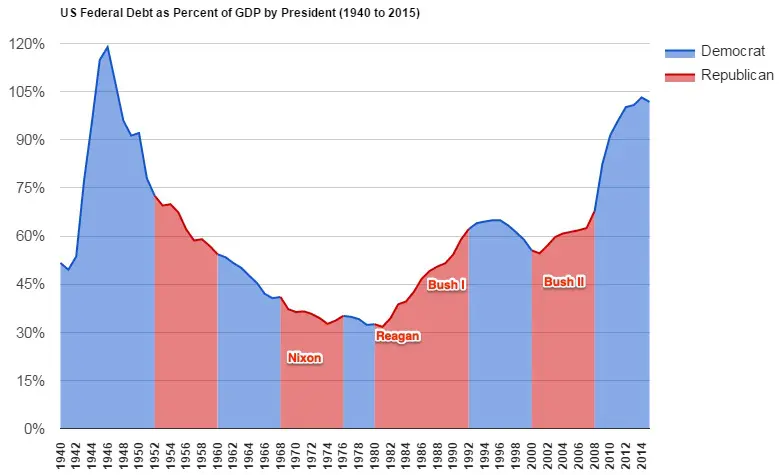
Mythology has it that “reckless Democratic spending” is to blame for the ballooning of the national debt — though the historical record shows otherwise.
In fact, the conservatives‘ beloved demi-god Ronald Reagan was the first President to skyrocket the debt, thanks to some bunk ideas from an old cocktail napkin that linger to this day — the Republican monetary theory in a nutshell is (I shit you not) that we should take all our pooled tax money and give it to… billionaires. Because, you know, they’re clearly the most qualified people to make decisions affecting the 99% poor people. Supposedly they’re the smartest folks to entrust with our money.
Trickle down, debt up
Except it’s not true, as year after year and study after study shows. Nor for all their finger-waggling at Democrats over the national debt has the GOP turned in a balanced budget since Nixon. Republicans are the most gigantic hypocrites on economics writ large, but particularly so for the national debt — with Reagan, Bush I, Bush II, and Trump all turning in record debt increases, primarily through tax cuts for the wealthy and the Gulf and Afghanistan wars.
Meanwhile, Bill Clinton balanced the budget, created a surplus, and reduced the debt during his 8 years in office, and Obama inherited the deepest recession since the 1929 Great Depression.
The financial crisis of 2008-09, itself caused by the reckless Republican zeal for deregulation — this time of financial derivatives — was a wholly GOP-owned debacle that the next president paid for politically. Nevertheless, President Obama had the debt again on a reduction path as a percentage of GDP — but then Donald “I bankrupted a series of casinos!” Trump oozed his way into the highest office in the land.
It’s weird how “reckless Democratic spending” always happens under Republican administrations!
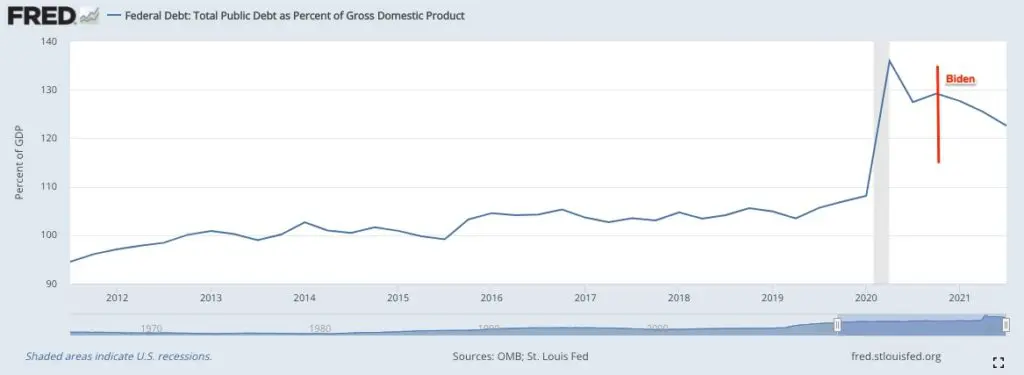
During the Trump administration, Republicans patted themselves on the back for giving a $2.7 trillion tax cut to billionaires for no reason, while the economy was relatively hot already (after being rescued by Obama). Not only was no progress made on diminishing the debt, but the national debt actually increased (both nominally and as a percentage of GDP) under Trump’s first term even before the sudden arrival of a novel coronavirus caused it to leap into the stratosphere like a 21st century American tech oligarch.
Only when President Biden arrived on the scene and took the helm of fiscal and monetary policy did the national debt begin cooling off once again — all while dramatically and quickly scaling up covid-19 vaccine production and distribution and passing over $3 trillion in Keynesian legislation meant to get the dregs of the middle class reoriented to a place on the map vis-a-vis the 1% once again.
Republican national debt bullshit
I am hereby calling bullshit on Republicans’ crocodile tears over the national debt, which they suddenly remember only when a Democrat is in town and summarily ignore while their guy is in the hot seat burning through cash like it’s going out of style.
We need to have a better collective narrative for Democratic success on the economy. The Republicans are no longer the kings of the economic world — if they ever were. It feels more like smoke and mirrors each passing day, with climate change denial, the Inflationary Boogeyman, and other GOP Greatest Hits playing ad nauseum on the AM social media waves.
Here are at least a few things to remember about the national debt, that Republicans generally get wrong:
wars are very expensive
booms in social services are expensive too; but not as expensive as wars
there is not any perceivable truth in the old GOP party line that Democrats always overspend and Republicans are always thrifty
Reagan and both Bushes presided over two of the biggest spikes in public debt in recorded history, outside of FDR who had both the Great Depression and WWII to contend with
Clinton, Carter, Johnson, Kennedy, and Truman all decreased the debt
be wary of graphs that don’t “normalize” to GNP — it’s an attempt to “lie with statistics” by obfuscating the roles of inflation and the growth of the economy itself
there is more than one way to look at and evaluate the level of public debt
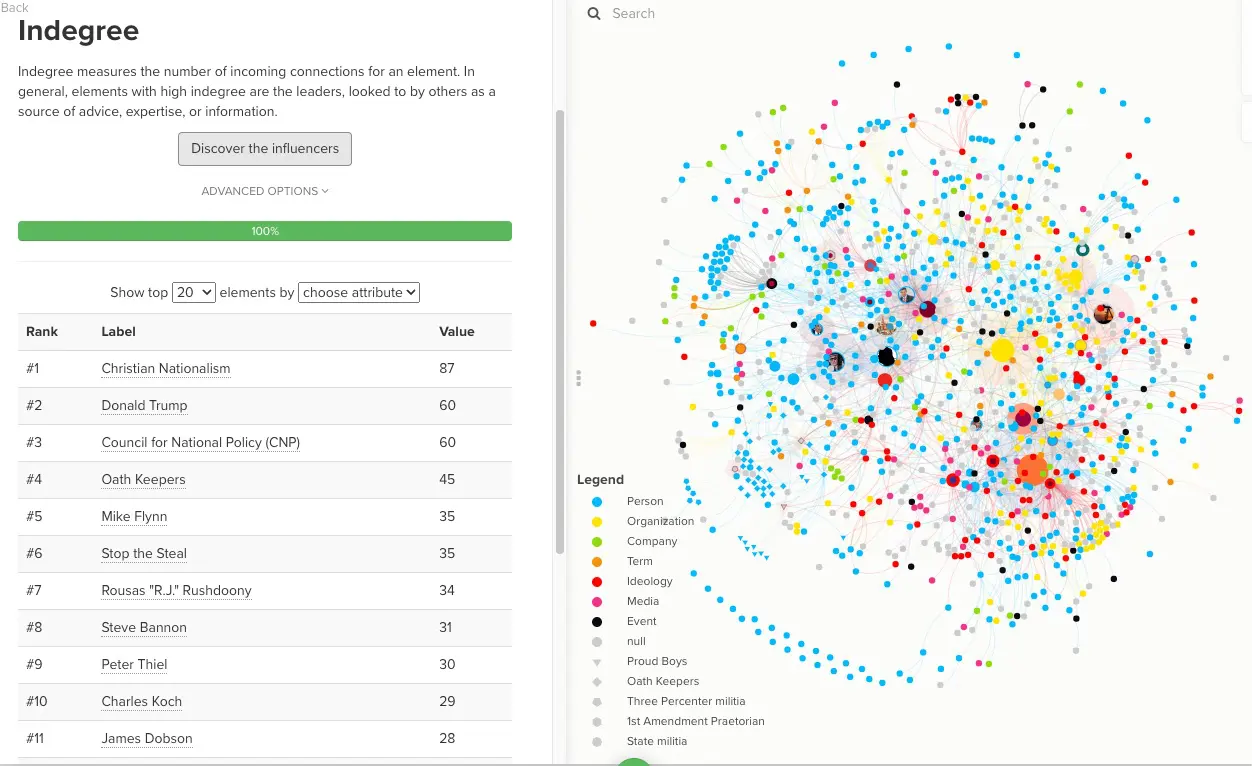
I’ll be continuing to work on this as information comes out of the various investigations and inquiries into the attempted coup to prevent the peaceful transfer of power, from the January 6 Committee to Merrick’s DOJ, the GA district attorney, NY district attorney, various civil suits, and probably more we don’t even know about yet. You can navigate the full mind map as it grows here:
Head onward into “Continue Reading” to see the same mind map through a geographic perspective:
Or capital vs. labor, oligarchs vs. plebes, plutocrats vs. proles, rich vs. poor — however you want to narrate it, the property vs. people struggle continues on in new and old ways, each and ere day.
Here in America, the plutocrats have devised many clever methods of hiding the class struggle behind a race war smokescreen, that is both real and manufactured — instigated, exacerbated, agitated by the likes of schlubby wife abusers like Sloppy Steve Bannon, wrinkly old Palpatines like Rupert Murdoch, and shady kleptocrats like Trump and Putin.
The United States has nursed an underground Confederacy slow burning for centuries, for sociopathic demagogues to tap into and rekindle for cheap and dangerous political power. Like The Terminator, racist and supremacist troglodytes seem always to reconstitute themselves into strange and twisted new forms, from slavery to the Black Codes to sharecropping to convict leasing to Jim Crow to Jim Crow 2.0 — the psychopaths want their homeland.
Ds need to start framing this as an oligarch's game in which a global class war is repeatedly laundered and diverted into a provincial race war. https://t.co/9a0KikBuGo
The political left loves people, and our extremists for the most part destroy capital or property that insurance companies will pay to make shiny and new again — unlike the right wing extremists who bomb federal buildings, killing hundreds of people and costing taxpayers’ money to replace.
Meanwhile, the right wing claims to be the righteous party for its extreme fixation on life before birth, yet its regulation-allergic capitalists destroy people and the natural world more broadly, from factory farming to deforestation, the destruction of habitats, strip-mining and other toxic extraction practices, and on into climate change itself. Being in fact the chief architects of manmade atmospheric devastation, they have managed to make themselves invisible from the deed by simply (wink wink!) denying it exists.
WWJD?!
Certainly, not anything the Republican Party is up to. Jesus would be sad.
Freedom means the right to make choices. When you have a large population, that means many different kinds of people are making many kinds of different choices for different reasons. That means, mathematically speaking, a broad distribution graph of options chosen over time. Freedom produces diversity, as a direct consequence of its own laissez-faire philosophy.
The Founders knew this. James Madison was an intellectual of his day, and a polymathic student of the great ideas of his time. It is hard not to see the influence of exposure to Condorcet’s theory about decision-making in Madison’s later ideas about diffusing the flames of factions by essentially dousing them in the large numbers of people spreading out within the growing nation. He believed that ideas and interests that were actively opposing each other would be a good way to preserve enough vigor to sustain an active self-governing democracy.
Regardless of the origin, Madison clearly himself was advocating for the power of diversity to preserve the very republic. He believed that this diversity of views in fact provided the structure that would help prevent singular demagogues from rising up too far and destroying democracy forever in their quest for unlimited power. The founders shared this foresight — that giving Americans the freedom to live as they may would lead to a healthy democracy, through the promulgation of different ideas and knowledge as well as through vigorous debate.
You can’t have freedom without diversity
Many who cite Freedom as their patriotic raison d’être do not seem to tolerate well the exercise of freedom by others, particularly others they disagree with or do not like. But as the great Civil Rights activist Fannie Lou Hamer once said, “Nobody’s free until everybody’s free.” She had the insight that if her civil rights could be taken away from her, then no one else’s rights would be safe in this nation either.
America has always struggled to live up to its founding ideals — but it seems like if we want to truly honor their memories, we would continue to take that vision at face value and continue to carry the light of the torch of equality, perhaps upwards to the crest of a hill from whence we may shine once again.
A national banking crisis in America that eventually spread to threaten economies around the globe, the economic crisis of 2007-8 was precipitated by the financial industry getting deeper and deeper into highly leveraged risk with a specific type of financial product called a subprime mortgage.
The loans were not of very high quality, due to the effects of predatory lending and of companies “pushing their luck” in a deregulated market by knowingly offering mortgage credit to Americans who couldn’t really afford to buy the homes they were encouraged to purchase. Mortgage underwriters were often incentivized with large bonuses for subprime signups, and even relatively well-off home buyers were often shepherded into subprime loans with worse terms than the traditional 30-year mortgages they would have qualified for.
Financial “hot potato”
The mortgages were securitized as complicated new types of assets, re-packaged into large bundles of derivatives to better obscure the sources, and rated far more favorably than warranted by the nation’s credit rating agencies. Sold swiftly around the world and especially here in the U.S. to institutional investors (who manage, among other securities, the pensions and retirement funds of the country), the game of financial “hot potato” ensured that almost no one in the complex chain of exchange had any incentive to take responsibility for the actual solvency of the underlying loans.
Eventually, the bubble popped and the house of cards came tumbling down. The downturn is widely regarded as the worst economic disaster in American history since the Great Depression of the 1930s, brought on by the stock market crash of 1929.
Moral hazard: Does commercial and investment banking under one roof create the wrong incentive?
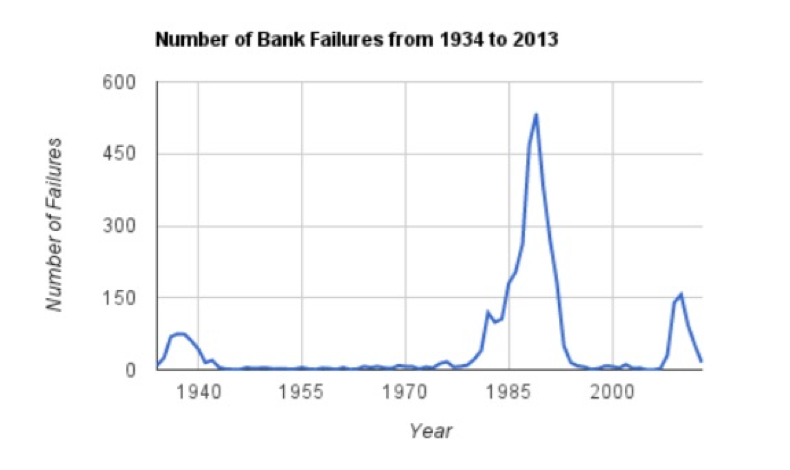
In post-recovery, much scrutiny remains over the question of whether one specific law — the Glass-Steagall Act of 1933 which separated commercial banking from investment banking in response to the Great Depression — should be reinstated. Following its passage, the U.S. was able to stop the previous historical cycle of banking crises with regularity about every ~15 years:
…Until “stagflation” (high inflation coupled with stagnant growth) plagued the American economy in the 1970s, and the political establishment began to adopt policies heavily influenced by Milton Friedman and the Chicago School of economic thought, which borrowed heavily from an earlier wave of economic philosophy in the 1930s loosely congealed under the term “neoliberalism.” Widespread financial deregulation ensued, leading to the full repeal of Glass-Steagall in 1999. Many economists now point to the deregulation spree as the ultimate cause of the 2007-8 financial crash.
The estate tax only kicks in at $5.4m in wealth — so it’s not about the “American worker”!
Repealing it would give away $270 billion to rich elites.
The concept of “double taxation” is a red herring, because most estates contain real estate assets whose capital gains have never been realized and taxed.
Inequality is the difference in measures of economic well-being between individuals in a group, among groups in a population, or among countries. Also known as economic inequality; inclusive of both income inequality and wealth inequality.
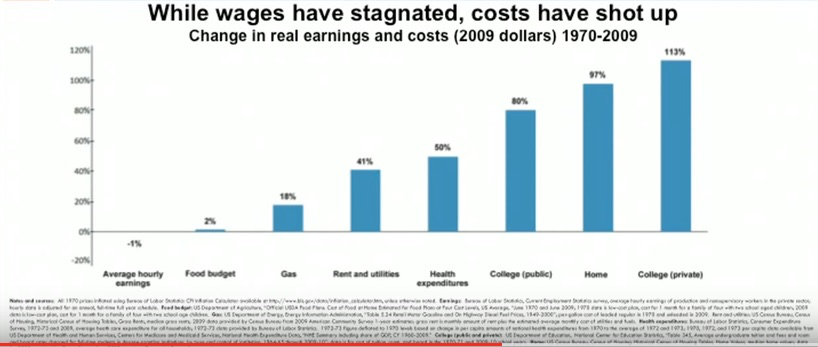
In the United States, the data broadly shows shared economic growth and prosperity in the post-WWII period until the 1970s, when things begin to take a turn: economic growth slowed and income inequality began to increase. For the past 40-50 years, income growth for lower and middle class Americans has stagnated while income growth at the top of the distribution remained growing strongly. Meanwhile as wages have stagnated, costs have risen dramatically, especially in key universal areas like housing, utilities, health care, and education.
Those at the top of the wealth distribution who benefit financially from the growing inequality find numerous ways to justify the architecture of the system, and retain much of the power and control over its design. Yet an overwhelming majority of the available historical and present-day data indicates that stark income inequality has wide-ranging negative effects on societies as a whole, from exacerbating social ills to deleterious effects on basic human needs.
Related effects
Endangers the basic viability of democracy by concentrating power vs. distributing it broadly