You’ll hear a common retort on the extreme right that now holds sway in the mainstream Republican Party, in response to protests about the dismantling of democracy in this country — that we’re “a republic, not a democracy.” Right off the bat, a republic is a form of democracy — so they are claiming something akin to having a Toyota and not a car. It’s a rhetorical trick, in which people who fully know better are hacking the simple ignorance of civics and basic political philosophy of the right-wing political base.
But it manages to get worse — the origins of the bully taunt “a republic, not a democracy” go way back — they’re actually located in the segregationist movement. Specifically, the concept comes from the pro-segregation book You and Segregation, written in 1955 by future Senator Herman E. Talmadge.
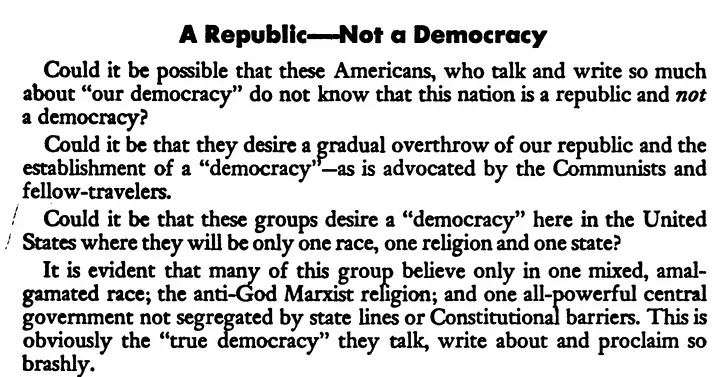
John Birch Society loonies laud “a republic, not a democracy”
The “republic, not a democracy” meme would go on to be featured in the John Birch Society Blue Book — an organization so toxically extremist that even conservative darling William F. Buckley distanced himself from them. They feared the idea that increasing democratization would be a shifting balance of power away from white conservative men, and they spun numerous conspiracy theories to explain this as the result of nefarious undercover plot to overthrow Western Civilization.
In reality, the trend towards greater democracy is something the Founders themselves envisioned — though they likely could not have imagined how it would turn out. They believed fiercely in self-governance, and a clear separation from the tyranny of kings.
Continue reading “A republic, not a democracy” came from segregationists