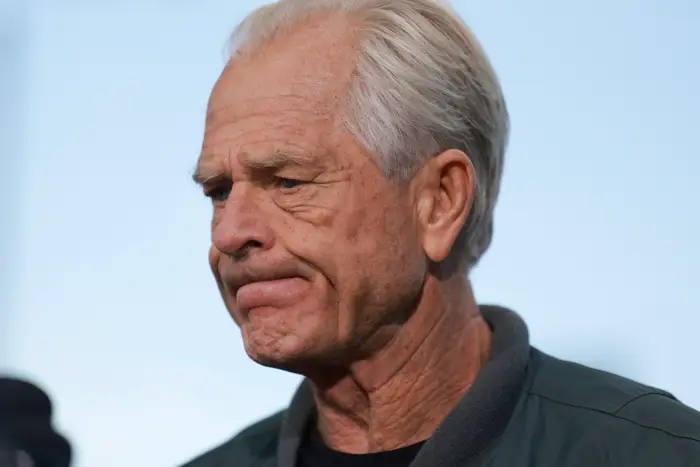
Former Trump advisor Peter Navarro — who wrote a book claiming credit for the idea to try and overthrow the 2020 election and bragged about it as the “Green Bay Sweep” to MSNBC’s Ari Melber — reported to prison today after the Supreme Court ruled he cannot get out of answering to a Congressional subpoena. Peter Navarro prison time is set to be 4 months for an independent jury’s conviction for Contempt of Congress.
The sentencing judge refuted Navarro’s allegations that he was the victim of a political prosecition: “you aren’t,” Mehta said. “You have received every process you are due.”
Election denialism, the refusal to accept credible election outcomes, has significantly impacted U.S. history, especially in recent years. This phenomenon is not entirely new; election denial has roots that stretch back through various periods of American history. However, its prevalence and intensity have surged in the contemporary digital and political landscape, influencing public trust, political discourse, and the very fabric of democracy.
Historical context
Historically, disputes over election outcomes are as old as the U.S. electoral system itself. For instance, the fiercely contested 1800 election between Thomas Jefferson and John Adams resulted in a constitutional amendment (the 12th Amendment) to prevent similar confusion in the future. The 1876 election between Rutherford B. Hayes and Samuel J. Tilden was resolved through the Compromise of 1877, which effectively ended Reconstruction and had profound effects on the Southern United States.
Yet these instances, while contentious, were resolved within the framework of existing legal and political mechanisms, without denying the legitimacy of the electoral process itself. Over time, claims of election fraud would come to be levied against the electoral and political system itself — with dangerous implications for the peaceful transfer of power upon which democracy rests.
The 21st century and digital influence
Fast forward to the 21st century, and election denialism has taken on new dimensions, fueled by the rapid dissemination of disinformation (and misinformation) through digital media and a polarized political climate. The 2000 Presidential election, with its razor-thin margins and weeks of legal battles over Florida’s vote count, tested the country’s faith in the electoral process.
Although the Supreme Court‘s decision in Bush v. Gore was deeply controversial, Al Gore’s concession helped to maintain the American tradition of peaceful transitions of power.
The 2020 Election: A flashpoint
The 2020 election, marked by the COVID-19 pandemic and an unprecedented number of mail-in ballots, became a flashpoint for election denialism. Claims of widespread voter fraud and electoral malfeasance were propagated at the highest levels of government, despite a lack of evidence substantiated by multiple recounts, audits, and legal proceedings across several states.
The refusal to concede by President Trump and the storming of the U.S. Capitol on January 6, 2021, marked a watershed moment in U.S. history, where election denialism moved from the fringes to the center of political discourse, challenging the norms of democratic transition. Widely referred to as The Big Lie, the baseless claims of election fraud that persist in the right-wing to this day are considered themselves to be a form of election fraud by justice officials, legal analysts, and a host of concerned citizens worried about ongoing attempts to overthrow democracy in the United States.
Implications, public trust, and voter suppression
The implications of this recent surge in election denialism are far-reaching. It has eroded public trust in the electoral system, with polls indicating a significant portion of the American populace doubting the legitimacy of election results. This skepticism is not limited to the national level but has trickled down to local elections, with election officials facing threats and harassment. The spread of misinformation, propaganda, and conspiracy theories about electoral processes and outcomes has become a tool for political mobilization, often exacerbating divisions within the American society.
Moreover, election denialism has prompted legislative responses at the state level, with numerous bills introduced to restrict voting access in the name of election security. These measures have sparked debates about voter suppression and the balance between securing elections and ensuring broad electoral participation. The challenge lies in addressing legitimate concerns about election integrity while avoiding the disenfranchisement of eligible voters.
Calls for reform and strengthening democracy
In response to these challenges, there have been calls for reforms to strengthen the resilience of the U.S. electoral system. These include measures to enhance the security and transparency of the voting process, improve the accuracy of voter rolls, and counter misinformation about elections. There’s also a growing emphasis on civic education to foster a more informed electorate capable of critically evaluating electoral information.
The rise of election denialism in recent years highlights the fragility of democratic norms and the crucial role of trust in the electoral process. While disputes over election outcomes are not new, the scale and impact of recent episodes pose unique challenges to American democracy. Addressing these challenges requires a multifaceted approach, including legal, educational, and technological interventions, to reinforce the foundations of democratic governance and ensure that the will of the people is accurately and fairly represented.
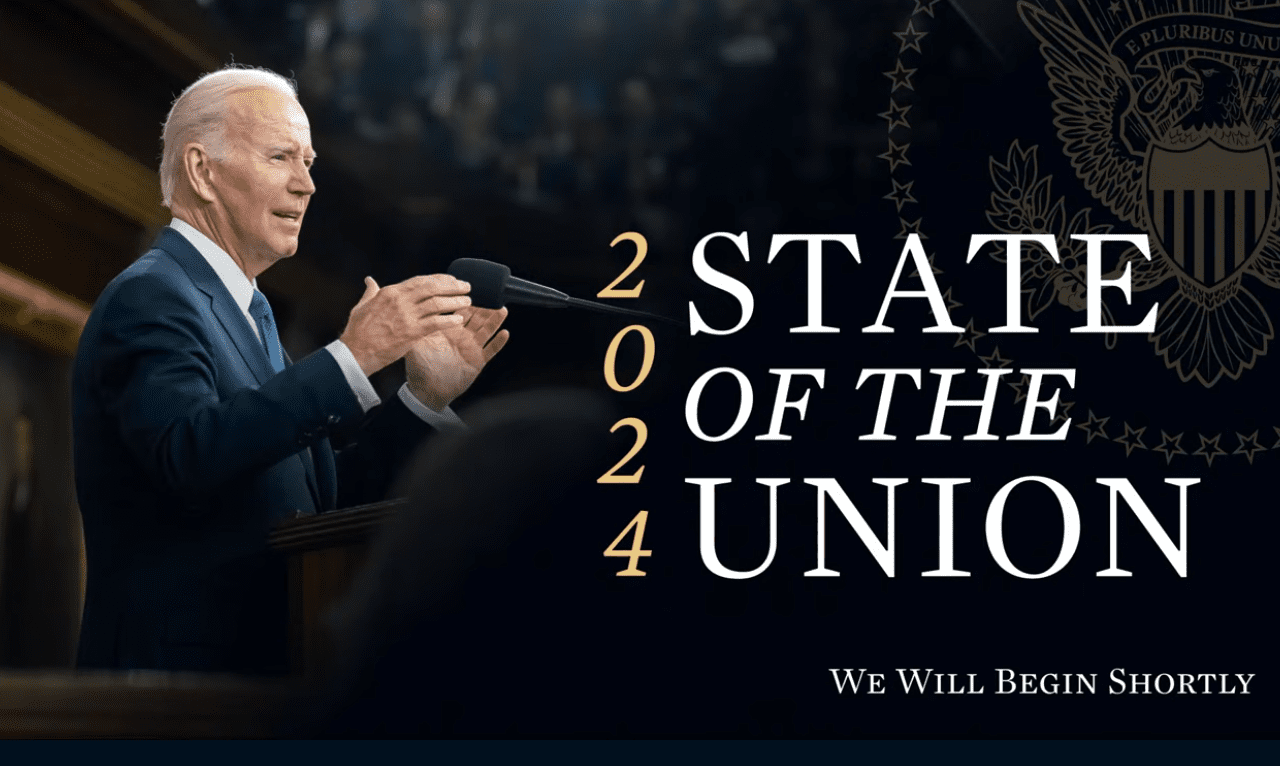
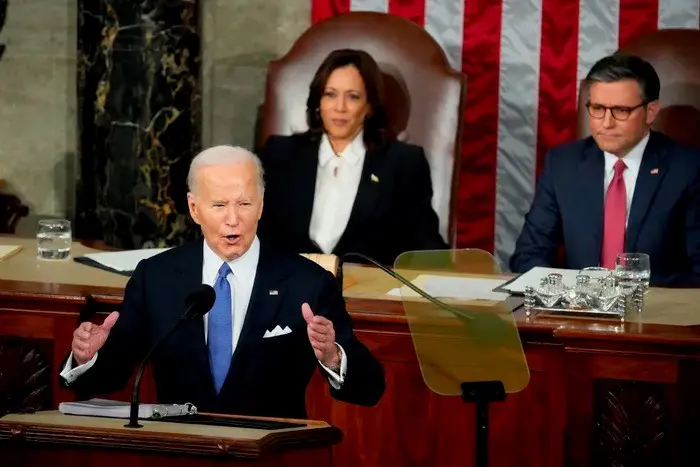
Strong economic messages of the Keynesian buttressing of the middle class that is Bidenomics were everywhere in evidence at last night’s State of the Union address, Biden’s third since taking office in 2021. In SOTU 2024 he spoke about stabbing trickle-down economics in its gasping heart as a repeated failure to the American people. Instead of giving another $2 trillion tax cuts to billionaires, Biden wants to give back to the people who he says built America: the middle class.
The President delivered strong, sweeping language and vision reminiscent of LBJ’s Great Society and FDR‘s New Deal. He also delivered a heartwarming sense of unity and appeal to put down our bickering and get things done for the American people.
“We all come from somewhere — but we’re all Americans.”
This while lambasting the Republicans for scuttling the deal over the popular bipartisan immigration bill thanks to 11th hour interference from TFG (“my predecessor” as JRB called him). “This bill would save lives!” He is really effective at calling out the GOP‘s hypocrisy on border security with this delivery.
“We can fight about the border or we can fix the border. Send me a bill!”
He is taking full advantage of being the incumbent candidate here. He has the power and the track record to do all these things he is promising, and he’s telling the exact truth about the Republican obstructionism preventing the American people from having their government work for them.
I love that he calls out Trump in this speech, without naming names — almost a kind of Voldemort effect. He who must not be named — because giving him the dignity even of a name is more than he deserves.
He says that Trump and his cabal of anti-democratic political operatives have ancient ideas (hate, revenge, reactionary, etc.) — and that you can’t lead America with ancient ideas. In America, we look towards the future — relentlessly. Americans wants a president who will protect their rights — not take them away.
“I see a future… for all Americans!” he ends with, in a segment reminiscent of the great Martin Luther King’s “I Have a Dream” speech, with its clear vision of power and authority flowing from what is morally right and just, instead of what is corrupt and cronyish. It gave me hope for the future — that Americans will make the right choice, as we seem to have done under pressure, throughout our history. π€π½
The phenomenon of anti-vaccination disinformation, often referred to as the “anti-vax” movement, is a complex and multifaceted issue that has evolved over time, particularly in the United States. It intersects with public health, misinformation, societal trust, and cultural dynamics — to name a few.
History and evolution in the U.S.
The roots of anti-vaccination sentiment in the U.S. can be traced back to the 19th century. Initially, it was based on religious and philosophical grounds, with some opposition to the smallpox vaccine. However, the contemporary form of the anti-vax movement gained momentum in the late 20th and early 21st centuries.
A significant turning point was a 1998 study published by Andrew Wakefield, which falsely linked the MMR vaccine (measles, mumps, and rubella) to autism. Despite being debunked and retracted, this study sowed seeds of doubt about vaccine safety.
Key proponents and spreaders of disinformation
The modern anti-vax movement is characterized by its diversity, ranging from fringe conspiracy theorists to wellness influencers and some celebrities. The internet and social media have been crucial in disseminating anti-vaccine misinformation.
Websites, forums, and social media platforms have allowed the rapid spread of false claims, often amplified by algorithms that favor sensational content — because that’s what keeps people consuming content on the sites. It’s part of a larger process of radicalization that social media can contribute to.
Impact on society and sulture
The impact of anti-vaccination disinformation is profound and multifaceted:
Public Health: It poses a significant threat to public health. Reduced vaccination rates can lead to outbreaks of preventable diseases, as seen with the resurgence of measles in recent years, as well as the refusal to get vaccinated to prevent the spread of covid-19.
Trust in Science and Institutions: It erodes trust in medical science, healthcare professionals, and public health institutions. This skepticism extends beyond vaccines, impacting broader public health measures and leading to an increasing science denialism in culture more generally.
Social Polarization: It contributes to social, cultural, and political polarization. Vaccination status has become a contentious issue, often intertwined with political and ideological beliefs.
Economic Impact: There are also economic implications, as disease outbreaks require significant resources to manage and can disrupt communities and businesses.
Combatting anti-vaccination disinformation
Addressing anti-vaccination disinformation requires a multi-pronged approach:
Promoting Accurate Information: Healthcare professionals, scientists, and public health officials need to proactively disseminate accurate, easy-to-understand information about vaccines. This includes addressing common misconceptions and providing transparent information about vaccine development, safety, and efficacy.
Engaging with Concerns: It’s essential to engage respectfully with individuals who have concerns about vaccines. Many people who hesitate are not staunchly anti-vaccine but may have genuine questions or fears that need addressing.
Media Literacy and Critical Thinking: Promoting media literacy and critical thinking skills can help individuals discern reliable information from misinformation.
Policy and Regulation: There’s a role for policy and regulation in addressing misinformation on social media and other platforms. This includes holding platforms accountable for the spread of false information and considering policies around vaccine requirements for certain activities or institutions.
Community Engagement: Leveraging community leaders, including religious and cultural figures, can be effective in promoting vaccination, particularly in communities that are distrustful of government or mainstream healthcare.
Global Perspective: Finally, recognizing that this is a global issue, international cooperation and support are essential, especially in countering misinformation in low and middle-income countries.
Combating anti-vaccination disinformation is a complex task that requires a nuanced understanding of its historical roots, the mechanisms of its spread, and its societal impacts. Efforts must be multidisciplinary, involving healthcare professionals, educators, policy makers, and community leaders.
The ultimate goal is to foster an environment where informed decisions about vaccinations are made based on credible information, thus protecting public health and societal well-being. To that end, we’ve got a long way to go.
In it simplest form, active measures incorporates information warfare aimed at undermining the West.
Active measures (“Π°ΠΊΡΠΈΠ²Π½ΡΠ΅ ΠΌΠ΅ΡΠΎΠΏΡΠΈΡΡΠΈΡ” in Russian) refer to a form of political warfare conducted by the Soviet Union and now, by extension, Russia, to influence the course of world events. These measures include a wide range of activities, such as espionage, the dissemination of propaganda, and the establishment of front organizations, all aimed at manipulating the public opinion and decision-making processes in other countries.
The goal is often to destabilize opponents and weaken alliances contrary to the interests of the Soviet Union or Russia, without engaging in much riskier direct military conflict.
Disinformation in active measures
Historically, active measures have included complex operations, such as spreading disinformation, orchestrating smear campaigns, and using psychological warfare to sow discord and confusion among the target population. For example, during the Cold War, the KGB engaged in active measures to spread false information about the United States, aiming to weaken its credibility and influence on the global stage.
These operations were meticulously planned and could span years or even decades, employing a variety of tactics from leaking altered documents to fostering relationships with sympathetic or unknowing individuals within influential positions.
In the digital age, the concept of active measures has evolved with technology. Social media platforms and the internet have become fertile grounds for such operations, allowing for the rapid spread of disinformation and the manipulation of public opinion on a scale previously unimaginable.
These modern active measures can involve cyber attacks, the use of trolls and bots to amplify divisive content, and the strategic release of hacked information to influence political outcomes, as seen in various elections around the world (the Wikileaks email dumps that helped Trump eke out the presidency in 2016, e.g.). The adaptability and covert nature of active measures make them a persistent challenge for governments and societies trying to safeguard democratic processes and maintain national security.
A “meme” is a term first coined by British evolutionary biologist Richard Dawkins in his 1976 book “The Selfish Gene.” Originally, it referred to an idea, behavior, or style that spreads from person to person within a culture. However, in the digital age, the term has evolved to specifically denote a type of media β often an image with text, but sometimes a video or a hashtag β that spreads rapidly online, typically through social media platforms like Facebook, Twitter/X, Reddit, TikTok, and generally all extant platforms.
Memes on the digital savannah
In the context of the internet, memes are a form of digital content that encapsulates a concept, joke, or sentiment in a highly relatable and easily shareable format. They often consist of a recognizable image or video, overlaid with humorous or poignant text that pertains to current events, popular culture, or universal human experiences. Memes have become a cornerstone of online communication, offering a way for individuals to express opinions, share laughs, and comment on societal norms.
Once primarily a tool of whimsy, amusement, and even uplifit, in recent years memes have become far more weaponized by trolls and bad actors as part of a broader shift in internet culture towards incivility and exploitation. The days of funny cats have been encroached upon by the racism and antisemitism of Pepe the Frog, beloved patron saint meme of the alt-right. The use of memes to project cynicism or thinly-veiled white supremacy into culture and politics is an unwelcome trend that throws cold water on the formerly more innocent days of meme yore online.
Memes as tools of disinformation and information warfare
While memes are still used for entertainment and social commentary, they have also become potent tools for disseminating disinformation and conducting information warfare, both domestically and abroad. This is particularly evident in political arenas where, for instance, American right-wing groups have leveraged memes to spread their ideologies, influence public opinion, and discredit opposition.
Simplicity and Virality: Memes are easy to create and consume, making them highly viral. This simplicity allows for complex ideas to be condensed into easily digestible and shareable content, often bypassing critical analysis from viewers.
Anonymity and Plausible Deniability: The often-anonymous nature of meme creation and sharing allows individuals or groups to spread disinformation without accountability. The humorous or satirical guise of memes also provides a shield of plausible deniability against accusations of spreading falsehoods.
Emotional Appeal: Memes often evoke strong emotional responses, which can be more effective in influencing public opinion than presenting factual information. The American right-wing, among other groups, has adeptly used memes to evoke feelings of pride, anger, or fear, aligning such emotions with their political messages.
Echo Chambers and Confirmation Bias: Social media algorithms tend to show users content that aligns with their existing beliefs, creating echo chambers. Memes that reinforce these beliefs are more likely to be shared within these circles, further entrenching ideologies and sometimes spreading misinformation.
Manipulation of Public Discourse: Memes can be used to distract from important issues, mock political opponents, or oversimplify complex social and political problems. This can skew public discourse and divert attention from substantive policy discussions or critical events.
Targeting the Undecided: Memes can be particularly effective in influencing individuals who are undecided or less politically engaged. Their simplicity and humor can be more appealing than traditional forms of political communication, making them a powerful tool for shaping opinions.
Memes in political campaigns
Memes have been used to discredit candidates or push particular narratives that favor right-wing ideologies. Memes have also been employed to foster distrust in mainstream media and institutions, promoting alternative, often unfounded narratives that align with right-wing agendas.
While often benign and humorous, memes can also be wielded as powerful tools of disinformation and information warfare. The American right-wing, among other political groups globally, has harnessed the viral nature of memes to influence public opinion, manipulate discourse, and spread their ideologies. As digital media continues to evolve, the role of memes in political and social spheres is likely to grow, making it crucial for consumers and citizens to approach them with a critical eye.
The term “alternative facts” gained widespread attention on January 22, 2017, when Kellyanne Conway, then-Counselor to President Donald Trump, used it during a “Meet the Press” interview. Conway was defending White House Press Secretary Sean Spicer’s false statements about the attendance numbers at Trump’s presidential inauguration the day before.
When challenged by the interviewer, who cited several facts indicating a much smaller crowd size relative to President Obama‘s inauguration, Conway asserted that Spicer was offering “alternative facts” to the media reports, which suggested a lower attendance compared to previous inaugurations.
Philosophical and Historical Context
The term, while new in its specific phrasing, taps into a long-standing philosophical debate about truth and reality. Historically, the idea that there can be different interpretations of facts has roots in relativism and constructivism.
However, the way “alternative facts” was used implied a more radical departure from the accepted notion of objective facts, tilting towards a post-truth era where the line between truth and falsehood becomes blurred. It indicated an intentional strategy of disseminating disinformation early on in the Trump administration, and articulated it out loud in a way that previous presidents had never done before.
Use in US politics
The use of “alternative facts” in US politics has been controversial and highly debated. Proponents argue that the term simply reflects different perspectives and interpretations of events. Critics, however, see it as an attempt to legitimize falsehoods or misleading information, particularly when used by those in power to contradict evidence and well-established facts.
The term quickly became symbolic of the Trump administration’s relationship with the media and its approach to information dissemination. It was seen as part of a broader strategy that involved discrediting mainstream media as so-called “fake news,” promoting favorable narratives, and challenging the notion of objective truth. It extended the already prevalent right-wing strategy of science denialism into a kind of denialism of reality itself — a dangerous path towards authoritarianism reminiscent of the use of Newspeak in George Orwell’s famous classic dystopian novel, 1984.
Implications for American democracy
The implications of the widespread use of “alternative facts” for American democracy are profound and multifaceted:
Erosion of Trust: The concept challenges the role of a free press and fact-checking institutions in democracy. When official statements are at odds with verifiable evidence, it erodes public trust in both the government and the media.
Polarization: It exacerbates political polarization. When people cannot agree on basic facts, finding common ground becomes challenging, leading to a more divided society.
Manipulation and Propaganda: The term can be weaponized for political ends, allowing for manipulation of public opinion and spreading propaganda.
Accountability and Governance: In a democracy, accountability is key. If leaders are seen to use “alternative facts” without consequence, it undermines democratic governance and the expectation that leaders are truthful and transparent.
Public Discourse and Decision Making: Accurate information is crucial for informed decision making by the electorate. When false information is disseminated under the guise of “alternative facts,” it impairs the public’s ability to make informed decisions.
Legal and Ethical Concerns: The concept raises ethical concerns about honesty and integrity in public office and can complicate legal proceedings when factual accuracy is disputed.
The dangers of “reality denial”alternative facts” in political discourse
“Alternative facts,” as a term and a concept, represents more than just a linguistic novelty; it signifies a shift in the landscape of political discourse and the relationship between truth, power, and democracy. Its emergence and use reflect deeper tensions in society about trust, media, and the nature of reality itself. For American democracy, grappling with the implications of this term is not just an intellectual exercise but a necessary endeavor to preserve the integrity of our democratic institutions and public discourse.
It’s one thing to have legitimately different perspectives on the issues. It’s quite another to throw out the founding ideals and Enlightenment principles of rational inquiry, scientific observation, and reality testing altogether. If we cannot agree even on the basic facts of a situation, the ability to arrive at any kind of policy consensus about what to do to solve issues and problems in society that will always occur is deeply impaired — and indeed, our democracy is placed in great peril.
We must recommit fully to the finding of Actual Facts — and put behind us the childish nursing of our favored Alternative Facts.
The “deep state” conspiracy theory, particularly as it has been emphasized by supporters of former President Donald Trump, alleges the existence of a hidden, powerful network within the U.S. government, working to undermine and oppose Trump’s presidency and agenda. In reality, the epithet is an elaborate way of discrediting the non-partisan civil service personnel who are brought in to government for their expertise and competence, who typically remain in their posts through Presidential transitions regardless of which party is occupying the White House.
Origin of the deep state meme
The term “deep state” originated in Turkey in the 1990s, referring to a clandestine network of military officers and their civilian allies who, it was believed, were manipulating Turkish politics. In the American context, the term was popularized during the Trump administration as a meme, evolving to imply a shadowy coalition — echoing other popular conspiracy theories such as the antisemitic global cabal theory — within the U.S. government, including intelligence agencies, the civil service, and other parts of the bureaucracy.
Main claims
Bureaucratic opposition: The theory posits that career government officials, particularly in intelligence and law enforcement agencies, are systematically working against Trump’s interests. This includes alleged sabotage of his policies and leaking information to the media.
Manipulation of information: Proponents believe that these officials manipulate or withhold information to influence government policy and public opinion against Trump.
Alleged connections with other theories: The deep state theory often intersects with other conspiracy theories, like those surrounding the investigation of Russian interference in the 2016 election and the impeachment proceedings against Trump. It suggests these events were orchestrated by the deep state to discredit or destabilize his presidency.
Contextual factors
Political polarization: The rise of the deep state theory is partly attributed to the increasing political polarization in the U.S. It serves as a narrative to explain and rally against perceived opposition within the government.
Media influence: Certain media outlets and social media platforms have played a significant role in propagating this theory. It’s often amplified by commentators who support Trump, contributing to its widespread dissemination among his base.
Trump’s endorsement: Trump himself has referenced the deep state, particularly when discussing investigations into his administration or when responding to criticism from within the government.
Criticism and counterarguments to deep state “theory”
Lack of concrete evidence: Critics argue that the deep state theory lacks substantial evidence. They contend that routine government processes, checks and balances, and the separation of powers are mischaracterized as clandestine operations.
Undermining trust in institutions: There’s concern that such theories undermine public trust in vital governmental institutions, particularly those responsible for national security and law enforcement.
Political tool: Detractors view the deep state concept as a political tool used to dismiss or discredit legitimate investigation and opposition.
Impact on governance and society
Influence on supporters: For many Trump supporters, the deep state theory provides an explanatory framework for understanding his political challenges and defeats. It galvanizes his base by portraying him as an outsider battling corrupt, entrenched interests.
Public trust and conspiracism: The theory contributes to a broader erosion of trust in government and institutions, fostering a climate where conspiratorial thinking becomes more mainstream.
Policy implications: Belief in the deep state can impact policy discussions and decisions, as it frames certain government actions and policies as inherently suspect or malicious.
Comparative perspective
Globally, similar theories exist in various forms, often reflecting local political and historical contexts. They typically emerge in situations where there is a distrust of the political establishment and are used to explain perceived injustices or power imbalances.
The deep state conspiracy theory as espoused by Trump’s MAGA movement plays a significant role in current American political discourse, impacting public perception of government, policy debates, and the broader social and political climate. Its lack of verifiable evidence and potential to undermine democratic institutions make it a dangerous propaganda prop applied recklessly by the current GOP frontrunner for the 2024 nomination.
PizzaGate originated in 2016 from the hacked emails of John Podesta, Hillary Clinton‘s campaign manager, published by WikiLeaks. Internet users on platforms like 4chan and Reddit began to interpret these emails, focusing on those that mentioned pizza and other food items. They falsely claimed these were code words for a child sex trafficking ring operated by high-ranking Democratic Party members and associated with a Washington, D.C., pizzeria named Comet Ping Pong.
The theory was fueled by various coincidences and misinterpretations. For instance, references to pizza were interpreted as part of a secret code, and the pizzeria’s quirky artwork was misconstrued as sinister symbolism. Despite the lack of credible evidence, these interpretations quickly gained traction online.
The broader political context
PizzaGate should be understood within the broader political context of the 2016 U.S. presidential election. This period was marked by intense partisanship and the proliferation of disinformation and fake news, with social media acting as a catalyst. The theory emerged against the backdrop of a highly contentious election, with Hillary Clinton as a polarizing figure. In such a climate, conspiracy theories found fertile ground to grow, particularly among those predisposed to distrust the political establishment.
Impact and aftermath
The most immediate and dangerous impact of PizzaGate was an incident in December 2016, when Edgar Maddison Welch, motivated by the conspiracy theory, fired a rifle inside Comet Ping Pong. Fortunately, there were no injuries. This incident highlighted the real-world consequences of online conspiracy theories and underscored the potential for online rhetoric to inspire violent actions.
In the aftermath, social media platforms faced criticism for allowing the spread of baseless allegations. This led to discussions about the role of these platforms in disseminating fake news and the balance between free speech and the prevention of harm.
Lasting effects
PizzaGate had several lasting effects:
Polarization and distrust: It exacerbated political polarization and distrust towards mainstream media and political figures, particularly among certain segments of the population.
Conspiracy culture: The incident became a significant part of the modern conspiracy culture, linking it to other conspiracy theories and contributing to a growing skepticism of official narratives.
Social media policies: It influenced how social media companies manage content, leading to stricter policies against misinformation and the promotion of conspiracy theories.
Public awareness: On a positive note, it raised public awareness about the dangers of misinformation and the importance of critical thinking in the digital age.
Legitimacy of investigations: The theory, though baseless, led some people to question the legitimacy of genuine investigations into sexual misconduct and abuse, potentially undermining efforts to address these serious issues.
Caveat, Internet
PizzaGate serves as a stark reminder of the power of the internet to spread misinformation and the real-world consequences that can ensue. It reflects the complexities of the digital age, where information, regardless of its veracity, can be disseminated widely and rapidly. As we continue to navigate this landscape, understanding phenomena like PizzaGate becomes crucial in fostering a more informed and discerning online community — as well as thwarting the march of fascism.
The special grand jury in Georgia that investigated efforts to overturn the state’s 2020 presidential election results in favor of loser Donald Trump has recommended indictments against 39 individuals, a number significantly higher than the 19 people ultimately charged by prosecutors. Among those recommended for indictment in the Georgia RICO case but who were not charged were South Carolina Sen. Lindsey Graham, former U.S. Senators Kelly Loeffler and David Perdue of Georgia, and former Trump national security adviser Mike Flynn.
The report suggests that Fulton County District Attorney Fani Willis exercised discretion in streamlining the case, possibly due to factors like immunity deals, federal protections, or insufficient evidence. The grand jury accused the individuals of various offenses, including racketeering, conspiracy to defraud the state, false statements, perjury, and criminal solicitation to commit election fraud.
39 Georgia co-conspirators recommended for indictment
Rudy Giuliani — Rudy Giuliani is an American attorney and politician, best known for serving as the Mayor of New York City from 1994 to 2001. He gained national prominence for his leadership during the 9/11 terrorist attacks. Later, he became a personal lawyer to Donald Trump and was involved in various legal challenges related to the 2020 U.S. Presidential election.
John Eastman — John Eastman is a constitutional law scholar and attorney. He gained attention for advising former President Donald Trump on legal matters, particularly concerning the 2020 election. Eastman has been criticized for promoting theories that questioned the election’s integrity.
Kenneth Chesebro — Kenneth Chesebro is a less-publicized figure, primarily known as a Harvard Law School lecturer. He specializes in legal writing and research, but has not been prominently involved in mainstream political or legal events.
Donald Trump — Businessman and television personality. His presidency was marked by a polarized political climate, economic highs and lows, and two impeachments. He remains a highly influential figure in American politics.
Cleta Mitchell — Cleta Mitchell is an American lawyer specializing in election law and campaign finance. She gained attention for representing Donald Trump in matters related to the 2020 presidential election and has been a vocal critic of its outcome.
Jenna Ellis — Jenna Ellis is an American attorney and author. She served as a legal advisor to Donald Trump during his presidency and was involved in legal challenges concerning the 2020 election. Ellis is known for her conservative viewpoints.
Mark Meadows — Mark Meadows is an American politician who served as the White House Chief of Staff under Donald Trump. Prior to that, he was a U.S. Representative from North Carolina. Meadows is a founding member of the Freedom Caucus in the House of Representatives.
David Shafer — David Shafer is a Republican politician from Georgia, serving as the Chairman of the Georgia Republican Party. He has been involved in state politics for years and was a vocal supporter of Donald Trump during the 2020 election.
Ray Smith III — Ray Smith is a Georgia-based attorney who gained attention for representing the Trump campaign in legal matters related to the 2020 election in Georgia. He specializes in civil litigation and business law. He is accused of making false claims of election fraud at legislative hearings in December 2020.
Lin Wood — Lin Wood is an American attorney known for high-profile defamation cases. He became a controversial figure for his involvement in legal challenges related to the 2020 U.S. Presidential election and his promotion of conspiracy theories.
Lindsey Graham — Lindsey Graham is a U.S. Senator from South Carolina, serving since 2003. A member of the Republican Party, Graham is known for his conservative stance on issues like national security and his close relationship with Donald Trump.
Sidney Powell — Sidney Powell is an American attorney and author. She gained national attention for her involvement in legal challenges related to the 2020 presidential election, promoting theories that have been widely discredited.
Robert Cheeley — Robert Cheeley is a Georgia-based attorney specializing in personal injury law. He gained attention for his association with Lin Wood in various legal matters but is not a mainstream political figure. He is accused of making false claims of election fraud at legislative hearings in December 2020.
Mike Flynn — Michael Flynn is a retired U.S. Army Lieutenant General who briefly served as National Security Advisor under Donald Trump. He was convicted of lying to the FBI but was later pardoned by Trump.
William Ligon — William Ligon is a Republican politician who serves as a State Senator in Georgia. He gained attention for his efforts to challenge the results of the 2020 presidential election in Georgia.
David Perdue — David Perdue is an American businessman and politician who served as a U.S. Senator from Georgia from 2015 to 2021. A member of the Republican Party, Perdue was a close ally of former President Donald Trump. He lost his re-election bid in the 2021 Georgia runoff to Democrat Jon Ossoff.
Kelly Loeffler — Kelly Loeffler is an American businesswoman and politician who served as a U.S. Senator from Georgia. Appointed in 2019, she lost her seat to Democrat Raphael Warnock in the 2021 Georgia runoff. Loeffler is co-owner of the Atlanta Dream, a WNBA team.
Cathy Latham — A previously lesser known figure in Georgia politics.
Misty Hampton — A previously lesser known figure in Georgia politics.
Scott Hall — A previously lesser known figure in Georgia politics.
Boris Epshteyn — Boris Epshteyn is a Russian-American political strategist and commentator. He served as a special assistant to President Donald Trump and has been a vocal supporter of Trump’s policies.
Jeffrey Clark — Jeff Clark is an American attorney who served as the Assistant Attorney General for the Environment and Natural Resources Division under the Trump administration. He gained attention for his role in Trump’s efforts to overturn the 2020 election results.
Kurt Hilbert — Kurt Hilbert is an American attorney based in Georgia. He gained attention for his involvement in legal challenges related to the 2020 U.S. Presidential election, particularly in Georgia.
Stephen Lee — A previously lesser known figure in Georgia politics.
Trevian Kutti — Trevian Kutti is a public relations consultant who has worked with high-profile clients, including politicians and celebrities. She is not a mainstream political figure but has some influence in the PR world.
Harrison Floyd — Harrison Floyd is a military veteran and political activist. He has been involved in conservative political campaigns and organizations but is not a mainstream political figure.
Alex Kaufman — Alex Kaufman is an American attorney based in Georgia. He specializes in election law and has been involved in various legal matters related to elections, although he is not a widely recognized public figure.
Joseph Brannan — A previously lesser known figure in Georgia politics.
Vikki Consiglio — Vikki Consiglio is a Georgia-based political activist and member of the Republican Party. She has been involved in local politics and grassroots organizing but is not a mainstream political figure.
Carolyn Fisher — A previously lesser known figure in Georgia politics.
Burt Jones — Burt Jones is an American businessman and politician serving as a Republican State Senator in Georgia. He has been in office since 2013 and is known for his conservative stances on issues like healthcare and education. Jones was a vocal supporter of Donald Trump and has been involved in efforts to challenge the 2020 election results in Georgia.
Gloria Godwin — A previously lesser known figure in Georgia politics.
Mark Hennessy — A previously lesser known figure in Georgia politics.
Mark Amick — A previously lesser known figure in Georgia politics.
John Downey — A previously lesser known figure in Georgia politics.
Brad Carver — Brad Carver is an American attorney and political strategist based in Georgia. He is a partner at Hall Booth Smith, P.C., and specializes in governmental affairs. Carver has been involved in Republican politics and has served as a delegate to the Republican National Convention.
Shawn Still — A previously lesser known figure in Georgia politics.
C. B. Yadav — C. B. Yadav is a businessman and community leader based in Georgia. While not a mainstream political figure, Yadav has been involved in local community initiatives and has received recognition for his philanthropic efforts.
Jacki Pick — Jacki Pick is an American attorney and conservative commentator. She has appeared on various media platforms to discuss legal and political issues. Pick is known for her conservative viewpoints and has been a guest speaker at several conservative events.
What is RICO?
The Racketeer Influenced and Corrupt Organizations Act (RICO) is a U.S. federal law enacted in 1970, designed to combat organized crime. Initially aimed at dismantling the Mafia, RICO has evolved to address a broad range of illegal activities carried out by enterprises, which can include businesses, gangs, and even political organizations. The law targets patterns of racketeering, which may involve activities like money laundering, drug trafficking, and fraud.
In the legal profession, RICO cases are approached with meticulous care due to their complexity. Prosecutors must prove four key elements: the existence of an “enterprise,” a pattern of racketeering activity, a connection between the enterprise and the criminal conduct, and the defendant’s participation in the enterprise through the pattern of racketeering. Establishing a “pattern” usually requires at least two acts of racketeering activity within a 10-year period.
Defense strategies often focus on dismantling one or more of these elements. For instance, they may argue that the alleged activities do not constitute a “pattern” or that the defendant was not sufficiently involved in the enterprise. Given the severe penalties, which can include hefty fines and up to 20 years in prison per racketeering count, both sides often rely on extensive documentation, expert testimonies, and intricate legal arguments.
Trials are usually long-drawn affairs, involving multiple parties and numerous charges. The prosecution may use tools like wiretaps, surveillance, and informants to build their case, while the defense may scrutinize the validity and legality of such evidence. Due to the high stakes, RICO cases are typically handled by attorneys with specialized expertise in this area of law.
TL;DR: RICO is a powerful tool for prosecuting organized criminal activities, but its cases are complex and require a nuanced legal approach.
The Council for National Policy is a conservative organization founded in 1981 by far-right Republican activists in the U.S. including Paul Weyrich, Richard Viguerie, Phyllis Schlafly, and Tim LaHaye to advance a Christian Right agenda in American politics.
Today, the CNP is enormously influential on the right and almost unknown on the left. Its secretive cabal designs policy for federal and state lawmakers to amplify or parrot, and they dutifully do. Members include a who’s who of the Trumpian rogue gallery, from Steve Bannon and Kellyanne Conway to Mike Pence, Jim Jordan, Cleta Mitchell, and of course, Ginni Thomas.
The CNP gave Mike Flynn an annual award. Then-President Trump spoke at their 2020 annual meeting. That tells you pretty much all you need to know about how dangerous and well-connected this organization is, and how great is the extent of the group’s influence on American politics — and it’s only the tip of the iceberg. Columbia University scholar Anne Nelson describes the primary impact of the group as βconnecting the manpower and media of the Christian right with the finances of Western plutocrats and the strategy of right-wing Republican political operativesβ in her excellent book, Shadow Network: Media, Money, and the Secret Hub of the Radical Right.
CNP and the Big Lie
They go to great lengths to conceal their activities, membership rosters, and connections within the corridors of Washington as well as in state legislatures and the judiciary. For more than 40 years the CNP has united the deep pocketbooks of right-wing donors with strategists, media campaigns, and activists. The group was deeply involved in both the efforts to overturn the 2020 election, leading up to and including the January 6 insurrection — from funding and planning to propaganda and “legal” challenges.
The CNP continues to press its narrow, historically revisionist ideas about America, including efforts to influence the 2022 midterm elections and, undoubtedly, the 2024 contest. In the quest to understand this fractious moment of bitter partisanship, the Council for National Policy is one of the secret keys to unlocking the true inner workings of the right-wing political machine.
They are men with little imagination, who seek to exalt themselves by squishing everyone else down into a mass of un-individuated peons. One of many right-wing Big Lies is that fascism is the opposite of communism — not so. Both are forms of collectivism, in which the masses must be relegated to nothingness by the immense, overwhelming pressures of society — such that a few secular gods of Greatness Thinking may shine above all the rest.
Fascists are Dittoheads
The ethos of “copying” is a signature psychological trait of fundamentalist minds devoid of creativity. Both Trump and Koch have fashioned themselves as carbon copies of Daddy — in true Strict Father Morality style. Thus they feel completely anachronistic in modern times — where children are falling farther and farther from the proverbial trees, ideologically speaking.
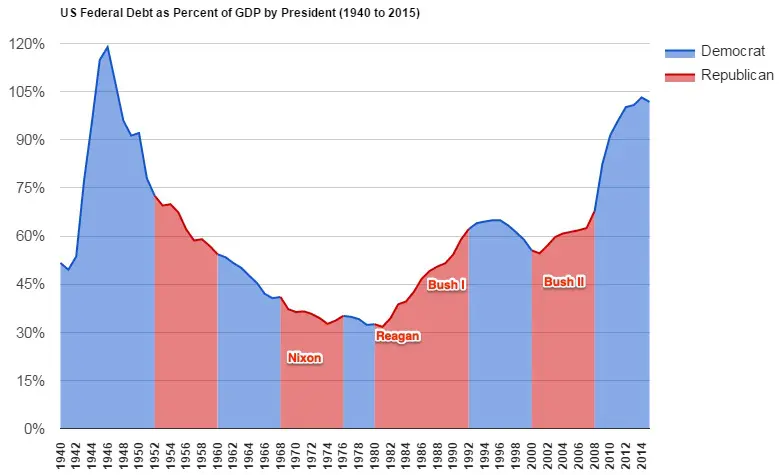
Mythology has it that “reckless Democratic spending” is to blame for the ballooning of the national debt — though the historical record shows otherwise.
In fact, the conservatives‘ beloved demi-god Ronald Reagan was the first President to skyrocket the debt, thanks to some bunk ideas from an old cocktail napkin that linger to this day — the Republican monetary theory in a nutshell is (I shit you not) that we should take all our pooled tax money and give it to… billionaires. Because, you know, they’re clearly the most qualified people to make decisions affecting the 99% poor people. Supposedly they’re the smartest folks to entrust with our money.
Trickle down, debt up
Except it’s not true, as year after year and study after study shows. Nor for all their finger-waggling at Democrats over the national debt has the GOP turned in a balanced budget since Nixon. Republicans are the most gigantic hypocrites on economics writ large, but particularly so for the national debt — with Reagan, Bush I, Bush II, and Trump all turning in record debt increases, primarily through tax cuts for the wealthy and the Gulf and Afghanistan wars.
Meanwhile, Bill Clinton balanced the budget, created a surplus, and reduced the debt during his 8 years in office, and Obama inherited the deepest recession since the 1929 Great Depression.
The financial crisis of 2008-09, itself caused by the reckless Republican zeal for deregulation — this time of financial derivatives — was a wholly GOP-owned debacle that the next president paid for politically. Nevertheless, President Obama had the debt again on a reduction path as a percentage of GDP — but then Donald “I bankrupted a series of casinos!” Trump oozed his way into the highest office in the land.
It’s weird how “reckless Democratic spending” always happens under Republican administrations!
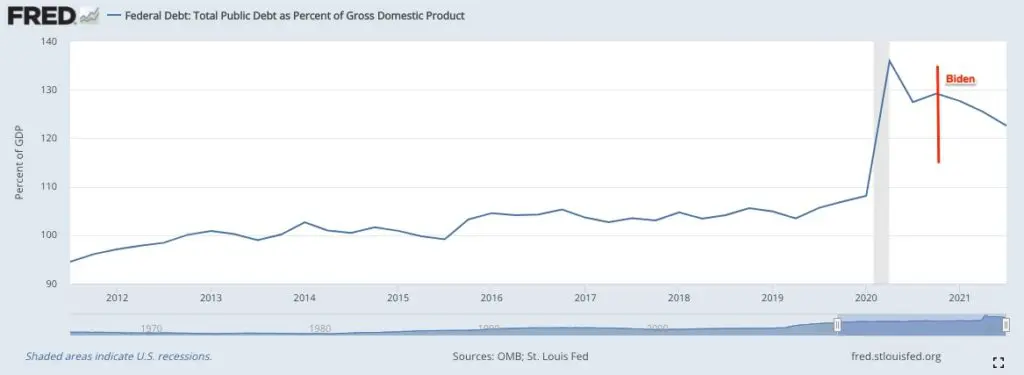
During the Trump administration, Republicans patted themselves on the back for giving a $2.7 trillion tax cut to billionaires for no reason, while the economy was relatively hot already (after being rescued by Obama). Not only was no progress made on diminishing the debt, but the national debt actually increased (both nominally and as a percentage of GDP) under Trump’s first term even before the sudden arrival of a novel coronavirus caused it to leap into the stratosphere like a 21st century American tech oligarch.
Only when President Biden arrived on the scene and took the helm of fiscal and monetary policy did the national debt begin cooling off once again — all while dramatically and quickly scaling up covid-19 vaccine production and distribution and passing over $3 trillion in Keynesian legislation meant to get the dregs of the middle class reoriented to a place on the map vis-a-vis the 1% once again.
Republican national debt bullshit
I am hereby calling bullshit on Republicans’ crocodile tears over the national debt, which they suddenly remember only when a Democrat is in town and summarily ignore while their guy is in the hot seat burning through cash like it’s going out of style.
We need to have a better collective narrative for Democratic success on the economy. The Republicans are no longer the kings of the economic world — if they ever were. It feels more like smoke and mirrors each passing day, with climate change denial, the Inflationary Boogeyman, and other GOP Greatest Hits playing ad nauseum on the AM social media waves.
Here are at least a few things to remember about the national debt, that Republicans generally get wrong:
wars are very expensive
booms in social services are expensive too; but not as expensive as wars
there is not any perceivable truth in the old GOP party line that Democrats always overspend and Republicans are always thrifty
Reagan and both Bushes presided over two of the biggest spikes in public debt in recorded history, outside of FDR who had both the Great Depression and WWII to contend with
Clinton, Carter, Johnson, Kennedy, and Truman all decreased the debt
be wary of graphs that don’t βnormalizeβ to GNP β it’s an attempt to βlie with statisticsβ by obfuscating the roles of inflation and the growth of the economy itself
there is more than one way to look at and evaluate the level of public debt
Or capital vs. labor, oligarchs vs. plebes, plutocrats vs. proles, rich vs. poor — however you want to narrate it, the property vs. people struggle continues on in new and old ways, each and ere day.
Here in America, the plutocrats have devised many clever methods of hiding the class struggle behind a race war smokescreen, that is both real and manufactured — instigated, exacerbated, agitated by the likes of schlubby wife abusers like Sloppy Steve Bannon, wrinkly old Palpatines like Rupert Murdoch, and shady kleptocrats like Trump and Putin.
The United States has nursed an underground Confederacy slow burning for centuries, for sociopathic demagogues to tap into and rekindle for cheap and dangerous political power. Like The Terminator, racist and supremacist troglodytes seem always to reconstitute themselves into strange and twisted new forms, from slavery to the Black Codes to sharecropping to convict leasing to Jim Crow to Jim Crow 2.0 — the psychopaths want their homeland.
Ds need to start framing this as an oligarch's game in which a global class war is repeatedly laundered and diverted into a provincial race war. https://t.co/9a0KikBuGo
The political left loves people, and our extremists for the most part destroy capital or property that insurance companies will pay to make shiny and new again — unlike the right wing extremists who bomb federal buildings, killing hundreds of people and costing taxpayers’ money to replace.
Meanwhile, the right wing claims to be the righteous party for its extreme fixation on life before birth, yet its regulation-allergic capitalists destroy people and the natural world more broadly, from factory farming to deforestation, the destruction of habitats, strip-mining and other toxic extraction practices, and on into climate change itself. Being in fact the chief architects of manmade atmospheric devastation, they have managed to make themselves invisible from the deed by simply (wink wink!) denying it exists.
WWJD?!
Certainly, not anything the Republican Party is up to. Jesus would be sad.
It’s been said that the devilish ways of pedophiliac liberal Democrats are killing Christianity in America, but the numbers tell a different story. Following the 2016 Armistice in the War on Christmas, Donald Trump yet managed to drive 1 in 7 Evangelicals from the fold, according to data from Pew and PRRI.
Far from the surge in True Believers prophesied by the right wing, the religious right’s deal with the proverbial and/or literal devil seems to have driven members away. Trump is losing Evangelicals, and really — should we be so shocked? If it doesn’t matter (to some) whether our leaders are serial philanderers and lifelong business cheats, or earnestly striving public servants spreading compassion — what use is their moral code, then? None. It is bankrupt.
ShrΓΆdinger’s Moral Leadership
The religious right can’t have it both ways — either moral leadership is important, or it isn’t. It can’t selectively be important *only* when a Democrat is in power. Evangelicals also need to make a choice between God and Caesar. Prosperity gospel is the latter and not the former, but many pretend otherwise or are fooled — after all, fool’s gold can still fool.
Cognitive dissonance upon dissonance continues to fall in the totally unraked forest of right-wing values. I’m aiming to continue pulling on a few threads connecting the religious right, and Evangelicals in particular, to the rise of political extremism in the Republican Party:
The pitch that winning the culture war is more important than God’s law is thin at best
Donald Trump is not a Christian
The “imperfect vessel” fails as moral justification
Jesus didn’t care about tax cuts
Christian leaders’ claims that politics is amoral ground beyond the reach of God’s teachings is self-evident nonsense
Christians are leaving their own moral house unguarded. No one is showing the living proof of Jesus’ teachings anymore — and it’s not the fault of the people on the left who weren’t doing it before.