Twitter

When usability pioneers have All the Feels about the nature of our creeping technological dystopia, how we got here, and what we might need to do to right the ship, it’s wise to pay attention. Don Norman’s preaching resonated with my choir, and they’ve asked me to sing a summary song of our people in bulleted list format:

  • What seemed like a virtuous thing at the time — building the internet with an ethos of trust and openness — has led to a travesty via lack of security, because no one took bad actors into account.
  • Google, Facebook, et al didn’t have the advertising business model in mind a priori, but sort of stumbled into it and got carried away giving advertisers what they wanted — more information about users — without really taking into consideration the boundary violations of appropriating people’s information. (see Shoshana Zuboff’s definitive new book on Surveillance Capitalism for a lot more on this topic)
  • Tech companies have mined the psychological sciences for techniques that — especially at scale — border on mass manipulation of fundamental human drives to be informed and to belong. Beyond the creepy Orwellian slant of information appropriation and emotional manipulation, the loss of productivity and mental focus from years of constant interruptions takes a toll on society at large.
  • We sign an interminable series of EULAs, ToS’s and other lengthy legalese-ridden agreements just to access the now basic utilities that enable our lives. Experts refer to these as “contracts of adhesion” or “click-wrap,” as a way of connoting the “obvious lack of meaningful consent.” (Zuboff)
  • The “bubble effect” — the internet allows one to surround oneself completely with like-minded opinions and avoid ever being exposed to alternative points of view. This has existential implications for being able to inhabit a shared reality, as well as a deleterious effect on public discourse, civility, and the democratic process itself.
  • The extreme commercialization of almost all of our information sources is problematic, especially in the age of the “Milton Friedman-ification” of the economic world and the skewing of values away from communities and individuals, towards a myopic view of shareholder value and all the attendant perverse incentives that accompany this philosophical business shift over the past 50 years. He notes that the original public-spiritedness of new communication technologies has historically been co-opted by corporate lobbyists via regulatory capture — a subject Tim Wu explores in-depth in his excellent 2011 book, “The Master Switch: The Rise and Fall of Information Empires.

Is it all bleak, Don?! His answer is clear: “yes, maybe, no.” He demurs on positing a definitive answer to all of these issues, but he doesn’t really mince words about a “hunch” that it may in fact involve burning it all down and starting over again.

Pointing to evolution, Norman notes that we cannot eke radical innovation out of incremental changes — and that when radical change does happen it is often imposed unexpectedly from the outside in the form of catastrophic events. Perhaps if we can’t manage to Marie Kondo our way to a more joyful internet, we’ll have to pray for Armageddon soon…?! 😱
https://www.youtube.com/watch?v=uCEeAn6_QJo
Read more

This list casts a wide net in enumerating the various principals of interest to Russian interference in the 2016 U.S. election… and beyond. The Russia scandal has continued to unspool throughout the Trump presidency, including the real estate magnate’s first impeachment over his extortion of Ukraine, and his second impeachment over the armed insurrection he incited following his failed re-election bid. It continues to this day.

Plus, don’t miss the RussiaGate Lexicon — and please note these are both works in progress and being updated as new details emerge about the Russia scandal, the Trump family criminal organization, and Putin’s revanchist influence in American politics.

Bestiary

NameNationalityTypeKnown for
Read more

Anger is the defining emotion of the internet.

It’s designed to whip you up into a frenzy in order to foment cheap pageviews. Its interest is in you becoming a histrionic attention whore, such that you suck in as much clandestinely stolen user data to your platform of choice as possible. Turns out, conflict gets attention.

Anger is also notably the “loophole” emotion — it’s the invisible one men get to have, while claiming for generations upon generations that “women are too emotional to be entrusted” with leadership or anything meaningful, really. Meanwhile male anger and aggression have killed hundreds of millions and wreaked destruction upon the earth many times over, as fragile masculinity is repeatably and predictably triggered over any little old thing.

A neat trick.

A story.

A lie.

Read more

While multiple formal investigations against the Trump family and administration continue to unfold, and Drumpf supporters weirdly deny the probable cause for concern, Putin’s troll army continues to operate out in the open on Twitter, Facebook, Medium, and other social media networks. The sheer scale of this operation started to become clear to me in the months leading up to Election 2016, having both spent a lot of time on social media both professionally and personally for over a decade as well as a hefty amount of time on political investigation during this presidential cycle: bots on Twitter had taken over.

Whatever your thoughts on the #RussiaGate corruption scandal may be, it should concern any citizen that an enormous group of bad actors is working together to infiltrate American social media, with a specific intent to sway politics. Media literacy is one part of the answer, but we’re going to need new tools to help us identify accounts that are only present in bad faith to political discourse: they are not who they claim to be, and their real goals are kept carefully opaque.

Cold War 2.0

We should consider our nation embroiled in a large international game of psychological warfare, or PsyOps as it is referred to in intelligence circles. The goal is to sow disinformation as widely as possible, such that it becomes very difficult to discern what separates truth from propaganda. A secondary goal is to sow dissent among the citizenry, particularly to rile up the extremist factions within America’s two dominant political parties in an attempt to pull the political sphere apart from the center. 

We didn’t really need much help in that department as it is, with deep partisan fault lines having been open as gaping wounds on the American political landscape for some decades now — so the dramatically escalated troll army operation has acted as an intense catalyst for further igniting the power kegs being stored up between conservatives and progressives in this country.

Luckily there are some ways to help defray the opposition’s ability to distract and spread disinfo by identifying the signatures given off by suspicious accounts. I’ve developed a few ways to evaluate whether a given account may be a participant in paid propaganda, or at least is likely to be misrepresenting who they say they are, and what their agenda is. 

Sometimes it’s fun to get embroiled in a heated “tweetoff,” but I’ve noticed how easy it is to feel “triggered” by something someone says online and how the opposition is effectively “hacking” that tendency to drag well-meaning people into pointless back-and-forths designed not to defend a point of view, but simply to waste an activist’s time, demoralize them, and occupy the focus — a focus that could be better spent elsewhere on Real Politics with real citizens who in some way care about their country and their lives.

Bots on Twitter have “Tells”

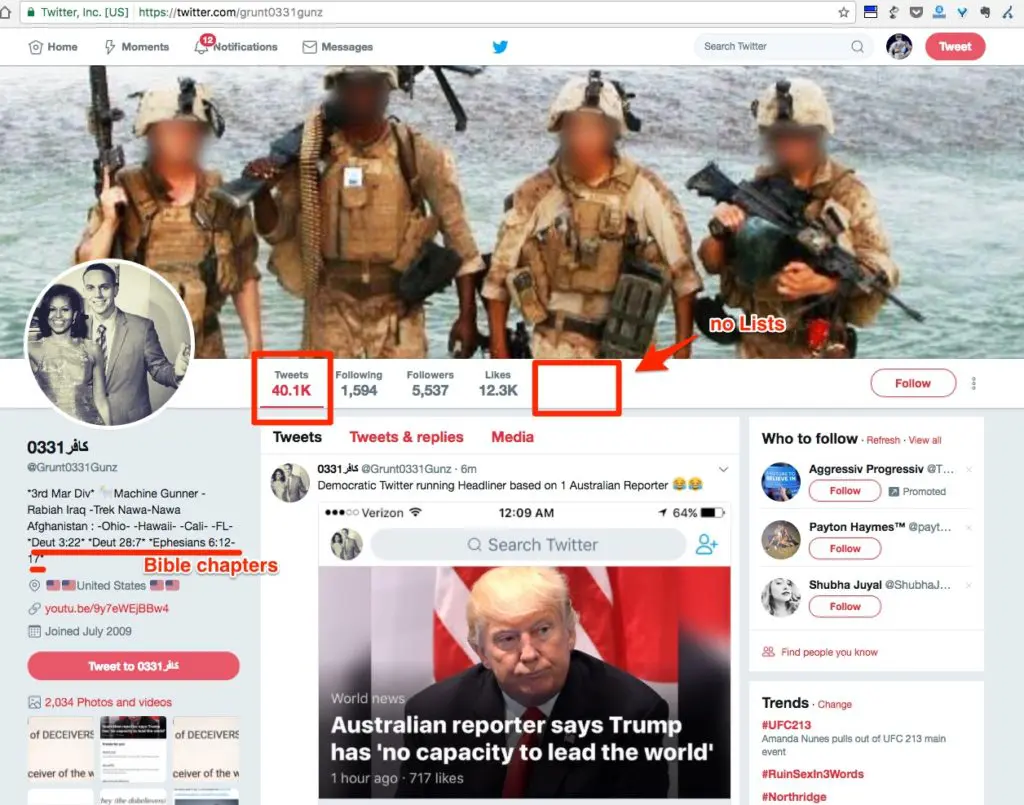
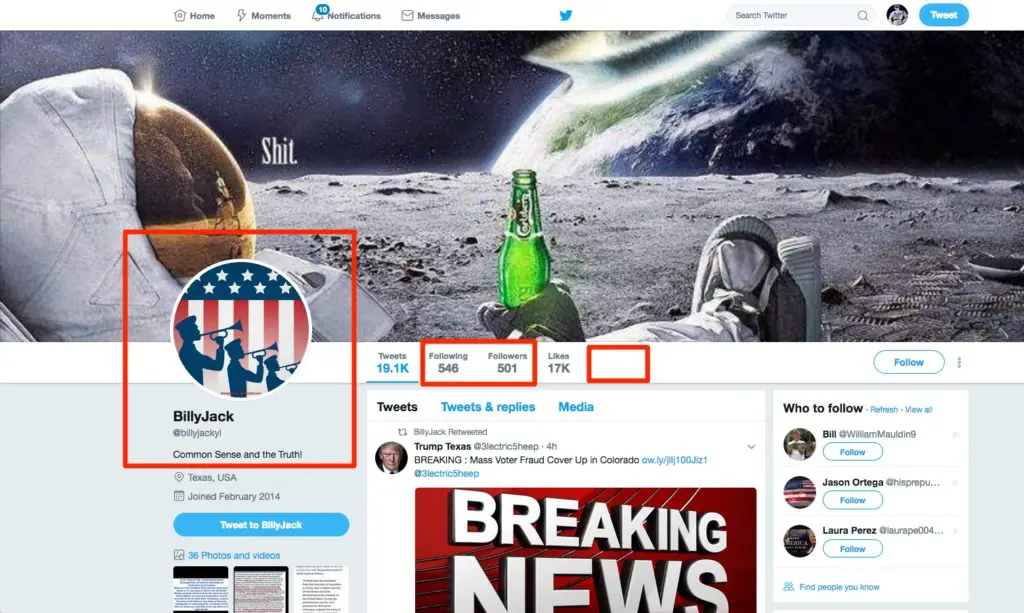
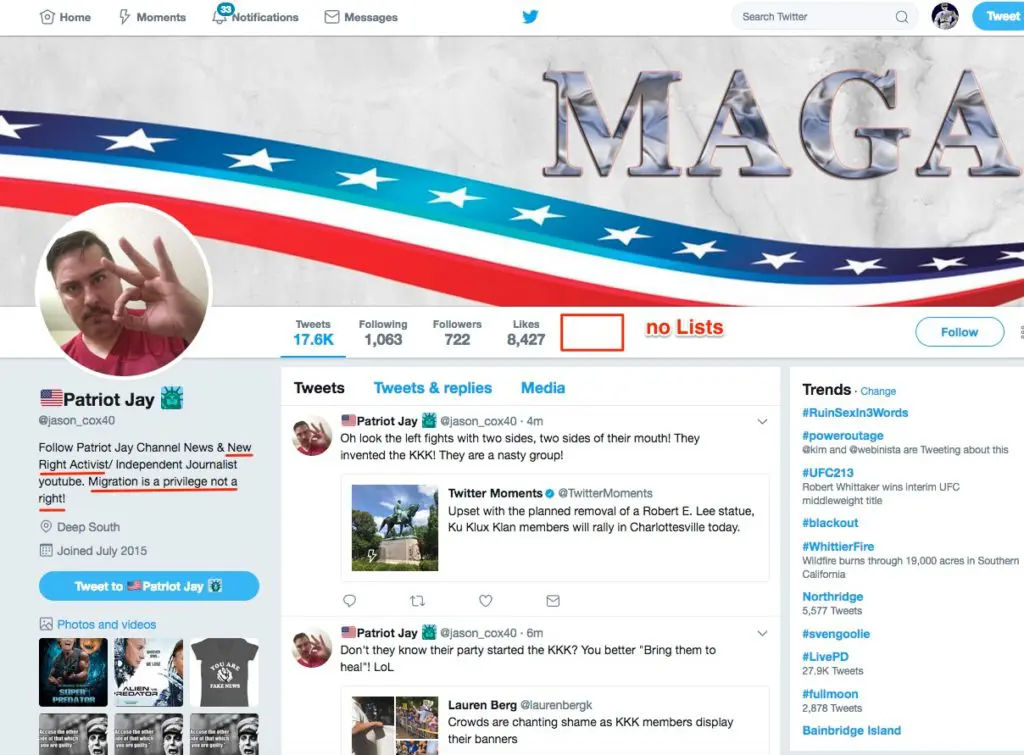
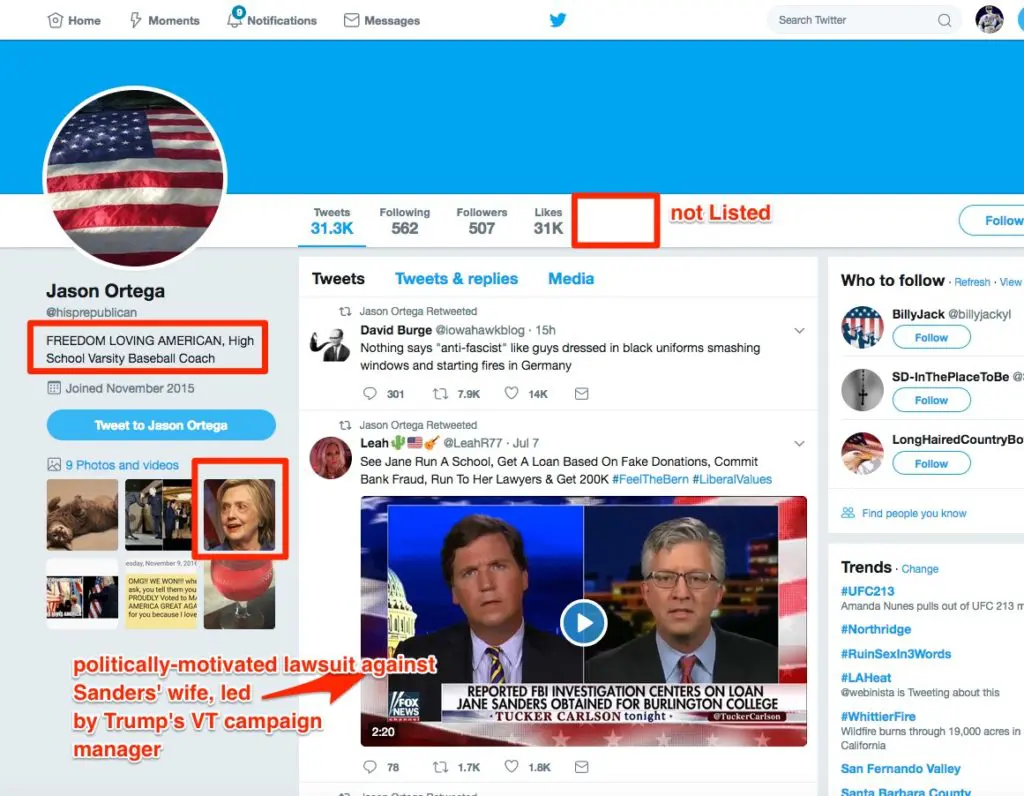
1) Hyper-patriotism

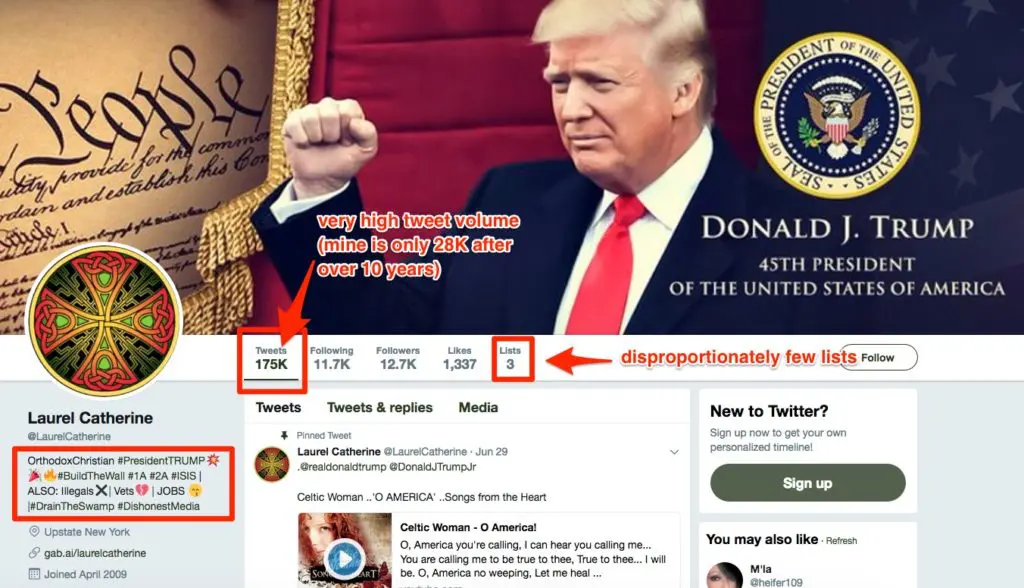
– Conspicuously hyper-patriotic bio (and often, name)  – Posts predominantly anti-Democrat, anti-liberal/libtard, anti-Clinton, anti-Sanders, anti-antifa etc. memes:


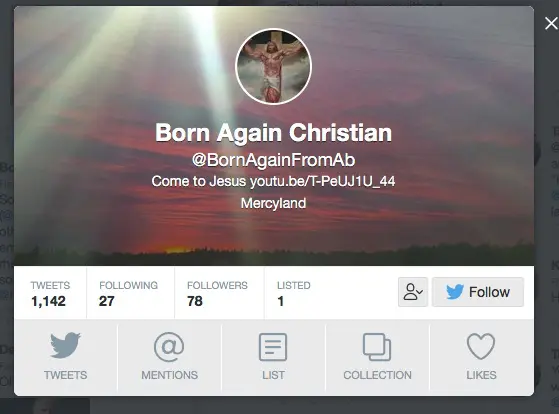
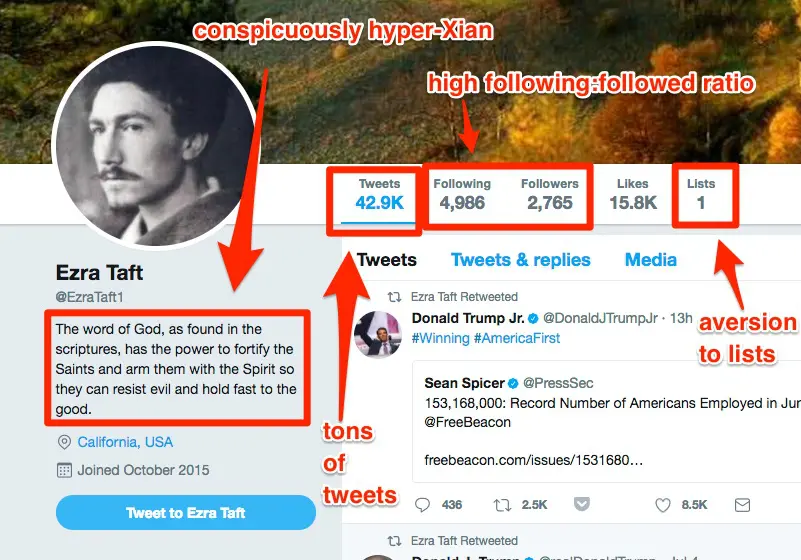
2) Hyper-Christianity

– Conspicuously hyper-Christian in bio and/or name of bots on Twitter: 


3) Abnormally high tweet volume

Seems to tweet &/or RT constantly without breaks — supporting evidence of use of a scheduler tool at minimum, and displaying obviously automated responses from some accounts. The above account, for example, started less than 2 years ago, has tweeted 15,000 more times than I have in over 10 years of frequent use (28K). Most normal people don’t schedule their tweets — but marketers and PR people do.


4) Posts only about politics and one other thing (usually a sport)

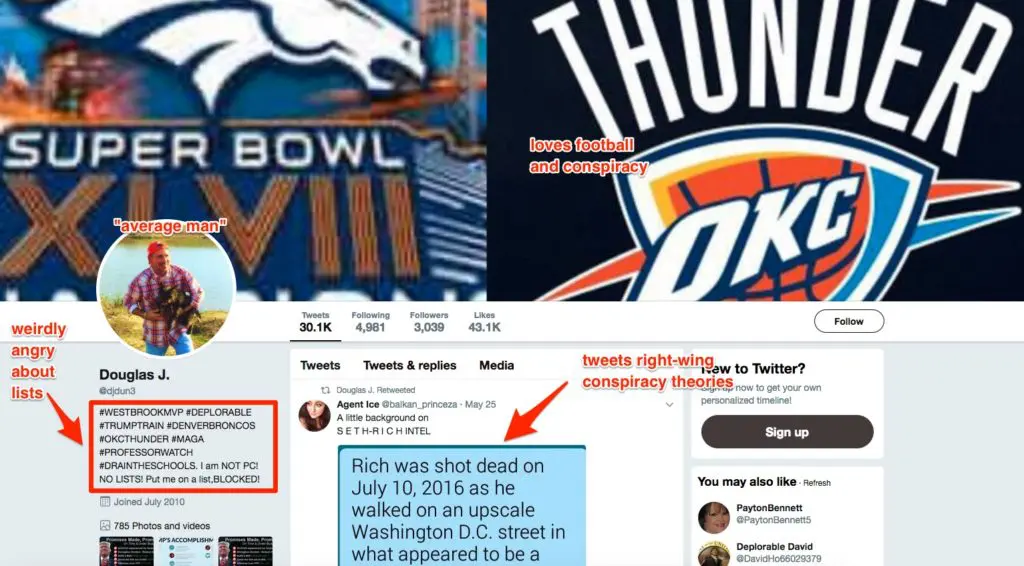
– Posts exclusively about politics and potentially one other primary “normie” topic, which is often a sport – May proclaim to be staunchly not “politically correct”:


5) Hates Twitter Lists

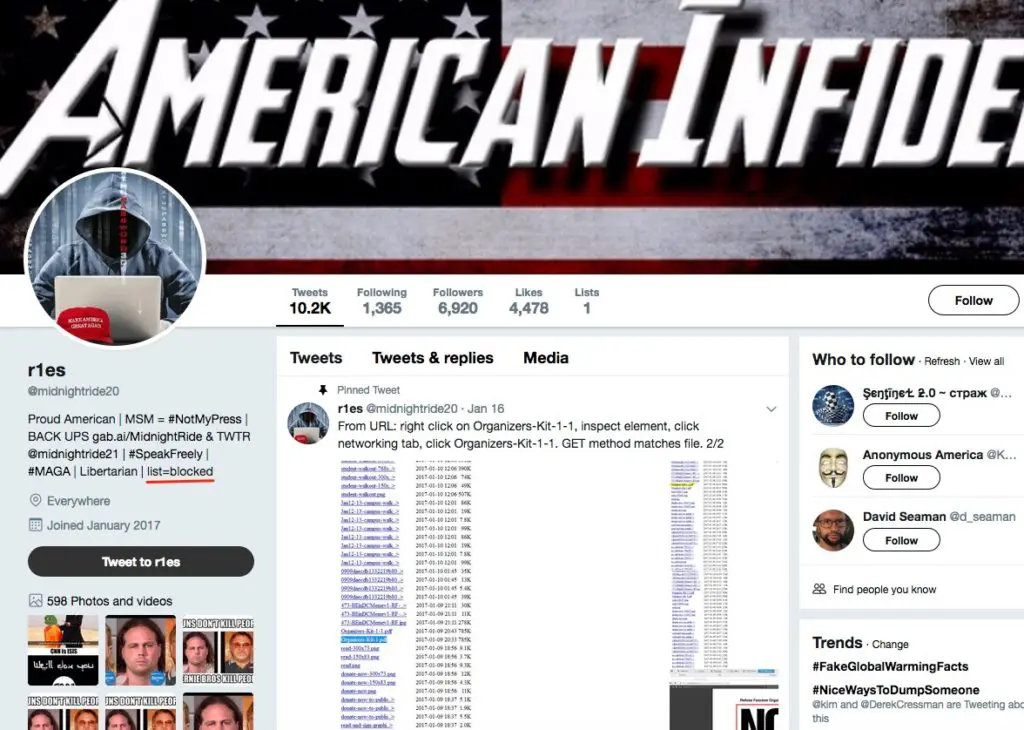
– Bots on Twitter have a strange aversion to being added to Lists, or making Lists of their own:


6) Overuse of hashtags 

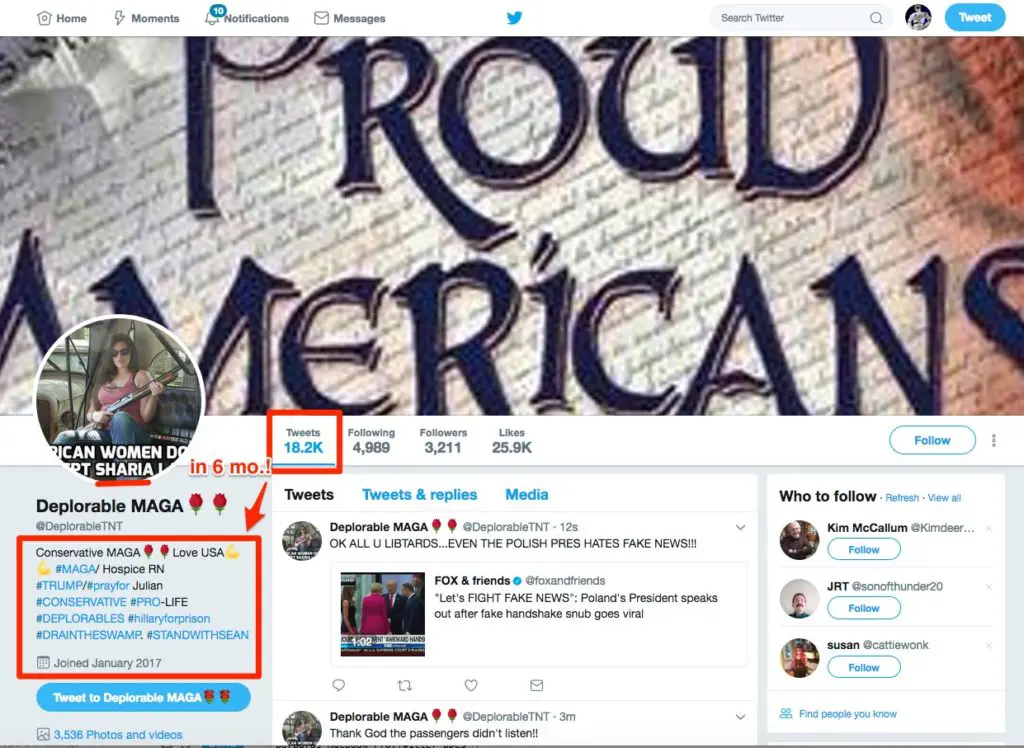
– Uses hashtags more than normal, non-marketing people usually do:


7) Pushes a one-dimensional message

– Seems ultimately too one-dimensional and predictable to reflect a real personality, and/or too vaguely similar to the formula:


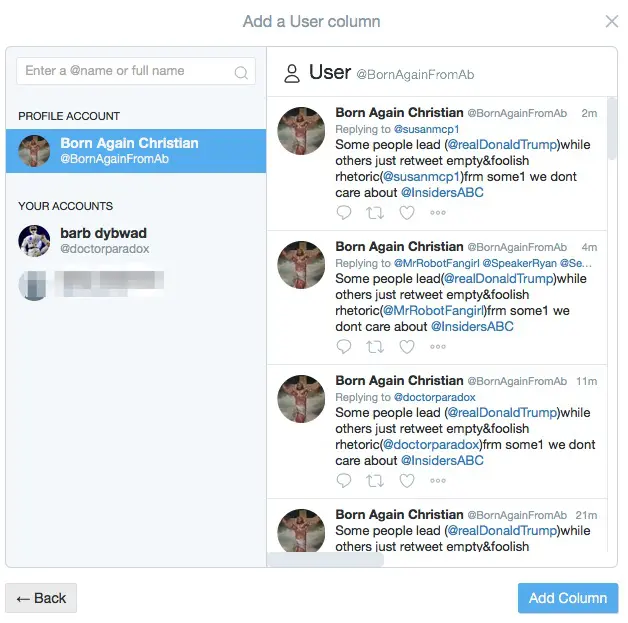
8) Redundant tweets

– Most obviously of all, it retweets the same thing over and over again:


9) Rehashes a familiar set of memes

– Tweets predominantly about a predictable set of memes:

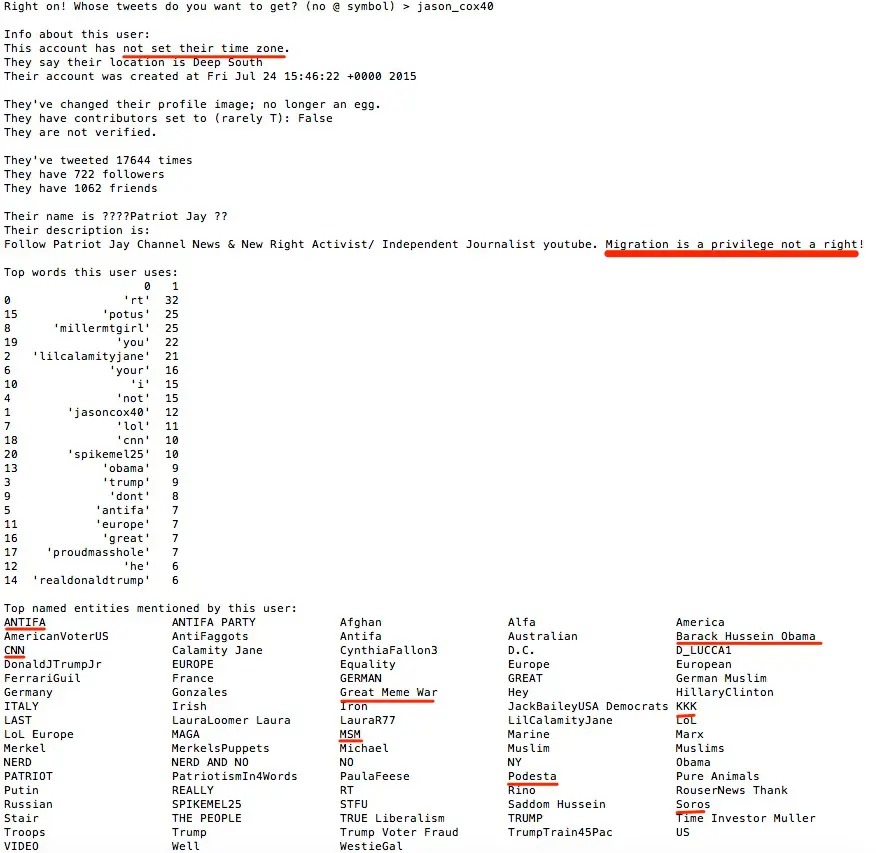
Mismatched location and time zone is another “tell” — and although you can’t get the second piece of data from the public profile, it is available from the Twitter API. If you know Python and/or feel adventurous, I’m sharing an earlier version of the above tool on Github (and need to get around to pushing the latest version…) — and if you know of any other “tells” please share by commenting or tweeting at me. Next bits I want to work on include:

  • Examining follower & followed networks against a matchlist of usual suspect accounts
  • Looking at percentage of Cyrillic characters in use
  • Graphing tweet volume over time to identify “bot” and “cyborg” periods
  • Looking at “burst velocity” of opposition tweets as bot networks are engaged to boost messages
  • Digging deeper into the overlap between the far-right and far-left as similar memes are implanted and travel through both “sides” of the networks

Further Reading

Read more

Before we dive into the perils of issue policing, I have to say that it’s heartening to see so many new faces and hear many new voices who may in the past have not explicitly considered themselves “activists,” or who have felt a greater call to stand up against a political administration whose ideologies show every indication of running counter to a constitutional democratic framework

If that describes you: THANK YOU! You are awesome. And if you’re an Old Hat at this sort of thing, this post is for you too — by way of initiating a civil dialogue with some of the fresh faces you see in your timeline or in your local community who may be exhibiting the following behavior:

Making claims that issue X, Y, or Z is “not important” or “not as important” as issue A, B, or C — which is what we should really be discussing right now.

Here’s why this behavior tends to do more harm than good:

Continue reading Activists: How (and why) to avoid issue policing (especially on Twitter)
Read more

But we will grow from it, and they will not — over the long run, at least.

Things we need to improve upon and/or rebuild:

  • media literacy
  • civic literacy
  • financial literacy
  • data literacy
  • tech literacy — especially security and privacy
Read more